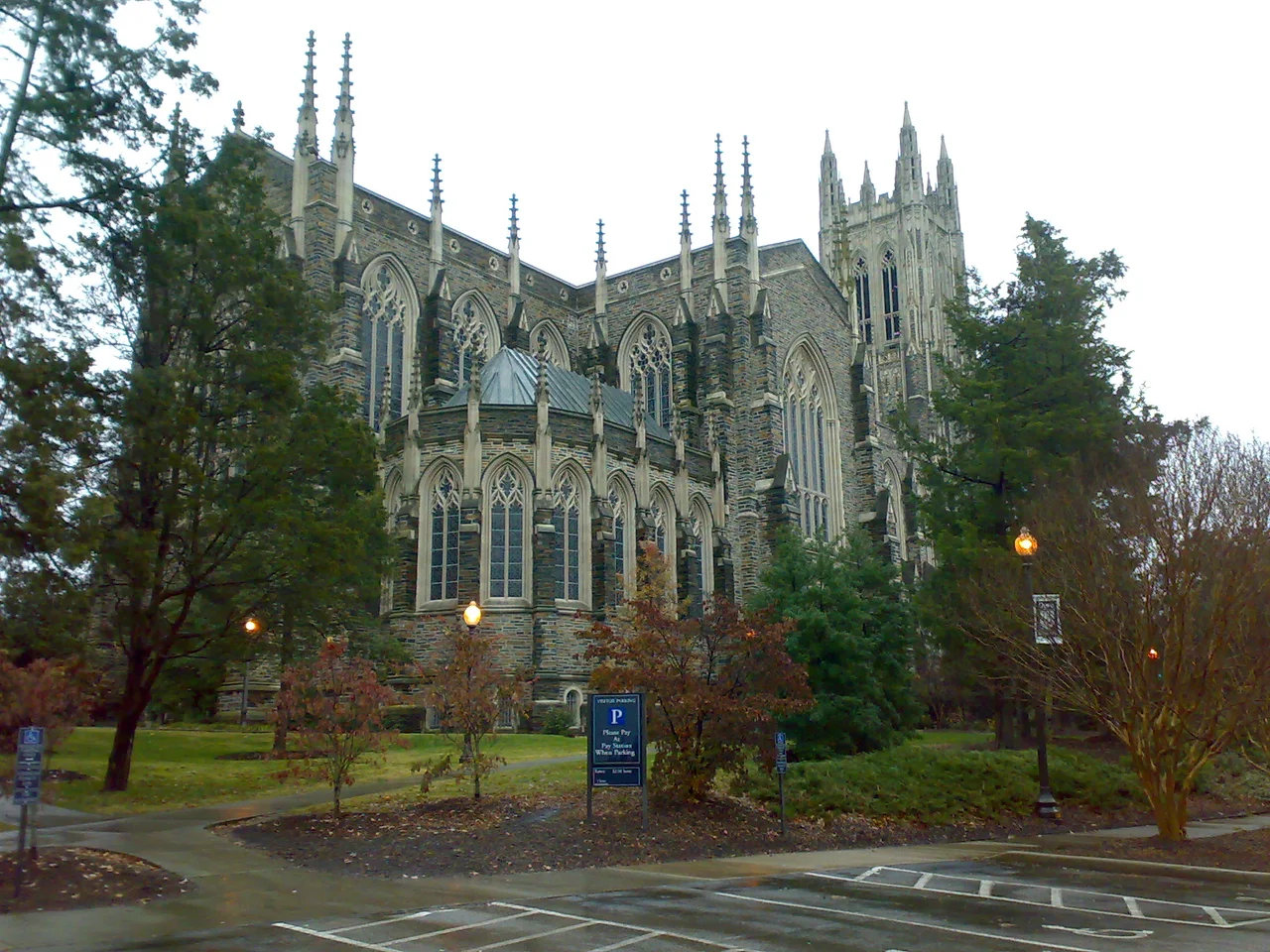

Duke Chapel
Julian Abele drew the building that sits at the center of Duke University. He was African American, trained at the Ecole des Beaux-Arts in Paris, and the chief designer for the Philadelphia firm of Horace Trumbauer. When Duke was rebuilt with James B. Duke's tobacco fortune in the 1920s and early 1930s, Abele designed much of West Campus, including the chapel that crowns the highest ridge on the property. He never visited the construction site. He could not have stayed in the segregated hotels of Durham. The 210-foot Collegiate Gothic tower that became the symbol of the university was designed by a man who in 1935 could not have attended its dedication as a guest.
$2.3 Million in Stone
Plans for the chapel were first discussed in April 1925, the year after James B. Duke established the Duke Endowment with $40 million and renamed Trinity College for his father. The cornerstone was laid October 22, 1930. Construction took five years and cost $2.3 million. The chapel was first used during commencement in 1932 while construction was still underway and was formally dedicated on June 2, 1935. The body of the structure is built from stone quarried at the Duke Quarry near Hillsborough, just up the road. The upper trimmings are limestone from Bedford, Indiana. The chapel was the last of the original buildings on West Campus to be finished. At completion it could seat 1,800 people.
The Bell Harry Tower
The 210-foot tower is modeled on the Bell Harry Tower of Canterbury Cathedral in England. It is 38 feet square at its base and houses a 50-bell carillon donated by The Duke Endowment. The heaviest bell, tuned to G-natural, weighs 11,200 pounds. The lightest weighs ten and a half pounds. A service elevator and 239 stair steps reach the top, but the tower is closed to the public except during Orientation and Graduation, when undergraduates climb it. The chapel is one of the tallest buildings in Durham County. Only the Basilica of the Sacred Heart at Notre Dame, at 218 feet, exceeds it among American university chapels of this scale. From a few miles out, the tower is the first thing you see of Duke.
The Stained Glass and the Million Pieces
The 77 chapel windows were constructed by 15 artists and craftsmen over three years, including S. Charles Jaekle of G. Owen Bonawit. They are made from over a million pieces of glass imported from England, France, and Belgium. The largest window measures 17.5 by 38 feet. The smallest is 14 by 20 inches. Among the 800 or 900 figures depicted, 301 are larger than life-size. The clerestory windows above the nave depict Old Testament scenes. The medallion windows along the aisle walls take up the New Testament. The Memorial Chapel windows are silver-tinted grisaille glass; the crypt windows are purple framed in lead. The Aeolian Organ Company built the 6,900-pipe Kathleen McClendon Organ in 1932, one of the last major instruments the company completed before Aeolian merged with the Skinner Organ Company to form Aeolian-Skinner.
Three Sarcophagi in Carrara Marble
The Memorial Chapel sits to the left of the main nave, behind iron gates, intended as a place for reflection. Along the left wall, three white sarcophagi of Carrara marble hold the university's benefactors: Washington Duke, who built the tobacco fortune that funded the university, and his sons James B. Duke and Benjamin N. Duke, who carried the fortune and the name forward. Each sarcophagus weighs 30 tons. Sculptor Charles Keck carved them. The Duke wealth, the wealth that paid for Carrara marble and Bedford limestone and Belgian glass, came largely from the labor of Black sharecroppers and tenant farmers across the North Carolina tobacco belt. Three presidents of Duke University are interred in the crypt directly beneath the Memorial Chapel: William Preston Few, Julian Deryl Hart, and Terry Sanford.
Robert E. Lee's Empty Niche
Carved on the chapel's entrance portal are ten figures considered important to Methodism, Protestantism, and the American South: Bishop Francis Asbury, John Wesley, Martin Luther, Thomas Jefferson, Sidney Lanier, and others. The right wall held three figures labeled as statesman, soldier, and poet of the South. The soldier was Robert E. Lee. On the morning of August 17, 2017, five days after the Unite the Right rally in Charlottesville, the statue was found with its face damaged and its nose chipped off. Duke president Vincent Price approved removal within a week. Lee's belt buckle had originally been inscribed USA rather than CSA; it was partially chiseled away but remained visible. As of April 2025, the niche where Lee stood remains empty. Duke has said the empty space is meant to evoke this moment in history.
From the Air
Duke Chapel sits at 36.00 N, 78.94 W on the highest ridge of Duke University's West Campus in Durham. The 210-foot Gothic tower is by far the most identifiable structure for miles around and is visible from cruising altitude in clear weather. The chapel is the natural landmark for orienting any flight over central Durham. Nearest airport: Raleigh-Durham International (KRDU) about 10 nautical miles southeast.
Nearby Stories
- Orange County Speedway 3.7 km away
- Tobacco Road 8.7 km away
- Haw River 15 km away
- Johnston County, North Carolina 18 km away
- Soul City, North Carolina 25 km away
- Chinqua Penn Plantation 29 km away
- North Carolina Aviation Museum 40 km away
- Cherry Hill Plantation 45 km away