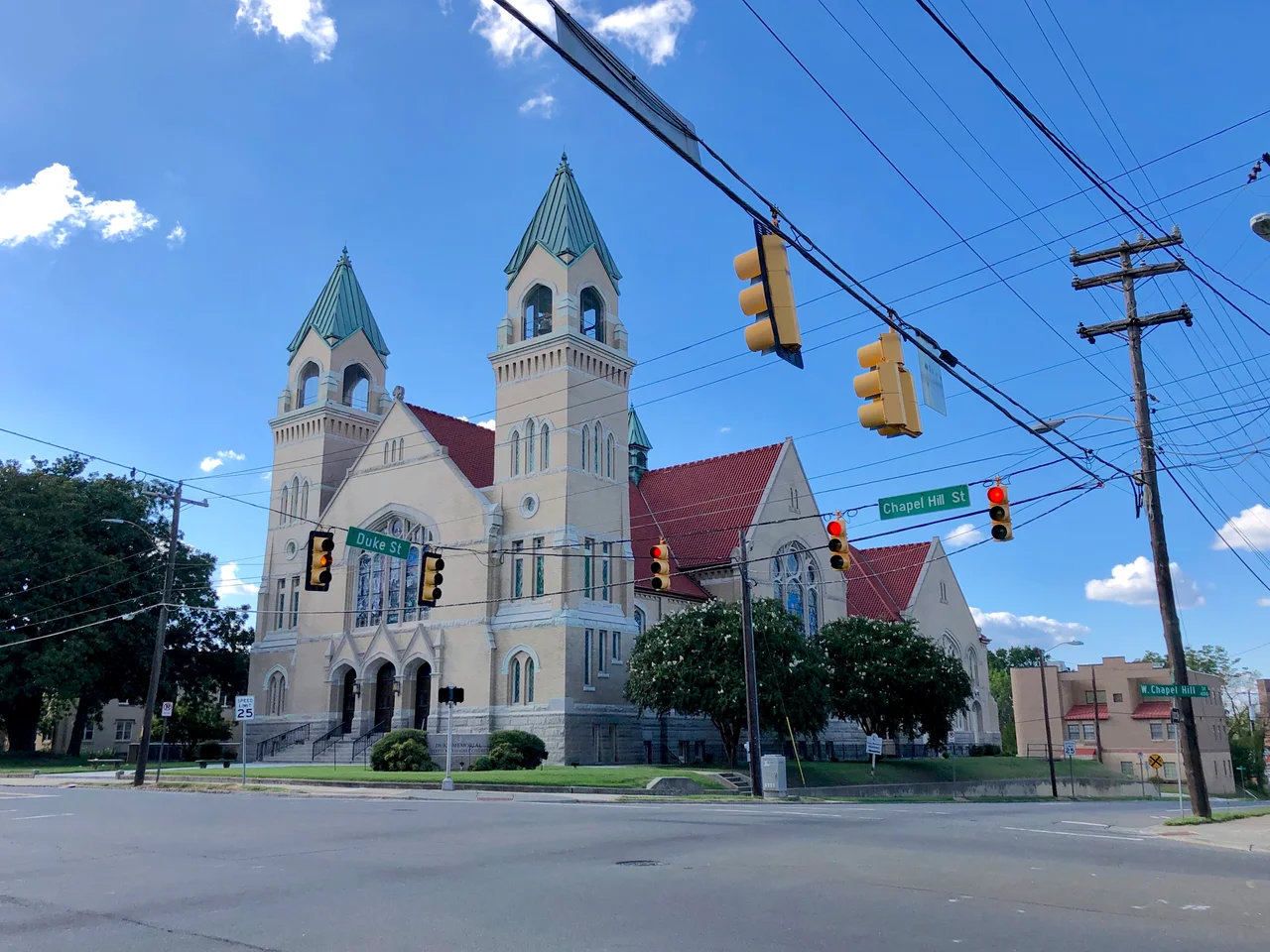

Duke Memorial United Methodist Church
Washington Duke walked into the home of Durham builder Albert Wilkerson one day in the mid-1880s and said, plainly: we've got to build another church. The Trinity church already existed, but Duke wanted one for the masses, one for the workers pouring into Durham as the tobacco factories grew. The first service of the new congregation was held on May 2, 1886, inside the Washington Duke, Sons & Company tobacco factory itself. The room smelled of cured leaf. The pastor, Rev. Amos Gregson, was a friend of Washington Duke. Forty years later the church would carry the Duke name, financed by the same family fortune, on a corner of West Chapel Hill Street in downtown Durham.
Church for the Masses
Durham in the 1880s was an economic boom town. Washington Duke's tobacco company and W.T. Blackwell's rival firm were pulling thousands of workers into the city. Cotton firms, including Julian Carr's, were doing the same. J.J. Ward wrote in 1884 that he had never heard tell of a town thriving any faster than Durham. The boom carried the usual risks of becoming a rowdy, unorganized industrial city. Washington Duke and Carr both wanted Durham to grow into a place with culture, not only wealth, and that meant churches and schools. A building committee formed in 1885. The first meetinghouse, built of red brick and measuring 40 by 70 feet, opened on October 10, 1886 on the southeast corner of Main and Gregson Streets, on land donated by Washington Duke's eldest son Brodie L. Duke.
Washington Duke's Faith
James B. Duke said his father had always credited the Methodist circuit riders who came to visit him in his boyhood home with whatever he became. "If I ever amount to anything in this world," James said, "I owe it to my daddy and the Methodist church." Washington Duke wrote in 1890, in a letter addressed to Black workers, "I am what I am because God was with me; because God goes before me." His personal faith motivated much of his philanthropy. In a 1900 Durham Recorder profile, Duke said his aim since age twelve had been to help make the world better by living in it. The wealth that funded the church was built on tobacco labor, much of it Black labor, in a Jim Crow South that confined those workers' lives in ways Duke himself never had to live.
Becoming a Memorial
James B. Duke died in October 1925. Shortly afterward, the church's administrative board changed the name to Duke Memorial Methodist Episcopal Church, South. The resolution cited Washington Duke's role in building the original Main Street Church and his sons' role in expanding it. On January 8, 1929, Benjamin N. Duke died in New York City. A special train brought his body back to Durham for his funeral at Duke Memorial. The church was filled to capacity. The Washington Post reported that several of his favorite hymns were sung by a picked choir and Dr. John R. Stanbury, pastor of the church, made brief remarks. The name changed again in 1939 with denominational mergers, then again in 1968 when the United Methodist Church formed.
Gothic Revival and Romanesque Towers
The building itself is a mix of styles. The body is Gothic Revival, with stone tracery around the entrance and the windows. The two four-story brick towers are Romanesque Revival. One of them holds an active 10-bell chime. Inside, the two-story sanctuary is cruciform and decorated with Gothic Revival woodwork, with ornamental bracings that imitate Gothic supports while concealing steel beams. The stained glass windows were installed in 1911. Bishop John C. Kilgo worked with the firm of Joseph V. Llorens Sr. on the design. Most depict men and women of the Bible and scenes from the life of Christ. The exception is the massive window facing Chapel Hill Street, which shows John Wesley preaching on his father's tomb after being denied the right to preach in the Epworth, England church.
Generations and the Endowment
In 1924, James B. Duke established the Duke Endowment with $40 million, an act that turned Trinity College into Duke University and committed a portion of the endowment's income to fund rural Methodist churches and orphanages across North Carolina. The Endowment still supports Methodist churches and clergy in the state. The 1963 education building's groundbreaking was conducted by Barbara Biddle Trent and James Duke Biddle Trent Semans, great-great-grandchildren of Washington Duke. Successive generations of Dukes have continued to fund the church and attend services. In 1970-71 the sanctuary was renovated and a Walter Holtkamp organ installed. In 1982 the carillon was overhauled. The church was named to the National Register of Historic Places in January 1986. The congregation still meets at 504 West Chapel Hill Street.
From the Air
Duke Memorial United Methodist Church sits at 36.00 N, 78.91 W at 504 West Chapel Hill Street in downtown Durham. From altitude the church is identifiable by its two four-story brick Romanesque towers and Gothic Revival sanctuary, near the western edge of the Downtown Durham Historic District. Nearest airport: Raleigh-Durham International (KRDU) about 12 nautical miles southeast.
Nearby Stories
- Orange County Speedway 3.7 km away
- Tobacco Road 8.7 km away
- Haw River 15 km away
- Johnston County, North Carolina 18 km away
- Soul City, North Carolina 25 km away
- Chinqua Penn Plantation 29 km away
- North Carolina Aviation Museum 40 km away
- Cherry Hill Plantation 45 km away