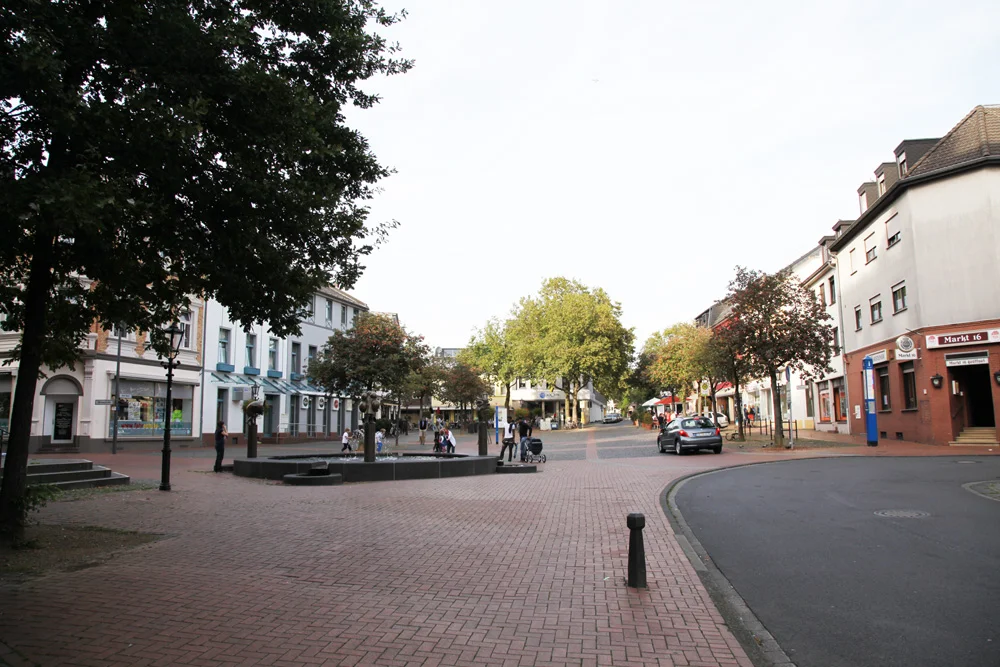

Dülken
In a converted windmill on the edge of Dülken's old town, a body called the Narrenakademie, the Fools' Academy, has been issuing honorary doctorates since 1554. Their seal shows a moon. Their degree is doctor humoris causa, doctor of humor. Real recipients include Salvador Dali, Neil Armstrong, and Konrad Adenauer, among current politicians, artists, and locals deemed worthy. The Narrenakademie claims to be one of the oldest carnival societies in the world. They are probably right. Dülken received its town charter sometime between 1352 and 1364, the oldest part of present-day Viersen, and even after centuries of textiles and engineering and Spanish occupation and French annexation and American liberation, the institution the town is proudest of is its mill full of self-mocking diplomas.
Glory to You, Duelken
The town motto is Gloria tibi Duelken, Glory to you, Duelken. The Romans came through first, displacing the Menapii and Eburones tribes who lived here before; they finally pulled back in the second half of the 5th century. The Franks moved in, organized the land as a county, ruled until about the 10th century. Mackenstein, the part of Dülken closest to today's industrial park, first appears in the historical record in 1135. Dülken itself shows up in 1210. The town charter came between 1352 and 1364. By 1400 Dülken was heavily fortified against the political tensions of the late medieval Rhineland: a stone wall, watchtowers, ditches. Pieces of all three still survive at the edges of the old town. The river Nette begins underground in the middle of town and surfaces nearby, a hydrology the streets were laid out around long before anyone knew the word.
Occupations
The Thirty Years' War passed through briefly, with Spanish troops occupying the town. Then came the French. From 1794 until 1814 Dülken was officially a municipality of the Roer department, part of the First French Empire. When Napoleon fell, Prussia took the Rhine Province, and Dülken with it. There was a brief Belgian occupation between 1919 and 1930, part of the Allied Occupation of the Rhineland after World War I. In March 1945 the U.S. Ninth Army arrived, and Dülken became part of two simultaneous American operations: Operation Grenade, the crossing of the Roer, and the deceptions of the Ghost Army in Operation Viersen, which staged a fake river crossing near Duesseldorf using inflatable tanks, recorded sounds, and fake radio traffic to draw German attention away from the real crossing further north. The Ghost Army's work in and around Viersen is one of the last great operations of strategic deception in European warfare, and it happened over Dülken's rooftops.
The Fools' Academy
The Narrenakademie does not take itself seriously, which is the entire point. Their headquarters is the Narrenmuehle, the Fools' Windmill, on the edge of the old town. Their crest is the moon. Their joke degrees are awarded with ceremonial pomp; the academy's small museum displays curiosities and historic exhibits from centuries of carnival. On the day after the last Carnival parade, on Ash Wednesday, the town holds the Duelkener Schoeppenmarkt, a flea and junk market that is one of the largest of its kind in Germany. The Carnival parade itself, in February, draws 80,000 to 100,000 visitors, depending on the weather. For most of the year Dülken is a small Lower Rhine town of about 20,000 people. For one weekend it becomes something else entirely, and the fools' academy in the windmill is presiding.
The Statue Nobody Expected
The most prominent monument in the old town is not a soldier, not a saint, not an emperor. It is a life-sized bronze statue installed by the citizens in 1980, depicting a man emptying slurry pits, the human cesspools of the era before 1890. He worked the outskirts of town. The plaque calls him an early example of outstanding service orientation. The statue sits in a more conspicuous spot than the statue of Emperor Wilhelm. This is the town that gave the world Salvador Dali's honorary doctorate; placing the slurry-pit man above the emperor is consistent. Above all of it rises the bell tower of St. Cornelius, one of the largest churches in the Lower Rhine region, the spire visible from the surrounding countryside the way old town churches tend to be.
Textiles, Then Tooling, Then Whatever Comes Next
Dülken's economy has reinvented itself several times. The old textiles industry gave way in the 1920s to engineering, and the engineering shifted in the 1970s into the wider mix of the Mackenstein industrial area: KraussMaffei makes tooling here, Mars makes chocolate bars, Schwarzkopf Henkel makes cosmetics, Otto Fuchs Metallwerke makes brass and bronze, Knauf AMF makes ceilings and windows, Doka makes construction systems, DHL runs logistics. There are robotics programmers, valve makers, water purifiers, IT specialists, the usual ecosystem of small specialized firms around the larger names. The surrounding farmland is shifting toward fruit and vegetable production, some of it organic. The Carnival keeps going. The fools' academy in the windmill keeps printing degrees. The Nette keeps rising in the middle of town, just as it did before the wall, the French, the Americans, and the chocolate factory ever arrived.
From the Air
Coordinates 51.2522 N, 6.3353 E, in the Lower Rhine region about 4 km west of central Viersen. Dülken reads from the air as a compact old town around the St. Cornelius church tower, surrounded by the Mackenstein industrial park to the east and farmland in all other directions, with the A61 and A52 autobahns crossing nearby. Recommended altitude 1,500-3,000 ft AGL. Nearest major airports: Duesseldorf Moenchengladbach (EDLN / MGL), 7 nm southeast; Duesseldorf International (EDDL / DUS), 17 nm east; Weeze (EDLV / NRN), 20 nm north. Duesseldorf Class C airspace lies just east; check the TMA and approach corridors before transiting.
Nearby Stories
- Rhine-Herne Canal 3.5 km away
- Limburg (Netherlands) 4 km away
- Raceway Venray 7.1 km away
- 1999 Wuppertal Schwebebahn Accident 7.2 km away
- Rheinisches Braunkohlerevier 7.3 km away
- South Limburg 10 km away
- European Transonic Wind Tunnel 15 km away
- Vetera 17 km away