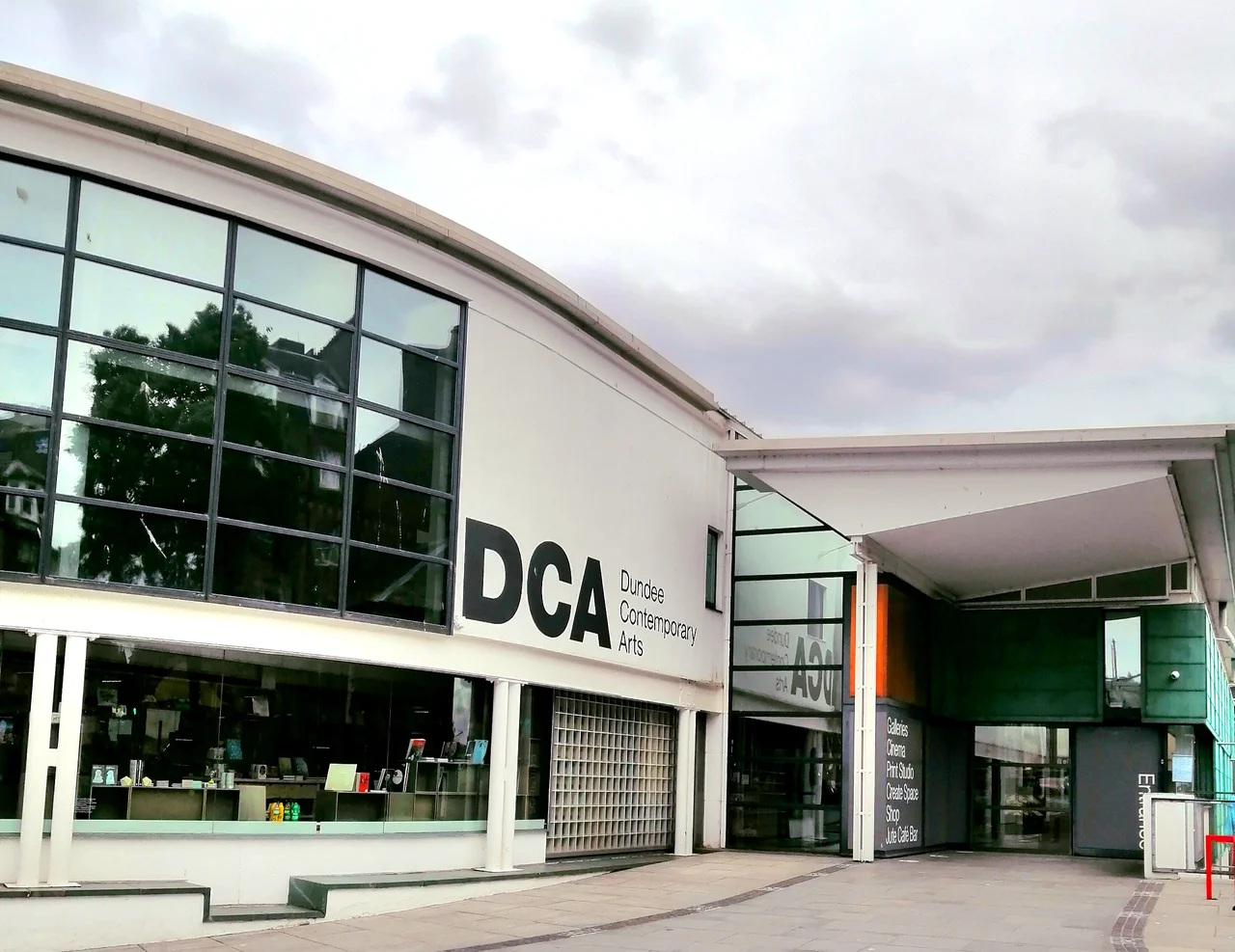

Dundee Contemporary Arts
Before V&A Dundee, before the waterfront's UNESCO City of Design designation, before any of the rebranding that turned Dundee into a city people fly in for, there was DCA - and there was a semi-derelict garage at 152 Nethergate that the council bought for £1 in March 1995. The vision belonged to a small group of artists, printmakers, and academics who believed Dundee deserved a serious contemporary art space. The architecture belonged to Richard Murphy. The opening, on 19 March 1999, marked the moment the city's modern cultural identity began to take shape.
From a Garage to a Vision
DCA was the work of a partnership: Dundee City Council, the University of Dundee, and a newly formed company called Dundee Contemporary Arts, led by founding chair Sheena Bell. The Printmakers' Workshop had been chairing the conversation since the mid-1980s, working alongside the long-closed Seagate Gallery. The goal was twofold: to nurture students and graduates of Duncan of Jordanstone College of Art and Design - one of the UK's leading art schools - and to replace the city's only part-time arthouse cinema, the Steps Theatre. The site chosen, at 152 Nethergate, was favoured for its proximity to the Dundee Repertory Theatre and the University. Together, those three buildings would anchor what is now known as Dundee's cultural quarter.
Richard Murphy's Building
An international design competition was won in July 1996 by Edinburgh-based Richard Murphy Architects. The resulting £9 million building was hailed as an innovative modern space - a careful insertion into the historic Nethergate streetscape that nevertheless announced itself as unmistakably contemporary. Murphy threaded the building's volumes around the existing terraced houses on either side, creating a long internal spine that gave the galleries, cinemas, studio and café each their own light, character, and rhythm. When DCA opened on 19 March 1999, it was instantly recognised as one of the most exciting new buildings in Scotland. Twenty-five years later, the design still feels intentional and confident - a rare quality in late-1990s civic architecture.
What Happens Inside
DCA runs two contemporary art galleries with a programme that has hosted Mark Wallinger, Jane and Louise Wilson, Clare Woods, Beck's Futures winner Roderick Buchanan, Turner Prize winner Simon Starling, Turner Prize nominee Fiona Banner, the Finnish video artist Eija-Liisa Ahtila, and the illustrator Johanna Basford - whose adult colouring books became a global phenomenon. The two-screen cinema mixes new releases with independent and world cinema and hosts both the Discovery Film Festival and the Dundead Horror Film Festival. The Print Studio is an open-access workshop using traditional presses alongside cutting-edge digital equipment, and runs courses, residencies, and collaborations. The Jute Café Bar serves the building day and night. The DCA Shop sells artist-made objects, design homeware, and books. The current director is Beth Bate.
Museum of the Year
In 2024, twenty-five years after opening, DCA was nominated for the Art Fund Museum of the Year - the UK's most prestigious museum prize. The nomination recognised what longtime visitors had always known: that DCA had quietly become one of the most consistently interesting art venues in Britain, sustained by a small staff in a small city, with a programme that punched far above the available resources. The cultural quarter the founders imagined in 1995 is now a destination. The Rep and the University are still on either side. V&A Dundee has joined them at the waterfront. But DCA remains the heart of it - the place where the idea that Dundee could be a contemporary cultural city was first made physical, in a building that began life as a tired Nethergate garage.
From the Air
Dundee Contemporary Arts sits at 56.4571 degrees north, 2.9748 degrees west, on Nethergate in central Dundee's West End cultural quarter. EGPN (Dundee Airport) lies approximately 1.3 nautical miles south-southwest, with V&A Dundee at the waterfront 600 metres to the south. From the air the building is a long, narrow modernist insertion between traditional terraced buildings, with a distinctive zinc-clad rear elevation visible looking north from the Tay. Best viewed at 1500-2500 feet AGL. The University of Dundee campus immediately to the north and Tay Square (Dundee Rep) to the south make easy navigation anchors.
Nearby Stories
- Battle of Dunkeld 7.2 km away
- Balgonie Castle 9.8 km away
- Bell Rock Lighthouse 10 km away
- Inverbervie 13 km away
- Battle of Dollar 14 km away
- Battle of Mons Graupius 16 km away
- HMS Pathfinder (1904) 23 km away