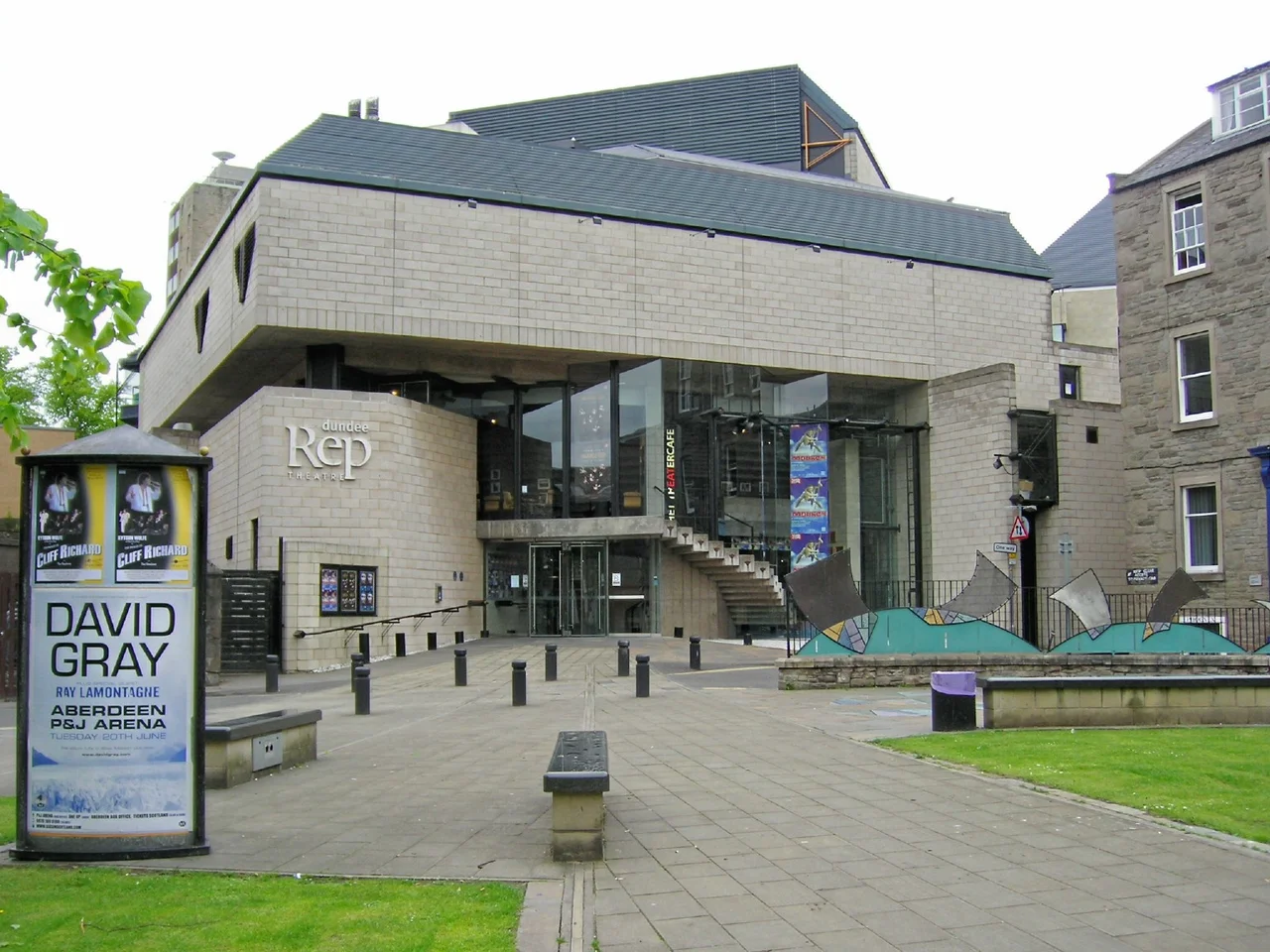

Dundee Repertory Theatre
Three actors who played the Doctor in Doctor Who have performed at Dundee Rep: William Hartnell appeared here in the 1940s, decades before Doctor Who existed; David Tennant worked here in the early 1990s before his television breakthrough; and Ncuti Gatwa joined the Rep's graduate scheme around 2013. That single fact says something about this theatre that no architectural award or critical review can quite capture. The Rep, as everyone in Dundee calls it, has been a working ladder for British acting talent for more than eighty years. It rose out of a disused jute mill, survived a building fire in 1963, scraped together £200,000 in public donations during a recession, and opened its current Tay Square home on 8 April 1982. Today the building is Category-A listed.
A Jute Mill and a Brave Idea
Dundee Repertory Theatre was founded in May 1939 - an audacious moment to launch a theatre, with the world on the brink of war. Robert Thornely, manager of the last touring company to perform in the city, was determined that Dundee should have its own professional company. He approached the amateur Dundee Dramatic Society, who had recently bought their own premises - a disused jute mill - and had nowhere to perform. The partnership that resulted was professional company, amateur support, in a building that smelled faintly of the city's industrial past. The Rep performed weekly repertory through the war and across the 1940s and 1950s. In June 1963 the company's home in Foresters' Hall burned down completely. The company spent eighteen difficult years in a converted former church on Lochee Road, refusing to close.
Building the Tay Square Theatre
In January 1979, construction finally began on a purpose-built theatre on land donated by the University of Dundee. Robert Robertson, the company's artistic director, drove the project through rising costs and brutal inflation. When the build threatened to stall, a public appeal raised £60,000 in under six weeks - eventually reaching £200,000 - in a city deep in economic recession. The building, designed by Dundee architects Nicoll Russell Studios, opened on 8 April 1982 with a 455-seat auditorium that quickly earned a reputation as one of the best stages in Scotland for actor-audience intimacy. The Civic Trust Award commended it in 1984; the RIBA Architecture Award honoured it in 1986. In 2022 Historic Environment Scotland listed it at Category A, calling it "a rare and exceptional example of post-war theatre design."
The Alumni List
Few regional theatres can rival the Rep's alumni list. Richard Todd started his career there in the 1930s. Lynn Redgrave played Portia in The Merchant of Venice in 1962, on a stage that also featured Steven Berkoff and a young Dundee-born actor named Brian Cox. Hannah Gordon and Donald Sutherland were members in 1962-63. Vivien Heilbron and Heather Ripley followed in the 1960s. In 1987 Alan Cumming starred as Phil McCann in two parts of John Byrne's The Slab Boys Trilogy. Joanna Lumley, Miriam Margolyes, Geoffrey Hayes - beloved by a generation of British children as the host of Rainbow - all passed through. David Tennant arrived in the early 1990s, starting with The Princess and the Goblin before his television breakthrough. Ncuti Gatwa joined a Rep graduate scheme in 2013, performing in David Greig's Victoria among other productions, years before he was cast as the Fifteenth Doctor.
Home to Scottish Dance Theatre
The Rep is unusual in that it houses not only its own producing company of over twenty resident performers but also Scotland's principal contemporary dance company, Scottish Dance Theatre. The result is a building running at high cultural density. On any given evening the auditorium might host a new Scottish play, a touring production from the National Theatre of Scotland or the Royal Lyceum, a musical co-produced with another regional company, a contemporary dance work, opera, jazz, comedy, or children's theatre. Under artistic director Andrew Panton, appointed in July 2016, the Rep has presented the Scottish premiere of David Greig's Victoria, collaborated on Let The Right One In with the National Theatre of Scotland, and partnered with the Lyceum on Time and the Conways.
The Next Building
In September 2018, Panton announced that the Rep was considering moving to new, larger premises - a building seating 800 to 1000 people, with greater flexibility for different audience sizes. He suggested this could tie in with the Rep's 80th anniversary in 2019 and become Dundee's next major cultural project after the opening of V&A Dundee. The pandemic delayed those plans, and as of 2023 they have yet to come to fruition. For now, the 455-seat 1982 building - the one paid for by donations from a city in recession, listed Category A, beloved by every actor who ever played a role on its stage - remains the Rep's home, and one of the most welcoming small theatres in Britain.
From the Air
Dundee Repertory Theatre stands at 56.458 degrees north, 2.9753 degrees west, in Tay Square in Dundee's West End cultural quarter, immediately adjacent to the University of Dundee. EGPN (Dundee) lies 1.3 nautical miles south-southwest. The Rep building, with its 1982 modernist form, sits in a tightly developed quarter that includes Dundee Contemporary Arts a few hundred metres away to the south on Nethergate. Best viewed at 1500-2500 feet AGL. Use Dundee Law to the north and the V&A waterfront to the south as navigation anchors.
Nearby Stories
- Battle of Dunkeld 7.2 km away
- Balgonie Castle 9.8 km away
- Bell Rock Lighthouse 10 km away
- Inverbervie 13 km away
- Battle of Dollar 14 km away
- Battle of Mons Graupius 16 km away
- HMS Pathfinder (1904) 23 km away