.jpg)
Durham Castle
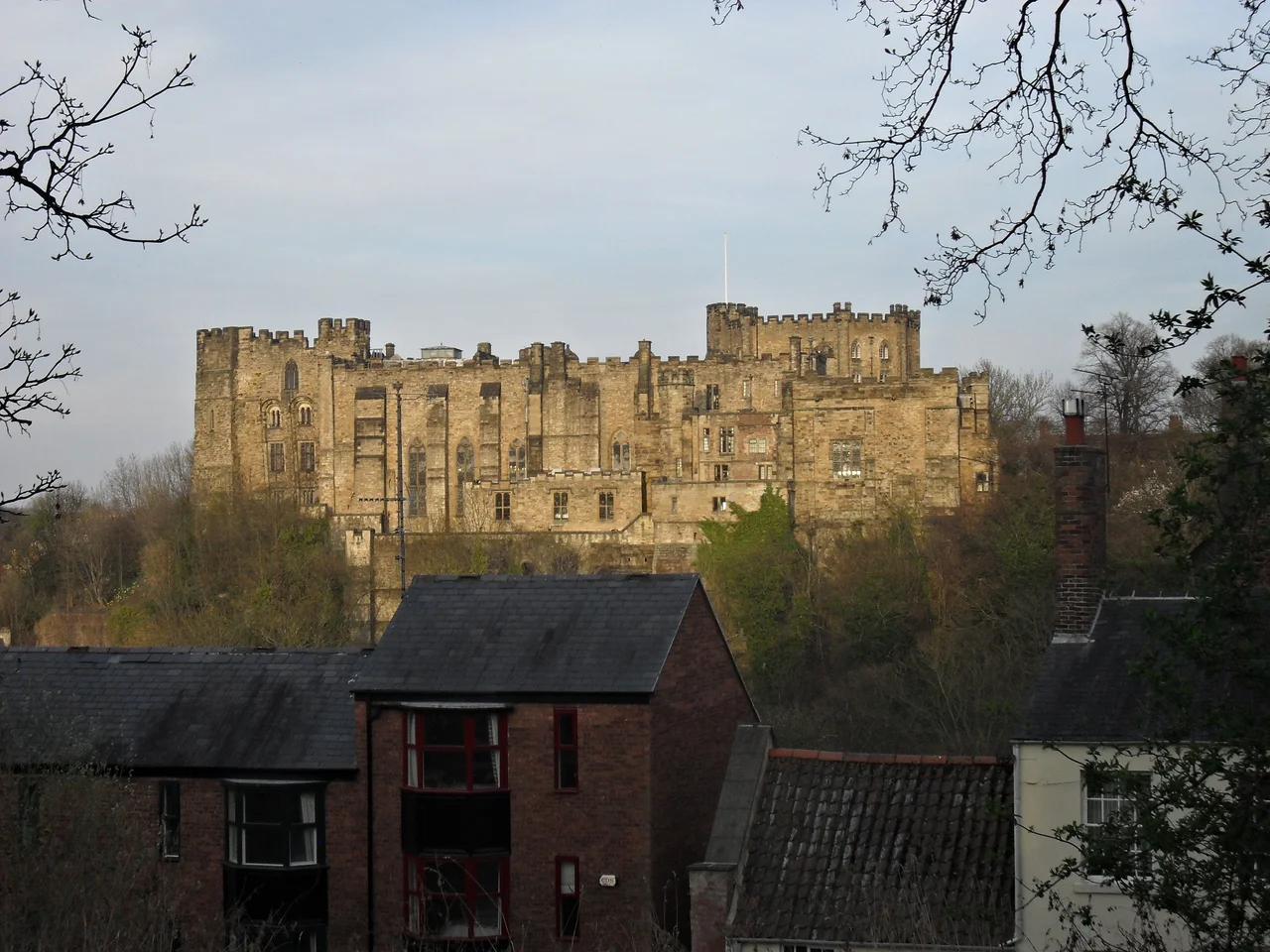
William the Conqueror ordered construction of Durham Castle in 1072, only six years after the Norman conquest, and his masons cut stone from the cliffs directly below the walls and hauled it up with winches. The earl supervising the work, Waltheof of Northumbria, would rebel against William and be executed in 1076. The bishop who took over construction, Walcher, would be murdered by Northumbrian rebels in May 1080 after a four-day siege. The castle has always been about power, and power in this part of England has always come at a price. Today over 100 university students sleep within walls that once defended the bishop's army.
The Prince-Bishops
The Bishop of Durham was no ordinary cleric. He was a prince of the realm. The English crown granted the bishops of Durham the right to raise an army, levy their own taxes, and mint their own coins. From their seat in Durham Castle they ruled a palatinate, a semi-autonomous territory designed to defend the north of England against Scottish invasion. Bishop Walcher, the first holder of this office, was the man William trusted to combine spiritual authority with military power. His successors followed his model. Bishop Antony Bek created the Great Hall in the early 14th century. Bishop Thomas Hatfield rebuilt the keep and added a wooden minstrels' gallery to the hall. Bishop Hugh de Puiset, known as Pudsey, built the Norman archway and the Galilee chapel of the cathedral across the green.
The Norman Chapel
The oldest accessible part of the castle is the Norman Chapel, built around 1078. Its architecture is Anglian in character, possibly because forced Anglo-Saxon labour built it under Norman supervision. By the 15th century its three windows were almost completely blocked when the keep was enlarged above it, and the chapel fell out of use. It was rediscovered in 1841 and turned into a corridor providing access to the keep. During the Second World War, the Royal Air Force used it as a command and observation post, an unlikely role for an 11th-century chapel. After the war it was reconsecrated and is now used for weekly services by the college that occupies the castle.
From Palace to College
In 1837, after Bishop Edward Maltby finished renovations, the castle became a college. University College, Durham, the founding college of Durham University, moved into the bishop's old residence and has occupied it ever since. The Great Hall, 14 metres high and over 30 metres long, serves as the college dining room. Students eat under medieval timbers where prince-bishops once entertained kings. Tunstall's Chapel, built in the 16th century and modified in the 17th by Bishop Cosin, is still used for college worship. Living in a castle sounds glamorous but the realities involve narrow stairs, drafty corridors, plumbing improvised into ancient walls, and the constant supervision required by a Grade I listed building.
The Fog That Saved Durham
In 1942, Nazi Germany launched the Baedeker Blitz, a series of bombing raids targeting English cities of historic and cultural importance. The choice of targets was inspired by the Baedeker travel guides. Durham Cathedral, alongside the castle one of the most distinctive medieval skylines in Europe, was on the list. Bombers were dispatched, but as they approached Durham, fog rolled in along the River Wear and obscured the city completely. The pilots could not find their target and turned back. The cathedral and castle survived intact. It is one of those moments in history where weather decided what art the future would inherit, and where the geography of the River Wear's deep gorge proved itself once again.
A World Heritage Site
UNESCO listed Durham Castle and Durham Cathedral together as a World Heritage Site in 1986. Seventeen elements of the castle are Grade I listed: the keep, the north and west ranges, the entrance gatehouse, a bastion, and twelve sections of the curtain walls. Within the castle precinct stand later buildings of the Durham Palatinate that reflected the prince-bishops' civic responsibilities: the Bishop's Court, now a library, almshouses, and schools. Palace Green, the open space connecting castle to cathedral, was once the venue for processions and public gatherings befitting episcopal status. It still hosts public events. The castle is open to visitors but only by guided tour, because it remains a working building, home to students and a functioning college.
From the Air
Durham Castle sits at 54.77 degrees north, 1.58 degrees west, on the spectacular peninsula formed by a tight bend in the River Wear. Newcastle Airport (ICAO: EGNT) is 18 miles north. Teesside International (EGNV) is 24 miles south-east. From cruising altitude the meander of the River Wear around the castle and cathedral is one of the most identifiable city centres in northern England, a roughly oval peninsula crowned by the castle keep and cathedral towers. The cathedral's central tower rises to about 218 feet above the peninsula. The East Coast Main Line runs through Durham on its tall viaduct, a distinctive landmark. The A1(M) bypasses the city to the east. In good visibility the North Pennines AONB rises 15 to 20 miles west, and the North Sea coast is about 12 miles east. Sea fog and Pennine cloud are both common.
Nearby Stories
- Hadrian's Wall Path 1.8 km away
- Killingworth 2.2 km away
- Allenheads 9.2 km away
- Nine Standards Rigg 11 km away
- Catterick Bridge Explosion 12 km away
- Rosedale Abbey 19 km away
- Saltburn Pier 20 km away
- Alexander L. Kielland (Platform) 306 km away