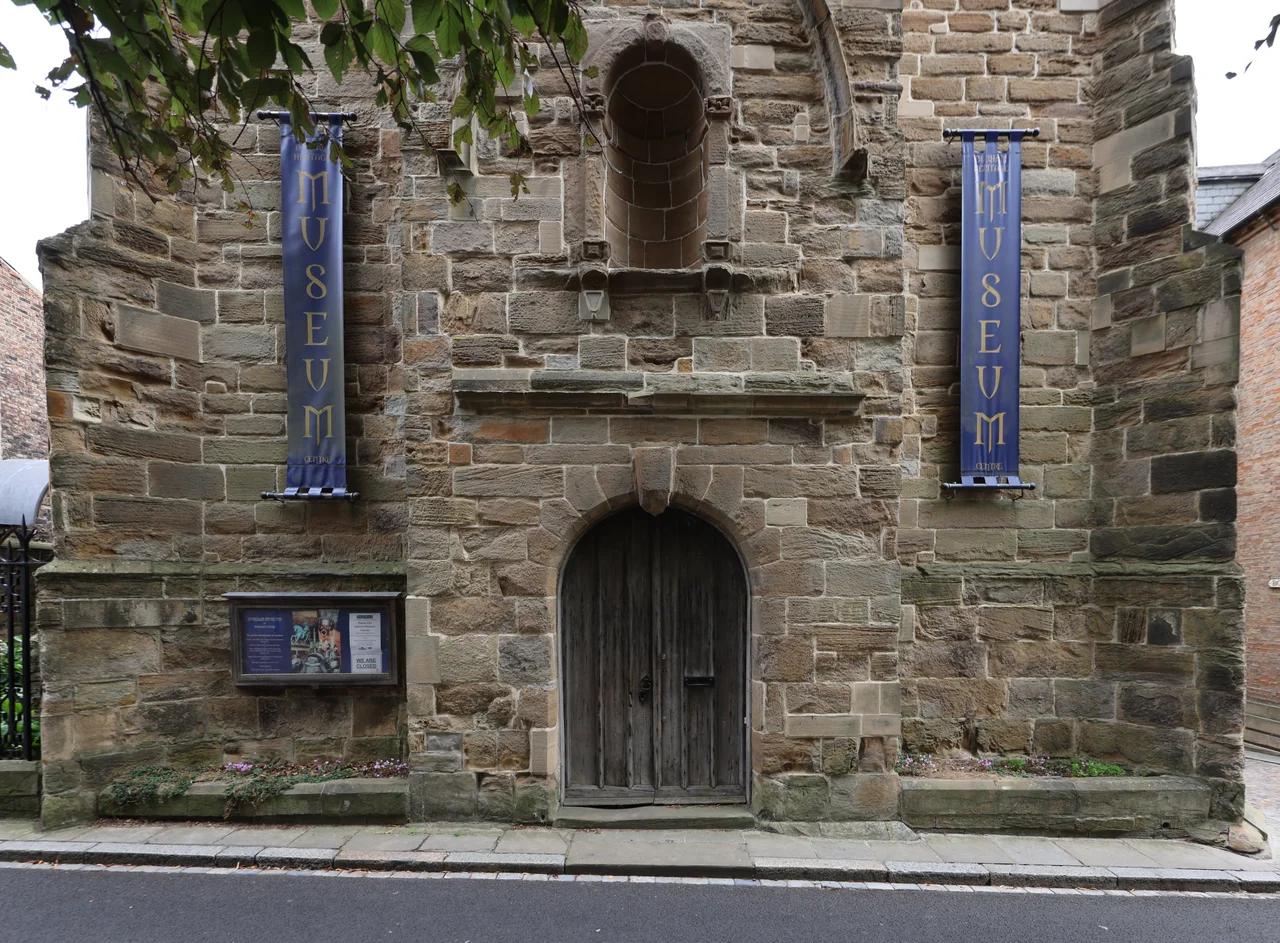

Durham Museum, Durham
In November 2024, after 52 years of operation, Durham Museum closed its doors. The building it occupied was older than almost anything else in the city centre apart from the cathedral itself: the church of St Mary-le-Bow on the North Bailey, just steps from the UNESCO World Heritage Site. The cost of maintaining a 17th-century church proved too much for the volunteers who had run the museum since 1972. Their collection now sits in storage while the Bow Trust looks for a new home. The end of one of Durham's quieter institutions tells a story familiar to small museums across Britain.
The Bow That Vanished
The name St Mary-le-Bow comes from a medieval arch that connected the church tower to Durham's fortifications, forming a 'bow.' That arch collapsed in 1635, taking part of the church with it. By 1632 the church itself had collapsed in another incident, and the building stood in ruins for half a century. The Bishop of Durham and the Dean and Chapter of Durham Cathedral funded the rebuilding in the 1670s. The present tower dates from 1702 and contains a bell cast by Dalton of York in 1759. The altar rails are from 1705, the wood screen from 1707, the wainscoting from 1731, and the west gallery and vestry from 1741. Each fitting documents another year of the long Stuart and Hanoverian project of putting the church back together.
A Church Becomes a Museum
The church closed for worship in 1968. Many of its original fittings were removed during the closure period. Then in 1972 the Bow Trust, a registered charity, took over the building and turned it into the Durham Museum and Heritage Centre. The trust's mission was to maintain the redundant church and to use it as a centre upholding the history and culture of the city and county of Durham. For half a century they made it work. The museum displayed objects, models, pictures, and audio-visual presentations covering life, labour, and leisure in the ancient fortified city. There was a brass rubbing centre and a souvenir shop. Volunteers, not professional curators, kept the operation running. The annual challenge was always the building itself, with its medieval bones and its endless need for maintenance.
The Industrial City
Many of the museum's displays focused on Durham's industrial and trade heritage, particularly the city's long tradition of organ manufacture. Pipe organs are still made in Durham today. The exhibitions revealed sides of the city that visitors to the cathedral and castle rarely encountered: the working lives of organ builders, mineworkers, market traders, and the artisans who supplied the prince-bishops' household. Periodic exhibitions highlighted lesser-known aspects of Durham social history, the kind of stories that academic histories often skip past. For two generations of Durham residents, this was the place to learn about their own town from a perspective that did not begin and end with the cathedral.
The Sculptures of Fenwick Lawson
Fenwick Lawson, a local sculptor who became one of County Durham's most distinguished artists, gave three works to the museum over its lifetime. The first was Cuthbert of Farne, sculpted in 1984 and donated in 2004. A bronze cast of the same piece stands at Lindisfarne abbey, but the museum held the original. Gaia, also from 1984 and named for the Greek earth goddess, came to the museum in 2011. His most recent gift depicted the biblical scene of Jacob wrestling with the angel. Lawson's work in St Mary-le-Bow created a quiet dialogue between modern sculpture and medieval architecture, the kind of conversation that happens in museums everywhere but had a particular intimacy in this small Durham space.
What Closes, What Continues
The Bow Trust closed Durham Museum in November 2024 because the maintenance bills had outgrown what volunteer fundraising could cover. They are now seeking a new home for the collection. The church itself, registered as a Grade I listed building, will likely find another use, perhaps similar to other redundant churches around England that have become arts venues, performance spaces, or community centres. The museum's closure is a loss to Durham, but it also reflects a wider pattern. Small volunteer-run museums across Britain face the same arithmetic: utility bills, insurance, repairs, accessibility upgrades, all rising faster than visitor income. Durham Museum's story is not just about Durham. It is about what cities do, or fail to do, when amateurs build something professionals will not.
From the Air
The former Durham Museum site sits at 54.77 degrees north, 1.57 degrees west, on the North Bailey street within the historic peninsula formed by the River Wear. It is bounded on the north and east by Hatfield College of Durham University. Newcastle Airport (ICAO: EGNT) is 18 miles north. Teesside International (EGNV) is 24 miles south-east. From the air the church tower is visible as part of the dense fabric of the Durham peninsula, but the cathedral and castle dominate any aerial view of the city. Look for the tight meander of the River Wear around the peninsula and the dense cluster of medieval and later buildings within it. The East Coast Main Line viaduct crosses the river west of the peninsula. Weather conditions in Durham vary widely; sea fog from the North Sea coast can roll inland up the Wear valley and obscure the city even when conditions over the Pennines are clear.
Nearby Stories
- Hadrian's Wall Path 1.8 km away
- Killingworth 2.2 km away
- Allenheads 9.2 km away
- Nine Standards Rigg 11 km away
- Catterick Bridge Explosion 12 km away
- Rosedale Abbey 19 km away
- Saltburn Pier 20 km away
- Alexander L. Kielland (Platform) 306 km away