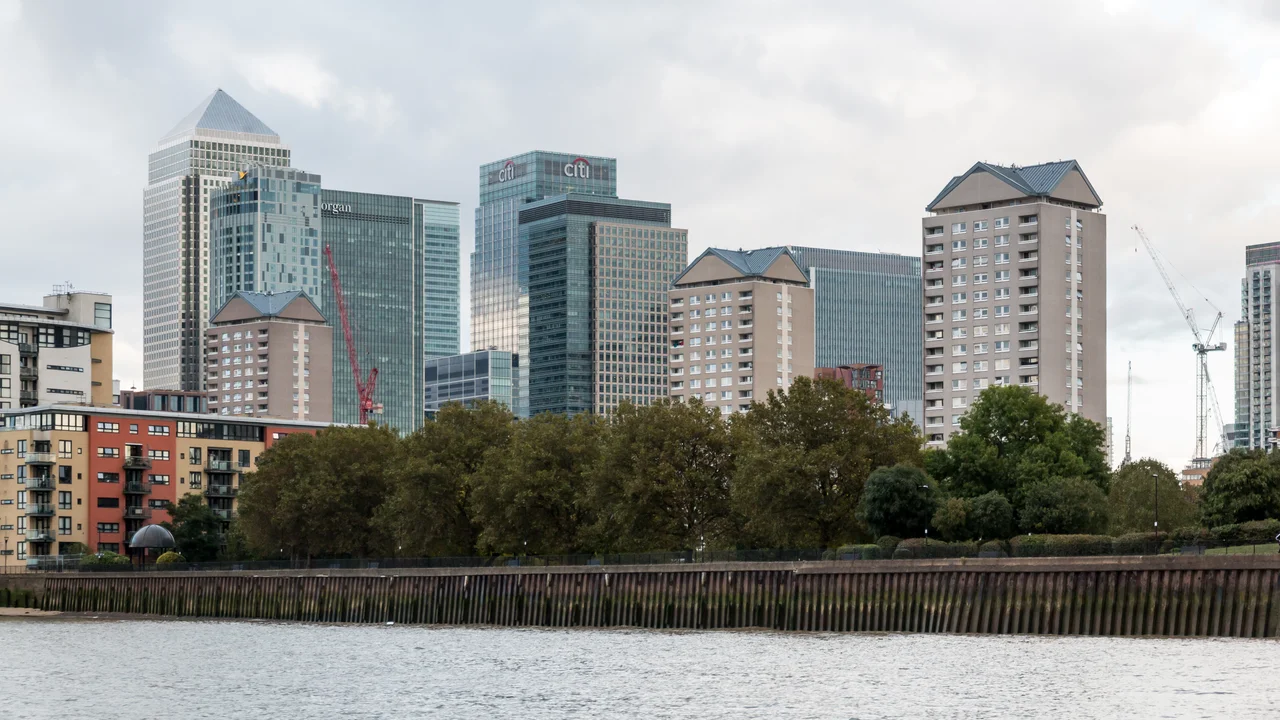

East End of London
Stand on Cable Street on a Sunday afternoon, in front of the enormous mural painted on the side of the old town hall, and you can read the date 4 October 1936 in the rendering. That was the day a hundred thousand East Enders - Jewish, Irish, English, communist, anarchist, dock workers, housewives, anyone who had decided enough was enough - blocked the British Union of Fascists from marching their black-shirted columns through the neighbourhood. They won. The fascists were turned back and made to parade in the West End instead. Cable Street is one episode in a much longer story that the East End tells about itself: that this is the part of London that arrivals come to, that the established population resents them, that the resentment eventually subsides, and then the next arrivals come. Huguenots, Irish, Jewish, Chinese, African, Bangladeshi, Somali. Each wave joining and remaking the place. The East End is the working-class heart of London. It also, more than almost any neighbourhood in Europe, is a record of who came and what was done to them and how they built lives anyway.
Built by the River
Industries followed the Thames. Rope makers needed long straight runs to twist their hemp - the modern streets near Mile End still trace the old roperies, narrow and unnaturally straight. Shipfitting was happening at Ratcliff in 1354 and at Blackwall by 1485. On 31 January 1858 the largest ship ever built, the SS Great Eastern, designed by Isambard Kingdom Brunel, was launched sideways from the Millwall yard of Scott Russell and Co - sideways because the ship was too long to fit across the river. The launch took agonising weeks and the difficulties did permanent damage to Thames shipbuilding. The Royal Docks, built between 1855 and 1921, could berth the biggest ships in the world; the last of them, the King George V Dock, opened in 1921 and could take vessels of thirty thousand tons. All of them were closed by 1980, made obsolete by container ships that no longer fit through the old lock gates.
The Weavers and the Pogroms
Each wave of immigration left a building behind. The Huguenots - French Protestants fleeing Catholic persecution after the Revocation of the Edict of Nantes in 1685 - settled around Spitalfields and brought silk weaving with them. They built a small chapel on Fournier Street in 1743 that became, in turn, a Methodist chapel, then a synagogue when Yiddish-speaking Jews fled the pogroms of the Russian Empire in the 1880s, and then in 1976 was acquired by the Bangladeshi community and reopened as the Brick Lane Mosque. One building, four congregations, three faiths, three centuries. The Jewish East End peaked around the turn of the twentieth century with over 150 synagogues; only three remain in Tower Hamlets today. The Bangladeshi community, mostly from Sylhet, now forms about a third of the borough's population, and Brick Lane is unofficially known as Banglatown. The first British mosque to broadcast the call to prayer over loudspeakers, the East London Mosque on Whitechapel Road, holds 7,000 worshippers.
The Battle of Cable Street
On 4 October 1936, Oswald Mosley's British Union of Fascists assembled between three and five thousand uniformed blackshirts and announced they would march through the heart of the Jewish East End. Up to one hundred thousand people - Jews, Irish dockers, communists, trade unionists, ordinary residents who had no organised politics at all - turned out to stop them. There were clashes at Tower Hill, at the Minories, at Gardiners Corner where Whitechapel High Street meets Commercial Street, and most famously on Cable Street itself, where local people built barricades from upturned lorries, mattresses, and broken paving stones. Police on horseback charged the crowd. Householders threw rotten vegetables and chamber pots from upper windows. By evening the fascists had been turned back and marched their parade in the West End instead. The mural on the wall of St George's Town Hall, painted in the 1980s, shows the day in vivid panel-by-panel detail. It is repainted, by hand, every time vandals deface it.
Bombs, Slums, and Tower Blocks
The East End was bombed harder than almost any neighbourhood in Britain during the Blitz of 1940-41. The docks were the target; the working-class housing around them was burned with the docks. Whole streets disappeared. After the war, slum clearance that had been interrupted by the conflict resumed at enormous scale - the London County Council and its successor authorities built dozens of tower blocks, many of them poorly designed and worse maintained, that became the visual cliche of post-war East London. The closure of the docks between the late 1960s and 1980 took the jobs along with the buildings. By 1980 the population of the three core East End boroughs - Bethnal Green, Poplar, and Stepney - had collapsed from a 1901 peak of 597,000 down to about 205,000. The 1981 establishment of the London Docklands Development Corporation kicked off the regeneration that produced Canary Wharf, the Docklands Light Railway, and London City Airport, built in 1986 on the bed of the old King George V Dock.
Pearlies, Bow Bells, and Bangladeshi Curry
The Whitechapel Bell Foundry opened in 1570 and ran continuously until 2016, the oldest manufacturing company in Britain when it finally closed. It cast Big Ben, the Liberty Bell in Philadelphia, and the original Bow Bells of St Mary-le-Bow, by tradition the bells you had to be born within earshot of to be a true Cockney. Modern noise pollution means the bells now only reach as far as Shoreditch; in the nineteenth century they would have been audible at Stamford Hill. The Pearly Kings and Queens, dressed in suits decorated with thousands of mother-of-pearl buttons, are the aristocracy of the old costermonger street traders, originally elected to defend the trade against thieves and bullies and now devoted to charity. They paraded at the opening ceremony of the 2012 Olympics, held on the eastern edge of the East End in the regenerated Olympic Park. Down Brick Lane, the curry restaurants and the bagel shops face each other across the street, and on Sundays the market sells everything anyone has ever owned. The East End keeps remaking itself, and the new layer never quite buries the old.
From the Air
The East End sits at roughly 51.51 degrees N, 0.05 degrees W along the north bank of the Thames east of the Tower of London. The neighbourhood stretches from Whitechapel and Spitalfields in the west out to the Isle of Dogs, Canning Town, and the Royal Docks in the east. Nearest airports: EGLC (London City) about 2 nautical miles east, EGLL (Heathrow) about 17 nautical miles west, EGKK (Gatwick) about 26 nautical miles south. From above, the most visible landmarks are the Canary Wharf cluster on the Isle of Dogs, the dramatic curve of the Thames around it, the Olympic Stadium at Stratford to the north-east, and the Tower of London with Tower Bridge marking the western boundary. The flat plain of the Thames Estuary opens out east toward Tilbury.
Nearby Stories
- Stevenage 5.7 km away
- Malling Abbey 5.7 km away
- 1952 Farnborough Airshow Crash 7.7 km away
- Ingatestone Hall 8.2 km away
- Hellfire Caves 9.1 km away
- The Carrington Event: The Solar Storm That Could Happen Again 9.8 km away
- Bletchley Park 16 km away
- Castle Hedingham 23 km away