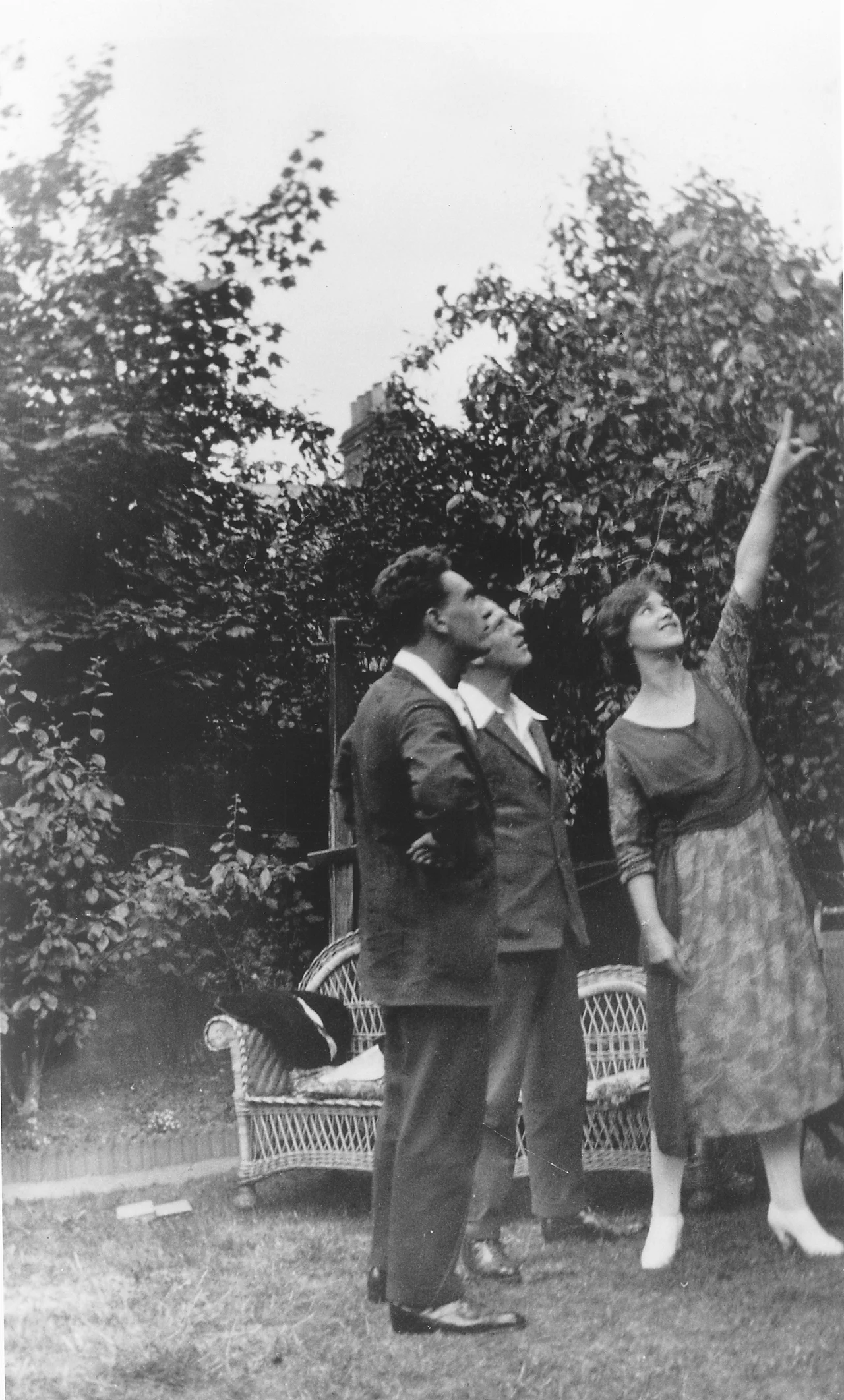

Edith Thompson and Frederick Bywaters
At nine o'clock on the morning of 9 January 1923, in two London prisons half a mile apart, the British state hanged Edith Thompson and Frederick Bywaters at the same moment. She was twenty-nine. He was twenty. Percy Thompson, Edith's husband, had been stabbed to death by Bywaters on an Ilford street three months earlier while Edith was knocked to the ground beside them. Bywaters never stopped saying she knew nothing about it. Edith Thompson protested her innocence at the gallows. A century later, lawyers, historians, and the Criminal Cases Review Commission have all agreed: something terrible happened in that courtroom, and the women's death penalty in Britain was effectively over.
Three Lives in Ilford
Edith Jessie Graydon was born in Dalston, north-east London, on Christmas Day 1893. She was the eldest of five children. She danced and acted in amateur productions, was clever at arithmetic, and went to work at fifteen for a wholesale milliner in the City. By her late twenties she was the firm's chief buyer, travelling regularly to Paris. She had married Percy Thompson, a shipping clerk three years her senior, in January 1916 at St Barnabas, Manor Park. They bought a comfortable house at 41 Kensington Gardens in Ilford in 1920. The marriage was unhappy. That same year Edith met Frederick Bywaters again. He was a ship's writer, then eighteen, who had been her younger brothers' schoolfriend nine years earlier. He went to sea for months at a time. The letters began.
The Letters
Edith Thompson wrote to Bywaters across two years and more than fifty-five thousand words. The surviving letters run from November 1921 to September 1922, a day-by-day account of her London life while her lover was at sea. In a handful of passages she described grinding glass into Percy's mashed potato, or putting poison in his food, or wishing she could be free. In one letter she remarked that a woman she knew had lost three husbands while she could not lose one. Two Home Office pathologists, including the famous Sir Bernard Spilsbury, would later find no trace of poison or ground glass in Percy Thompson's body. The poison plots were never real. Whether they were Edith's fantasy, or her literary self-projection (she was a voracious reader of novels), or her clumsy effort to keep her young lover's attention, was the question her trial never resolved.
The Murder
On the night of 3 October 1922, Edith and Percy Thompson were walking home from a London theatre near their Ilford house. A man jumped from behind some bushes and attacked Percy. Edith was knocked down. Neighbours later said they heard a woman screaming hysterically, calling out oh don't, oh don't. Percy Thompson died on the pavement before help reached him. The attacker was Frederick Bywaters. He had cooperated completely with the police, led them to the knife he had hidden, and insisted from the first that he had acted alone and that he had only meant to confront Percy, not kill him. Percy Thompson, killed in his early thirties, was a real victim whose name is now mostly remembered for the trial that followed his murder.
The Trial
Edith Thompson and Frederick Bywaters were tried together at the Old Bailey before Mr Justice Shearman in December 1922. The prosecution, led by the Solicitor-General Sir Thomas Inskip, used a selection of Edith's letters to argue that she had incited Bywaters to murder her husband. The Court of Appeal would later say it scarcely mattered whether her poison talk was true or invented, because the letters themselves were evidence of continuous incitement. Edith's counsel begged her not to testify. The burden of proof, he reminded her, was on the Crown, and she had not been physically involved in the killing. She testified anyway, hoping to save Bywaters. She made a disastrous impression. She contradicted herself. When asked what passages of her letters meant, she sometimes simply said she had no idea. The jury convicted them both.
9 January 1923
Frederick Bywaters was hanged at HMP Pentonville. Edith Thompson was hanged at HMP Holloway. They were executed at exactly the same hour. Reports from those present at Holloway describe Edith's hanging in terms that haunted prison reformers and abolitionists for decades; she was, by every account, in a state of collapse, terror, and grief. The journalist James Douglas wrote in The Express that the hanging of Mrs Thompson was a miscarriage of mercy and justice. He counted eight things she was not guilty of. Edgar Lustgarten, René Weis, Lewis Broad, Laura Thompson, William Twining, and others have argued in books and articles across a hundred years that her conviction was unsafe. Her execution, and the manner of it, contributed to the eventual end of capital punishment for women in Britain. The last woman hanged would be Ruth Ellis in 1955, also at Holloway. After Ellis, no British woman was executed again.
A Long Reburial
Frederick Bywaters lies in an unmarked grave inside the walls of Pentonville, where his remains were buried hours after his execution. Percy Thompson is buried at the City of London Cemetery. Edith Thompson was buried in Holloway, then reburied in a single unmarked plot with three other executed women at Brookwood Cemetery in Surrey. In 1993, the historian René Weis and Audrey Russell placed a grey granite stone over the plot and had it consecrated by the vicar of St Barnabas, Manor Park, the church in which Edith had married Percy seventy-seven years before. On 22 November 2018, Edith Thompson's remains were exhumed and reburied alongside her parents in the City of London Cemetery, as her mother had wanted. In March 2023, on the hundredth anniversary of her death, the Secretary of State for Justice referred the case to the Criminal Cases Review Commission as a potential miscarriage of justice. The story, after a century, is still not over.
From the Air
The case is centred on the suburb of Ilford in the London Borough of Redbridge, north-east London. Brookwood Cemetery in Surrey, where Edith Thompson was reburied between 1923 and 2018, sits at approximately 51.30°N, 0.63°W. Holloway Prison stood in north London at 51.55°N, 0.12°W; Pentonville Prison sits two miles away in Islington. Visual landmarks at altitude include the Thames Estuary to the east, the City of London skyline, and Heathrow's approach paths. Class A controlled airspace and the London CTR cover the entire area; this is no place for a casual overflight. Nearest GA airfields include EGKB Biggin Hill 12 nautical miles south-east of central London and EGTB Booker further west.
Nearby Stories
- Silvertown Tunnel 0.6 km away
- Uxbridge 5.3 km away
- Amberley Museum & Heritage Centre 8.8 km away
- Hever Castle 9.9 km away
- Russian Memorial, Lewes 11 km away
- Portchester Castle 16 km away
- Ufton Nervet rail crash 20 km away
- Abingdon-on-Thames 24 km away