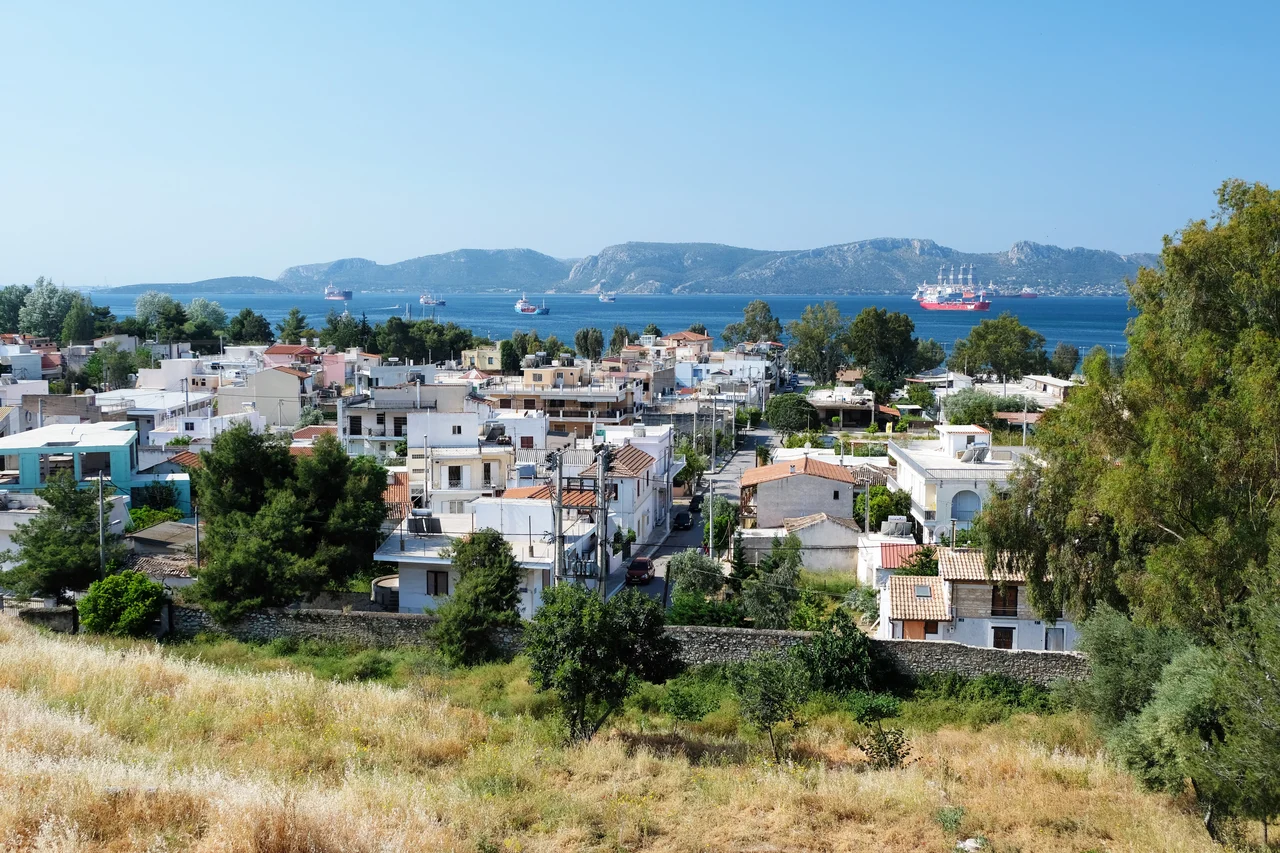

Elefsina
What the initiates saw at Eleusis, they were forbidden to describe. For over a thousand years, the Eleusinian Mysteries drew pilgrims from across the ancient world to this coastal city on the Saronic Gulf — emperors, philosophers, generals, common farmers — and every one of them kept the secret. We know they witnessed something. We know it involved grain, torchlight, the myth of Persephone's abduction by Hades. We know initiates left believing, in some deep way, that death was not the end. But the specific content of the rites, the thing revealed in the innermost chamber of the Telesterion, was never written down. Eleusis kept its secret for eternity. Today the city goes by Elefsina, and it is best known for its oil refineries.
Sacred Ground, Industrial Shore
The contrast is not subtle. Drive west from Athens on the A6 motorway and the city gives way to suburbs, the suburbs give way to the Thriasio Plain, and then the stacks and tanks of the largest oil refinery in Greece appear on the waterfront, just west of where the ancient sanctuary of Demeter once stood. Elefsina today is a working industrial city — refineries, cement plants, shipyards — and its air quality has historically reflected that fact. The ancient Telesterion, the hall of initiation that Strabo described as large enough to hold an audience the size of a theatre, sits in ruins on a low hill above the town, surrounded by archaeological fencing.
Yet the tension between Elefsina's ancient sanctity and its modern grit is precisely what makes the city interesting. When the European Union designated it as a European Capital of Culture — announced in 2016 for 2021, then postponed to 2023 due to the COVID-19 pandemic — the choice was deliberate. Elefsina was not chosen despite its industrial character but because of the creative friction between that character and what lay beneath.
The Mysteries and Their Myth
The theological heart of Eleusis was the story of Demeter and Persephone. Persephone, the daughter of the harvest goddess Demeter, was abducted by Hades and taken to the underworld. Demeter, disguised as an old woman and wandering in grief, arrived at Eleusis, where the daughters of the local king Keleos found her by a well and brought her to their palace. There she nursed the royal infant Demophoon, anointing him with nectar and holding him in fire at night in an attempt to grant him immortality — until Metaneira, the queen, discovered this and cried out in horror. Demeter, her disguise broken, revealed herself in her full divine glory and instructed Keleos to build her a temple.
That temple, the source material says, was the origin of the Eleusinian Mysteries. The rites that grew up around it were called the Eleusinia and were regarded as the most sacred of all Greek religious observances. Emperor Hadrian was initiated around 125 AD. The Roman nobles who followed him made initiation fashionable. Not until Alaric I and his Visigoths sacked Eleusis in 396 AD did the Mysteries come to an end — over a thousand years of continuous rite.
The caves along the Elefsina coastline carry their own sacred weight. One is identified in tradition as the spot where Persephone was taken into the underworld, a gateway to Tartarus. A sanctuary to Hades and Persephone — a Ploutonion — once stood at the spot.
Aeschylus and the Weight of Origins
Elefsina is the birthplace of Aeschylus, born around 525 BC, the playwright who essentially invented tragedy as a dramatic form. He fought at Marathon in 490 BC and witnessed the Persian destruction of the Demeter temple at Eleusis in 480 BC — saw the sacred city burned and the mysteries interrupted. His plays, rooted in divine justice and the weight of fate, carry in them something of this place: a world in which the gods are present, in which suffering has meaning, in which the violation of sacred things brings consequences.
The Aeschylia Festival, established in 1975, honors his memory each year at a former soap factory on the seafront that functions as an open-air theatre. It runs from late August through September and is the longest-standing cultural event organized by any municipality in the Attica region. Aeschylus himself is a remarkable figure to honor in this specific way: a man from a sacred city who fought in its defense, watched it burn, and went on to create some of the most enduring dramatic literature in human history.
The Long Modern Story
After Alaric's sack, Eleusis slipped from history. Byzantine writers described it as a small village. Under Ottoman rule, European travelers found it nearly deserted, full of ruins. The Greek War of Independence in the 1820s left it with about 250 inhabitants. Then industrialization arrived, and the city grew fast and hard: cement factories, soap factories, distilleries, and eventually the oil refinery that now defines its skyline.
Many Greek families displaced from Asia Minor after the catastrophe of 1922 settled in Elefsina, doubling its population and adding new cultural layers. During the Axis occupation of Greece from 1941 to 1945, resistance developed in the city and its factories. The military airport east of town — Elefsina Air Base — played a key role in the final British evacuation from Greece in 1941, an episode Roald Dahl recounted in his memoir Going Solo; he served with RAF Squadron 80, which was stationed there.
The city's designation as European Capital of Culture in 2023 brought art installations, performances, and international attention to a place that rarely makes headlines beyond the refinery sector. Whether that attention will shift Elefsina's identity as it moves forward remains to be seen. The ruins of the Telesterion are still there, the mysteries still unspoken.
From the Air
Elefsina (ancient Eleusis) sits at approximately 38.041°N, 23.545°E on the northern shore of the Saronic Gulf in West Attica, about 23 km west of central Athens and close to Athens International Airport Eleftherios Venizelos (LGAV), roughly 30 km to the southeast. From the air, the city is immediately recognizable by the large industrial complex — the oil refinery — on its western waterfront, set against the blue waters of the Saronic Gulf and the island of Salamis to the south. The ancient acropolis and sanctuary site sit on a low hill just east of the refinery. Recommended viewing altitude: 3,000–5,000 feet provides excellent context for the entire Saronic Gulf geography, with Salamis island, the Elefsina bay, and the Athens basin all visible simultaneously.
Nearby Stories
- Hellenic Geodetic Reference System 1987 3.4 km away
- Mount Helicon 4.2 km away
- Siege of Thebes (292–291 BC) 4.8 km away
- Archaeological Museum of Aegina 6.3 km away
- Berbati Valley 10 km away
- Theatre of Thorikos 14 km away
- Sicyon 15 km away
- Euboea 22 km away