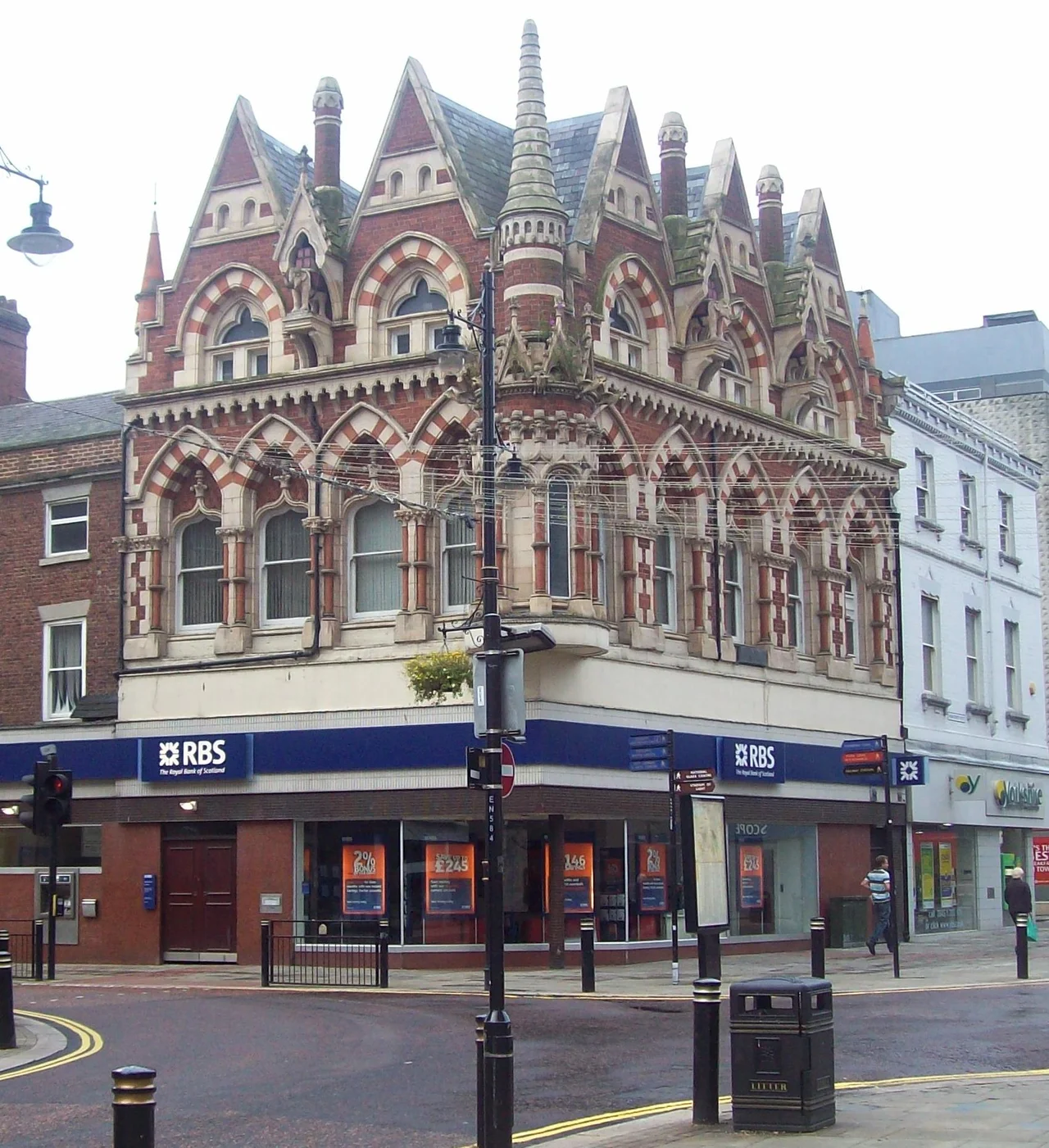

Elephant Tea Rooms
Look up at the gables and you will see elephants - actual sculpted elephants, in glazed faience, standing on bracketed shelves between every shaped gable along the roof line. Below them runs an arcade of pointed arches with crocket capitals, ogee window heads with fleur-de-lys finials, and lozenge-patterned terracotta spandrels. At the corner, a round oriel turret rises into a Buddhist-style conical roof with ringed ribs. The Elephant Tea Rooms in Sunderland was built between 1872 and 1877 for William Grimshaw, a local tea merchant and grocer, by the architect Frank Caws in a blend of Hindu Gothic and Venetian Gothic styles. The exotic appearance was the entire commercial point: this was Victorian advertising in brick, terracotta and faience, telling Sunderland that the tea inside came from places the building looked like.
Tea Theatre
The tea trade in 1870s Britain was both lucrative and competitive. Sunderland was a port city, with ships arriving from across the world and a population willing to pay for the better blends. William Grimshaw wanted a shop that would announce itself, and he hired the city's most adventurous architect to design it. Caws gave him a building that fused the pointed arches and tracery of Venetian Gothic with the curved rooflines and dome-shapes associated with South Asian architecture. The polychrome exterior - brick, terracotta and faience in contrasting colours - was a calculated departure from the soot-darkened sandstone that dominated commercial Sunderland. Even the Buddhist-style turret roof was a tea reference. Customers approaching High Street would see, before they saw the door, exactly what was on sale inside.
The Grimshaw Confusion
For decades, internet sources have credited the building to a tea merchant named Ronald Grimshaw. This is wrong, and it is wrong in a specific way: Ronald Grimshaw was William Grimshaw's great-grandson, born in 1905 - thirty years after the building was completed. The error appears to have entered the record through a single misattribution and propagated. The original commissioner was William Grimshaw, the local tea merchant and grocer; this is documented in Bill Greenwell's 2021 study The Elephant Tea Family. The building's interior layout served the tea business through the early 20th century before changing hands, changing uses, and eventually surviving where most of its commercial neighbours did not.
Restoration and Library
By the early 21st century the building was Grade II listed but worn. In 2020 it became home to the city's Local History Library, which gave the upper floors a public reading purpose for the first time. Between 2022 and 2024, Historic England funded a major restoration - the faience elephants were cleaned, the terracotta repaired, the polychrome surfaces returned to something closer to their 1877 brilliance. The roof, with its terracotta crestings, faience gable copings and brick chimneys, was renewed. The work has revealed details that had been blackened for a century: the trefoil bargeboards with crocket decoration, the eaves gargoyles around the corner turret, the corbelled trefoil frieze under the eaves. It is now one of the most striking restored Victorian commercial buildings in the north-east.
From the Air
From altitude the steep slate roof with its lantern, distinctive elephant gablets and corner turret reads as one of the small but unmistakable spikes in the centre of Sunderland's commercial district. The building stands on Fawcett Street, a short walk from Frank Caws' other surviving works including the Corder House and Sydenham House. Together they form a small pocket of late-Victorian exuberance preserved in a city that lost much of its Victorian commercial fabric to wartime bombing and post-war planning. To the north, the River Wear curves to the docks. To the east, the North Sea coast runs down through Hendon. The faience elephants - eight of them, glazed and grey-white - have been catching the daylight here for nearly 150 years.
From the Air
Located at 54.9074 N, 1.38213 W, on Fawcett Street in central Sunderland. Recommended viewing altitude 1,500 to 3,000 feet for the city centre and surrounding districts. Nearest airports: Newcastle International (EGNT) approximately 10 nm north-west, Durham Tees Valley (EGNV) further south. Visual landmarks include the River Wear and Sunderland docks just to the north-east, Sunderland Minster a short distance west, and the distinctive elephant-topped gables and corner turret roof of the Tea Rooms themselves.
Nearby Stories
- Seaton Carew 2.7 km away
- HMS Unity (N66) 6 km away
- George Stephenson's Birthplace 6.1 km away
- Raby Castle 9 km away
- Cragside 15 km away
- Whitby Abbey 21 km away
- German submarine U-2367 46 km away
- Alexander L. Kielland (Platform) 277 km away