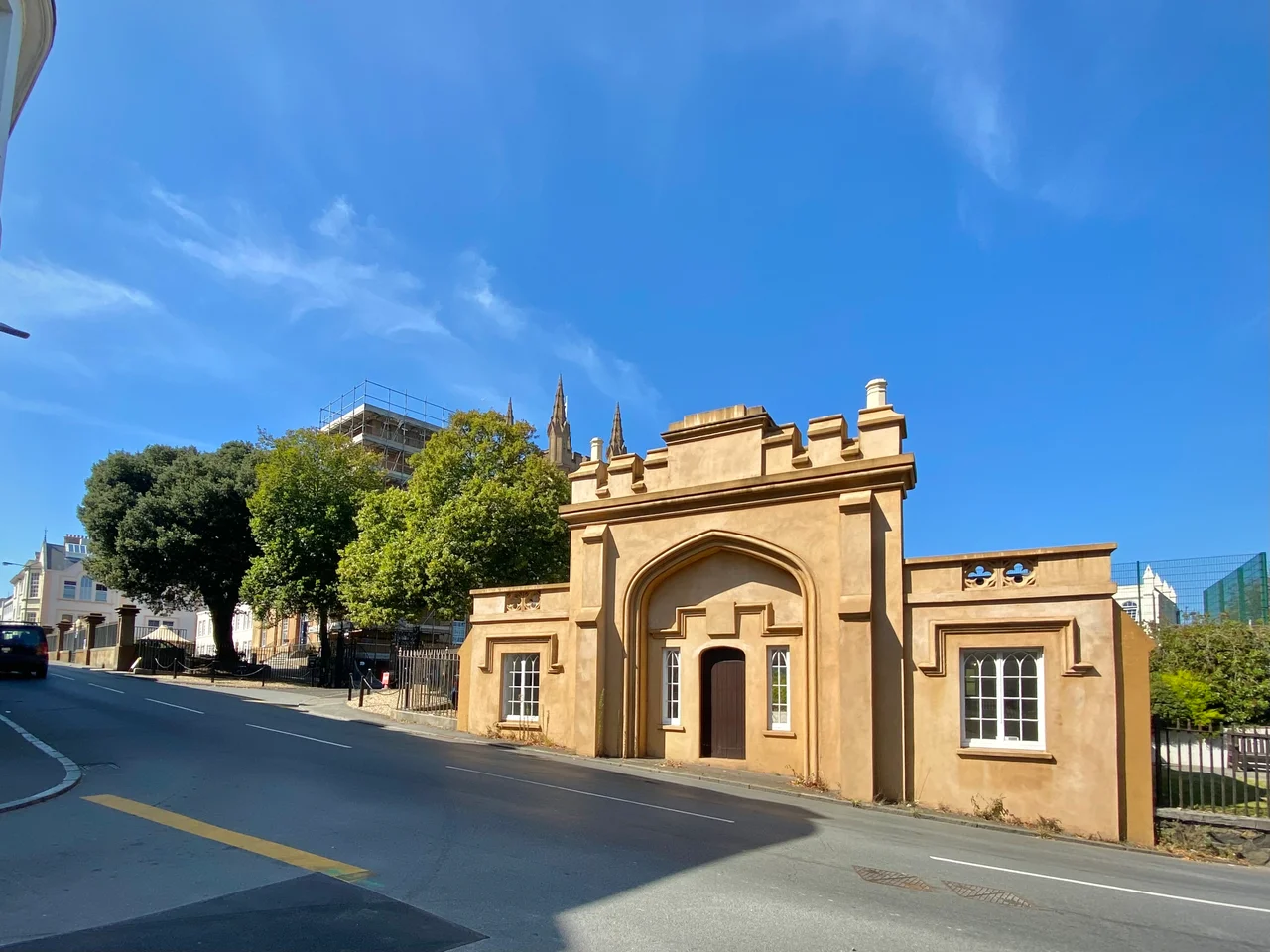

Elizabeth College, Guernsey
On 25 May 1563, in the same year three Guernsey women were burned for witchcraft, Queen Elizabeth I signed a patent roll establishing a free grammar school on the island. The Privy Council had decided that Guernsey badly needed educated clergy. The Franciscan friars at La Rue Des Frères were politely moved off their land. A Belgian scholar named Adrian Saravia was installed as the first master. Within eight years Saravia had quit, describing the islanders as an 'uncivilised race' that 'hates all learning.' Elizabeth College has been there ever since - 463 years and counting, the oldest public school in the Channel Islands.
Two and a Half Centuries of Almost Failing
For its first 261 years, the school nearly collapsed repeatedly. The endowment was 80 quarters of wheat rents a year, and the bursar's books rarely balanced. Buildings were abandoned. Land was sold off. Principals were dismissed or resigned in disputes with the local authorities. The pupil roll never exceeded 29 boys, and for stretches of years there were no students at all. In 1824, with demand for serious schooling rising across the British world, the Lieutenant Governor John Colborne set up a committee to fix it. The school was re-chartered, the foundation stone of a new main building was laid by Colborne himself on 19 October 1826, and the institution was renamed the Royal College of Elizabeth. Within a year there were over a hundred boys on the roll. Every pupil from that day forward has been allocated a unique, sequential school number.
Sons of Empire, Victoria Crosses
Through the nineteenth century, Elizabeth College became a finishing school for the sons of British colonial officers. Many alumni went straight on to Sandhurst and into uniform. Four of them eventually won the Victoria Cross - Duncan Home in 1857, John McCrea in 1881, Lewis Halliday in 1900, and Wallace Le Patourel in 1943. When the Great War came, 662 Old Elizabethans served. One in five of every boy who had passed through the school since the 1824 re-chartering was in uniform; 105 of them never came home. The roll of honour in the main hall lists them all. Today's pupils walk past their names every day on the way to assembly.
Evacuation, Occupation, and a Belgian Strongroom
In June 1940, French resistance collapsed and the Channel Islands suddenly found themselves indefensible. The school governors moved fast. On the evening of Thursday, 20 June 1940, Elizabeth College was evacuated to Great Hucklow in Derbyshire. The pupils would spend the next five years in a Peak District village, with little or no contact with parents trapped on Guernsey. Back on the island, the school's air-raid shelter was repurposed by German forces as an ammunition store. In 1941 the German authorities seized the main building as their headquarters. A strongroom bunker was built into what is now called the AJ Perrot room; the bunker is still there, minus its door. Even so, in those five years eight pupils-in-exile won scholarships to Oxford. On 12 May 1945, Brigadier Alfred Ernest Snow read the Royal Proclamation of liberation from the terrace steps of the school, to a crowd of cheering locals who had not seen their children in half a decade.
Wodehouse, Hester, and a Quiet Coeducation
The list of Old Elizabethans reads like a strange index card of twentieth-century Britain. P.G. Wodehouse passed through from 1890 to 1892. Robert Morley acted from 1921. Jean Hugo, painter and great-grandson of Victor Hugo, arrived in 1907. Carl Hester, Olympic dressage gold medallist and four-time Olympic medallist, started in 1978. World-champion racing driver Andy Priaulx began in 1984. The school stayed all-male and all-boarding longer than most. It became a day school in 1996. Jenny Palmer became its first female principal in 2017. Girls were admitted to year seven and the sixth form in September 2021. By 2025, after 462 years, Elizabeth College was fully coeducational - the slowest revolution in island education quietly finished.
From the Air
Elizabeth College stands at approximately 49.46°N, 2.54°W, on the high ground overlooking Saint Peter Port harbor. The main building's pale stucco facade - what one Victorian critic called 'a formidable stucco composition in a sort of Tudor style' - is visible on the skyline from the eastern approaches to Guernsey. Guernsey Airport (EGJB) lies about 5 km south. Approaching from the east, the school appears as a prominent rectangular block against the rooftops of St Peter Port, with playing fields visible at Footes Lane to the southwest.
Nearby Stories
- Pallot Steam, Motor & General Museum 29 km away
- HMS Affray 29 km away
- Operation Donnerkeil 29 km away
- German Submarine U-672 35 km away
- Action of 18 June 1793 60 km away
- Mont Saint-Michel: The Abbey That Becomes an Island Twice a Day 78 km away
- Basilica of Sainte-Therese, Lisieux 209 km away
- 1941 Santander Fire 642 km away