.jpg)
Elm Hill, Norwich
In 1926, Norwich Corporation had a plan: tear down the slum on Elm Hill and put up a municipal swimming pool. The cobbled street running down toward the Wensum was a Tudor relic that had decayed into squalor, where weavers' great-grandchildren now lived in rotting houses with their windows boarded. The pool would have been modern, useful, sanitary. At nearly the last possible moment, the Norwich Society persuaded the Corporation to read their survey first. Renovation began in 1927. A hundred years later, Hollywood scouts come to Elm Hill when they need a street that looks the way a medieval English town is supposed to look - and they get it, complete with the cobbles, the jettied upper storeys, and a tree where the elm used to be.
The Fire That Almost Erased It
There is some evidence Elm Hill existed by 1200, but nobody can date its founding. What can be dated, very precisely, is 1507 - the year a fire tore through Norwich and destroyed more than 700 houses, including almost everything on this street. One building made it through: the Briton's Arms, a thatched, jettied survivor at the corner that is older than anything else here and is now a coffee house in a building from around 1420. After the fire the merchants of Norwich rebuilt, and the new houses are what visitors come for today. The street had once continued in a straight line past the Briton's Arms toward St Georges Street, but in the 15th century it was re-aligned to make room for St Andrew's and Blackfriars Halls - originally the home of the Dominican friars - and that elbow in the layout remains. Elm Hill today runs from the Church of St Peter Hungate at the top down to the Church of St Simon and St Jude where Wensum Street begins.
Merchants and Weavers
The street took its name from the elm trees that the churchwardens of St Peter Hungate began planting here in the first quarter of the 16th century. The current tree in the square is not an elm - Dutch elm disease has made true elms a rarity in Britain - but a parish pump still stands near it, marking the old gathering point. In the 15th and 16th centuries Elm Hill was a working commercial thoroughfare. The north side of the street runs parallel to the Wensum, and although it does not look it now, many of the merchant houses had their own private quays. Raw materials came up from Great Yarmouth; finished goods went the other way. Norwich was prosperous in those years because waves of religious refugees from the Low Countries had brought their skills with them, and the city absorbed weavers, dyers, goldsmiths, and silk workers in numbers large enough to change its character. The wealthy merchants of Elm Hill faced the street; their factories sat at the rear; and in between, in the lanes leading down to the river, lived the workpeople. Sixteen of Norwich's mayors and sheriffs came from houses on this single street.
Slum, Survey, Rescue
When the weaving industry collapsed in the 19th century, Elm Hill went down with it. By the 1920s the merchant houses were neglected and the river lanes were poor and overcrowded. The Corporation's pool would have been the practical answer to a real housing problem - the people living in those tenements deserved better than what they had. But the Norwich Society argued for a different kind of practical answer. Their 1927 survey acknowledged the squalor while pointing to the historic timber framing buried beneath layers of additions, and they proposed clearance combined with sympathetic restoration. The Corporation accepted the case. The slums came down. The fine buildings were bought up and carefully renovated, and today Norwich City Council still owns most of them. It was an early example of urban heritage rescue at a moment when the more usual answer was the bulldozer. The pool was never built. The tenement residents were rehoused. The merchant houses were saved.
Of Stardust and Keyboards
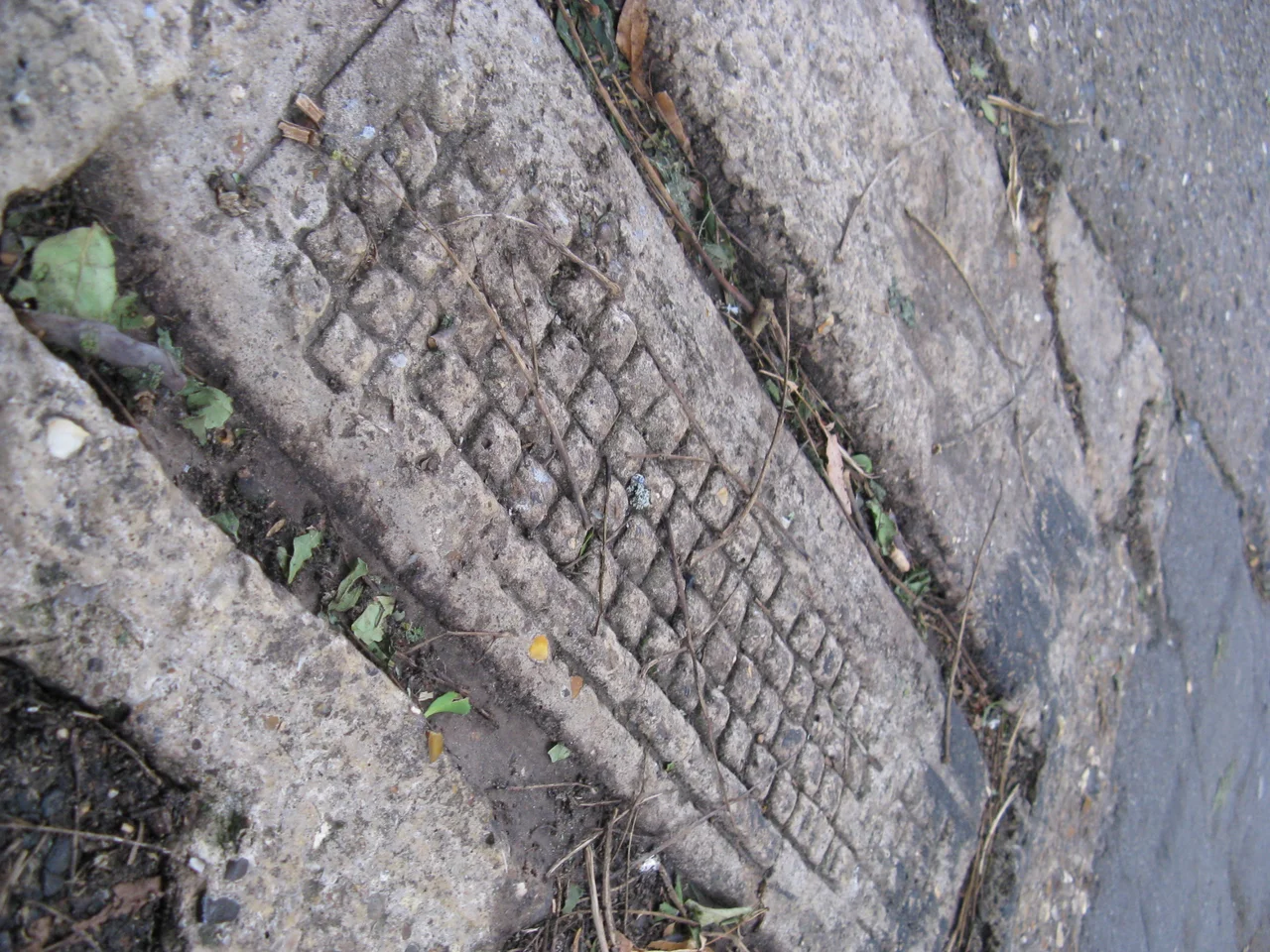
Modern Elm Hill earns its keep partly through tourism and partly through film. The 2007 fantasy Stardust used the lane as a backdrop, and Netflix returned in 2020 to shoot the Christmas musical Jingle Jangle here. Briton's Arms still pours coffee, the Stranger's Club still meets, Pettus House still sells collectibles, and the Dormouse Bookshop still does what its name suggests. And on the corner of Princes Street and Elm Hill there is a small mystery solved. In 1999 Molly Sole, then a student at the Norwich School of Art and Design, set what looked like a fossilized computer keyboard into the pavement as an art project. Norwich locals spent two decades inventing explanations - it had fallen in the wet cement in the 1980s, it was the imprint of an antique typewriter, it was leftover Victorian printing equipment. In May 2020 the YouTuber Nostalgia Nerd tracked Sole down and posted the answer. The keyboard has been there all along, a small modern artifact embedded in a street that runs the gamut from 1200 to 2020 in two hundred meters of cobble.
From the Air
Elm Hill runs roughly north-south at 52.6318N, 1.2971E in the heart of medieval Norwich, two blocks west of the Wensum and 200 m north-east of Norwich Cathedral. The cobbled lane is too tight to spot from cruise altitude - it is best appreciated on the ground - but the cathedral's 96 m spire just south-east is the anchor landmark from the air. Norwich International (EGSH) lies about 3 nm north. At 1,500 ft AGL the dense medieval core of Norwich appears as a tight cluster of red-tiled roofs around the cathedral and castle, with Elm Hill tucked between them.
Nearby Stories
- Sheringham 2.7 km away
- Wingfield Castle 4.4 km away
- Castle Acre Castle and Town Walls 6.3 km away
- Brancaster 7.1 km away
- West Stow Anglo-Saxon Village 9.3 km away
- Four Days' Battle 80 km away
- Battle of Lowestoft 80 km away
- SM U-97 110 km away