
Elstree
Elstree is barely a village. About five thousand people live there, on the old A5 north-west of London where Watling Street begins to climb out of the Thames basin towards St Albans. It is leafy, it is quiet, and it has been steadily eaten by the suburb of Borehamwood to its north for the last hundred years. But the name belongs to film history. The studios that bear it, sitting just over the boundary in Borehamwood proper, made the original Star Wars trilogy, every Indiana Jones film, Stanley Kubrick's The Shining, Tim Burton's Sleepy Hollow, the Harry Potter productions of the early 2000s, and - since 1985 - every single episode of EastEnders. The Anglo-Saxons called the place Tidulfres treow, meaning Tidwulf's Tree. The eagles are mentioned in seventeenth-century records as well. None of that quite prepared the village for what arrived in 1914.
Tidwulf's Tree
The Anglo-Saxon name appears in a charter of 786 in the form Tidulfres treow - Tidwulf's tree. Over the next eight hundred years the spelling drifted through Eaglestre and Ilstrye and Idlestrye before settling on Elstree by the eighteenth century. The topographer John Norden, writing in the 1590s, suggested that the name might actually mean grove of eagles, from a Latin gloss in an earlier manuscript. Daniel Defoe came through in 1748 on his English travels and described the village from Brockley Hill: a lovely view across Middlesex, over the Thames, into Surrey. By that point the place was still principally a stopping point on the old Roman road from London to Holyhead, which is still discernible underneath the modern A5. The 1540 Tudor manor house that became The Manor hotel still stands on Barnet Lane. So does the fifteenth-century Holly Bush pub. The village survives, even if the studios have made the surrounding fields famous in places its ancient charter-keepers would never have heard of.
The Murder of Martha Ray
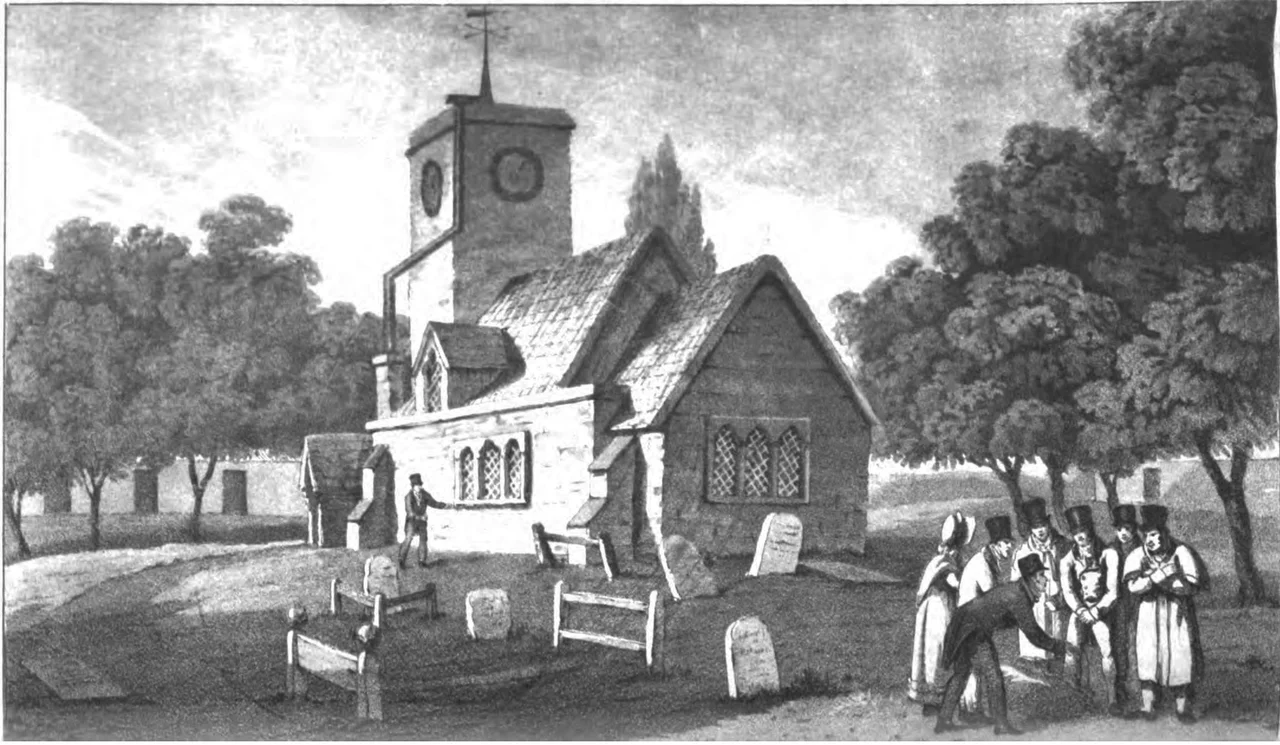
The most extraordinary single event in the village's pre-cinema history happened in London in 1779, but the burial was in Elstree. Martha Ray was a singer and the long-term mistress of John Montagu, the 4th Earl of Sandwich - the same Earl of Sandwich whose name is on, among other things, the snack and the islands. She had borne the Earl nine children. The Reverend James Hackman, an Anglican rector from Norfolk, had become obsessed with her and proposed marriage; she refused. On 7 April 1779, as Ray was leaving the Covent Garden theatre, Hackman shot her in the head at point-blank range, then attempted to shoot himself with a second pistol and only wounded himself. He was hanged at Tyburn nineteen days later. Martha Ray was buried in Elstree parish churchyard. The case scandalised London - James Boswell visited Hackman in prison and described the encounter in his journals - and made Elstree's small church an unwilling minor pilgrimage site for the morbid for years afterwards.
When the Cameras Arrived
The film industry came in 1914, when Percy Nash built Neptune Studios just over the village boundary in Borehamwood. By the 1920s there were six separate studios in the area, all of them trading on the village name even when their actual address was elsewhere. Alfred Hitchcock made his first sound film, Blackmail, at Elstree's British International Pictures studios in 1929. After the Second World War the place became the British capital of large-scale film production - EMI Elstree handled Star Wars in 1976 and 1977 and Raiders of the Lost Ark in 1980, with the original X-Wing fighters and the Millennium Falcon built on sound stages whose foundations are still there. Kubrick filmed The Shining at EMI in 1979 and 1980, building the entire Overlook Hotel as an interior set; he lived nearby in a house on Barnet Lane. Indiana Jones and the Last Crusade was shot there in 1989. The studios complex has expanded, contracted, gone bankrupt, been bought, and been split up several times, but big-budget productions still arrive there - the Disney Star Wars productions used Elstree extensively in the 2010s, and several Marvel films and Netflix prestige series in the early 2020s.
Albert Square in a Field
The BBC Elstree Centre, a separate complex from the film studios down the road, opened on a former ATV site in 1984 and was almost immediately repurposed to host the new soap opera the BBC was developing as a rival to ITV's Coronation Street. EastEnders began filming there in late 1984 and broadcast its first episode in February 1985. The outdoor lot on which fictional Albert Square sits is now one of the oldest continuously-used television production sets in Europe - it was rebuilt in 2022 after thirty-seven years on the original plywood and painted-brick fabric, but the basic geography of the square has not changed. Holby City, Top of the Pops, Casualty exteriors, and a long list of other BBC drama have also been shot at Elstree Centre. The site is on Eldon Avenue in Borehamwood, about a mile from the original film studios down Shenley Road. The number of cars parked outside on a winter weeknight is genuinely surprising.
A Village That Became an Adjective
Stanley Kubrick is buried about ten miles away, but he lived for the last quarter-century of his life in a house on Barnet Lane in Elstree, walking the dogs along the lanes between filming The Shining and Eyes Wide Shut. Peter Sellers, Tom Cruise, and John Cleese all stayed at The Manor hotel during productions. The Buggles, whose 1979 song Video Killed the Radio Star opened MTV two years later, also recorded a track called Elstree on the same album, an oddly tender lament for the disappearing world of British studio film-making. The village itself is now mostly green belt: bridleways, golf courses, the breeding programme for rare livestock at Aldenham Country Park. Aldenham reservoir doubles as a film location too - the bridge over Tyke's Water Lake appears in the opening titles of the 1972 horror film Dracula AD 1972 and in several Avengers episodes. The trees are still there. The eagles are not. The eagles were never quite there in the first place.
From the Air
Elstree village sits at 51.64 degrees N, 0.30 degrees W in Hertfordshire, about 12 nautical miles north-west of central London. From the air the area is recognisable for the cluster of studio buildings around Borehamwood to the north, the lake of Aldenham Country Park to the south-east, and Elstree Aerodrome itself - a small general aviation field with a 2,150-foot paved runway - directly south of the village. Nearest commercial airports: EGGW (Luton) about 10 nautical miles north, EGSS (Stansted) about 25 nautical miles east, EGLL (Heathrow) about 14 nautical miles south. Elstree Aerodrome (EGTR) is itself the closest field and is a major light-aircraft and helicopter base for north London. Best viewed at 2,000-4,000 feet in clear weather, with the M25 running just to the north as a visible reference.
Nearby Stories
- Stevenage 5.7 km away
- Malling Abbey 5.7 km away
- 1952 Farnborough Airshow Crash 7.7 km away
- Ingatestone Hall 8.2 km away
- Hellfire Caves 9.1 km away
- The Carrington Event: The Solar Storm That Could Happen Again 9.8 km away
- Bletchley Park 16 km away
- Castle Hedingham 23 km away