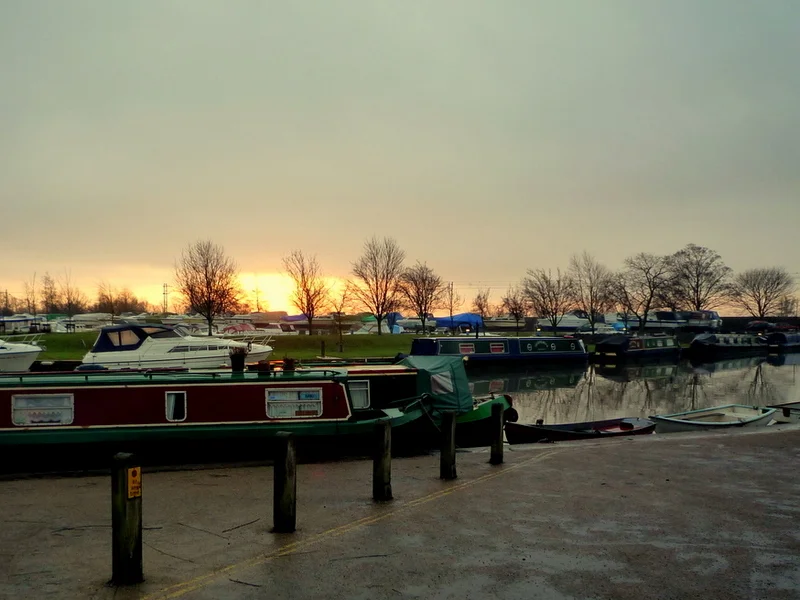

Ely, Cambridgeshire
King Cnut arrived at Ely by boat. The medieval accounts describe him rising up in the middle of his men and directing the boatsmen to make for the port at full speed, as he could hear the monks singing in the abbey from across the water. The story may be embellished, but the geography is real: for much of its history, Ely was an island, rising above the surrounding fenland on a low ridge of higher ground. The fens were drained over centuries, the water level fell, and the surrounding land sank — leaving Ely elevated above its own landscape like a natural cathedral mount. The city that grew here, one of England's smallest, takes its name from the eels that once crowded its waterways. It is a place where the past is not merely preserved but physically embedded in the stone and water around it.
A City on a Ridge
Ely is technically a city — it was granted city status by virtue of its cathedral — with a population of roughly 20,000, small enough that it can feel more like a market town. It sits on the north-south A10 road from London to King's Lynn, and its railway station connects it to Cambridge, London, and most of East Anglia. The River Great Ouse flows nearby, providing what was historically the town's most important transport link; a medieval port has been identified archaeologically between Broad Street and the present riverbank, with artificially cut channels at right angles to the river front. The River Cam joins the Ouse to the south of Ely, and in 1944 and 2021, the Oxford-Cambridge Boat Race was held on the Ouse here — displaced from the Thames, once by World War II and once by the COVID-19 pandemic.
The Cathedral's Presence
The cathedral dominates Ely in the way that cathedrals were designed to dominate: visibly, from a great distance, across flat ground. John Wesley visited in November 1774 and wrote that "the western tower is exceedingly grand, and the nave of an amazing height." From the surrounding fens, the lantern tower and west tower are visible for miles. Locally, the cathedral is called "the ship of the Fens." The Octagon lantern, which replaced the Norman crossing tower after it collapsed in 1322, is one of the most distinctive features in English medieval architecture — a timber construction of extraordinary engineering, visible from the city's streets and from the farmland beyond. Ely Cathedral was the background of the cover photograph for Pink Floyd's 1994 album *The Division Bell*, and David Gilmour recorded orchestral and choral parts for his 2024 album at the cathedral.
Education and Notable Residents
King's Ely, one of England's oldest schools, traces its origins to the re-foundation of St Etheldreda's monastery in 970 by the Benedictine order. It received a royal charter from Henry VIII in 1541. Edward the Confessor may have been educated at Ely between approximately 1005 and 1010. The RAF hospital that operated at Ely during and after the Second World War meant that many children of service personnel were born in the city, including actor Guy Pearce, rugby coach Clive Woodward, and The Sisters of Mercy singer Andrew Eldritch. Poet Wendy Cope and crime writer Jim Kelly also come from Ely. In 1973, the city won the international *Jeux Sans Frontières* competition — known in Britain as *It's a Knockout* — becoming the last British town to win the title outright. Among Ely's other distinctions, the autogyro world record-holder Ken Wallis was born here.
Fen Life and Getting Around
Historically, Ely was reached by water more than by road. The medieval accountant Clement of Thetford's sacrist's rolls from 1291–92 record him travelling from Ely to Bury St Edmunds, Boston, Reach, and London by a combination of boat and road — the fen drainage channels serving as the motorways of the period. A thrice-weekly coach service was running from Ely to Cambridge by 1753, and in the 1760s the Reverend James Bentham — a minor canon at the cathedral and an antiquarian — campaigned successfully for an improved turnpike road between the two towns. Today the rail connections are direct and frequent, and the Great Ouse and River Cam are used almost entirely for leisure: rowing, boating, and the annual experience of watching Oxford and Cambridge oarsmen compete on waters that were once a Viking highway and a monastic port.
From the Air
Ely is located at 52.398°N, 0.262°E in Cambridgeshire, approximately 15 miles north of Cambridge. The cathedral is the definitive visual landmark — the octagonal lantern tower and west tower are visible from miles away across the flat fenland. The River Great Ouse curves to the west of the city. Nearest airport: Cambridge (EGSC), approximately 15 miles south.
Nearby Stories
- Bed Burial 2.5 km away
- Thetford Priory 6.6 km away
- Oundle School 8.1 km away
- RAF Lavenham 9 km away
- John Bunyan Museum 11 km away
- King's Lynn Minster 15 km away
- Woolsthorpe-by-Colsterworth 21 km away
- Walsingham Priory 21 km away