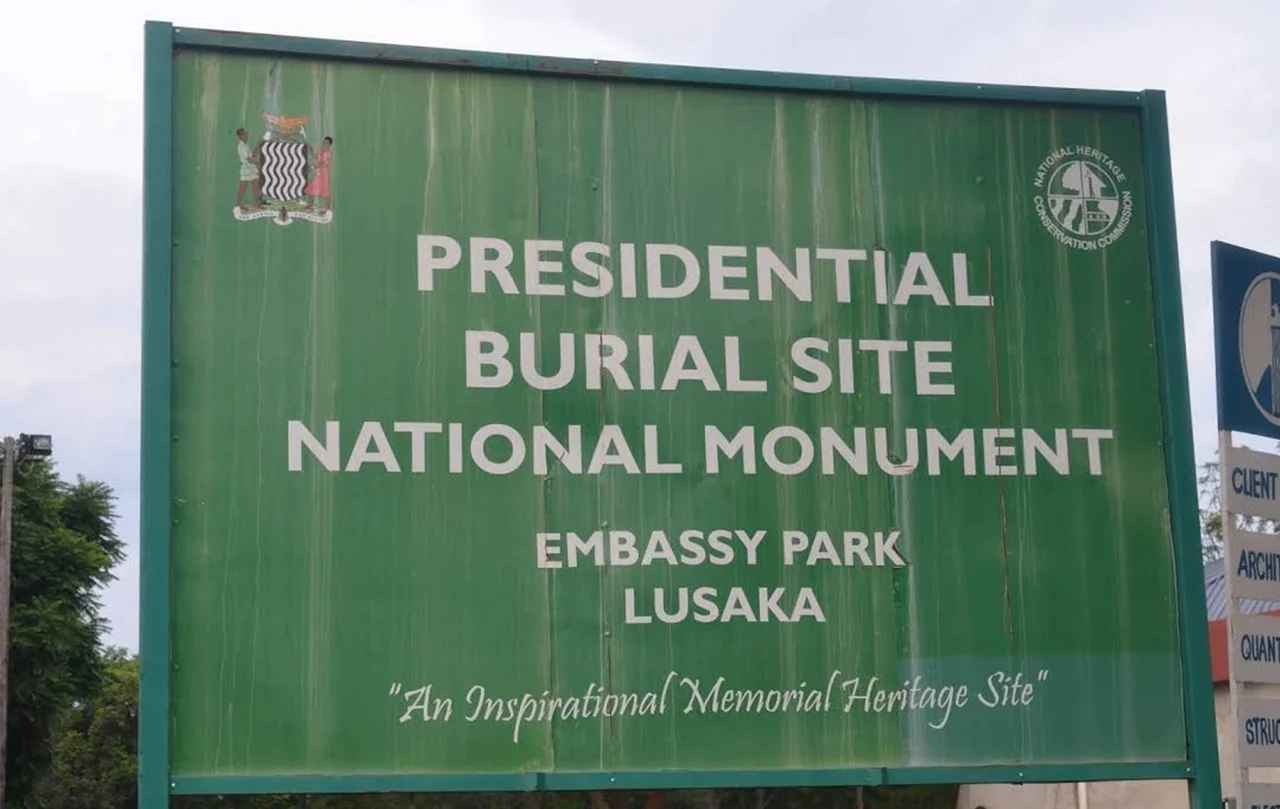

Embassy Park Presidential Burial Site
Every mausoleum at Embassy Park is a story told in architecture. Levy Mwanawasa's tomb is shaped like a traditional African stool - a symbol of authority. Four boot-shaped pillars stand at its corners, references to his anti-corruption crusade that became known as 'the boot' for its forceful approach. Eight steps lead up to the entrance: five wide ones for his completed first term, three narrower ones for the second term cut short by his death in office. The ramp at the entrance is shaped like a necktie, a nod to the tailored suits that were his trademark. Read the building and you have read the man.
A National Burial Ground
Embassy Park Presidential Burial Site sits on Independence Avenue in central Lusaka, across the road from the Cabinet Office. Formally designated a National Monument in 2009 and managed by the National Heritage Conservation Commission, it spans about 24,654 square feet - a compact memorial park rather than a sprawling cemetery. The site is reserved for Zambia's former heads of state. As of 2025, five presidents are buried here: Kenneth Kaunda, Frederick Chiluba, Levy Mwanawasa, Rupiah Banda, and Michael Sata. The grounds are open to the public. Schoolchildren come on civics trips. Visiting dignitaries come to lay wreaths. Ordinary Lusakans walk through on quiet afternoons to stand beside the mausoleums of leaders they remember voting for - or voting against.
Kenneth Kaunda
Kaunda led Zambia to independence in 1964 and served as president until 1991 - twenty-seven years, through the long struggle to free southern Africa from apartheid and white minority rule, through the nationalization of the copper mines and their eventual privatization, through the economic crises of the 1980s. His grave at Embassy Park is marked with the national motto he championed: 'ONE ZAMBIA ONE NATION.' His burial there in July 2021 came only after a legal dispute between his family and the state. His son had argued that Kaunda had wished to be buried beside his wife, not at the presidential site. A court ruled in favor of state burial. The compromise was that he would lie among the leaders who followed him, his motto carved into the stone above his resting place.
Levy Mwanawasa
Mwanawasa was the first Zambian president to die in office, suffering a stroke in June 2008 and passing away that August. His mausoleum - the first built at Embassy Park - was completed in 2018 at a reported cost of approximately 2.9 billion Zambian kwacha. He was interred on what would have been his 60th birthday, 3 September 2008. His presidency, from 2002 to 2008, is remembered for the anti-corruption drive that recovered hundreds of millions of dollars and for prosecuting his predecessor Frederick Chiluba on graft charges. The architectural choices - the stool, the boots, the steps, the necktie - are specific to his story and unmistakable to anyone who watched him in office.
Rupiah Banda and the Others
Rupiah Banda, who served as president from 2008 to 2011 after Mwanawasa's death, was interred at Embassy Park in March 2022. His gravesite bears the epitaph 'The world is diminished because he was here.' A mausoleum has been announced but as of mid-2025 had not yet been constructed. Michael Sata, who served from 2011 until his death in office in October 2014, also rests at the site. Frederick Chiluba, Zambia's second president (1991-2002), completes the first five. Each president's mausoleum is intended to carry its own symbolic program - the stools, the pillars, the steps all pointing to specific aspects of their service. The site reads like a three-dimensional history of post-independence Zambian politics, one building at a time.
The Absence That Makes News
In June 2025, the burial of Zambia's sixth former president took an unexpected turn. Edgar Lungu, who had served from 2015 to 2021, died that month. A state funeral was planned, his interment at Embassy Park arranged. Then, on 18 June, Lungu's family abruptly halted the repatriation of his remains from South Africa, citing what they described as a breach of the funeral agreement and asserting that Lungu himself had wished that President Hakainde Hichilema not attend the ceremony. The dispute - between a family deeply aggrieved by the political conflicts of the Lungu years and a sitting government trying to manage a delicate national moment - could not be resolved. The family sought to bury him in South Africa, but a South African court halted the burial on 25 June 2025 at the Zambian government's request. As of mid-2026, legal proceedings continue - Lungu remains unburied, caught between his family's wishes and the government's insistence on Embassy Park. Embassy Park still has space waiting. The dispute is still generating political commentary in Lusaka.
A Place for Quiet Reflection
The park is small by the standards of state cemeteries. There is no vast pantheon, no monumental columns. The buildings are close together, each a distinct shape and color, each meant to be read in its own right before being read as part of the whole. Trees and lawn soften the transitions between them. Lusaka's traffic hum is audible from the gates but recedes inside. The site was added relatively late to the national heritage registry - in 2009, more than forty years after independence - which says something about how long it took for the country to formalize the question of where its leaders should rest. Now the answer is Embassy Park, usually. When it is not, it becomes news.
From the Air
Located at 15.42°S, 28.31°E in central Lusaka, Zambia, at approximately 1,270 meters elevation. Kenneth Kaunda International Airport (LUN) is the nearest airport, about 15 nautical miles northeast of the city center. Embassy Park sits on Independence Avenue in the government quarter of Lusaka, opposite the Cabinet Office - an area dense with state institutions. From cruise altitude Lusaka is a broad urban sprawl on the southern African plateau, recognizable by its roughly radial street pattern and the distinct corridor of Independence Avenue running through the administrative core. The city enjoys good flying conditions most of the year; the rainy season (November-April) brings frequent afternoon convective activity. Kafue Flats visible to the west; the Zambezi valley escarpment to the south.
Nearby Stories
- Northern Rhodesia 13 km away
- Rhodesia (region) 15 km away
- Lusaka Province 19 km away
- Mazabuka 25 km away
- Chirundu Bridge 44 km away
- Zambezian flooded grasslands 80 km away
- Kafue Flats 81 km away
- Lukanga Swamp 101 km away