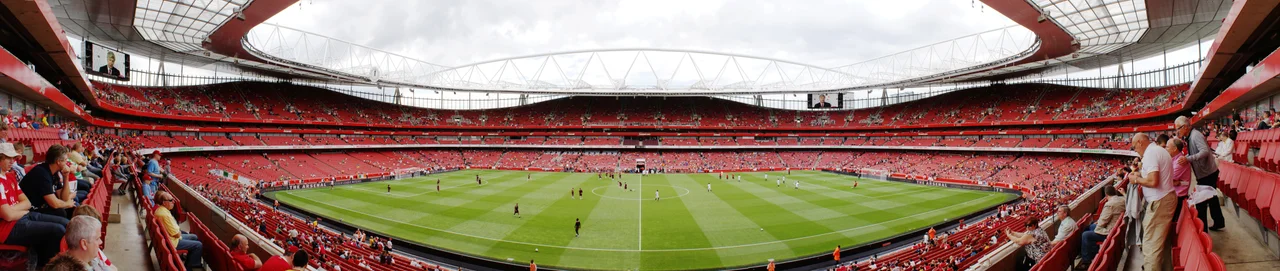

Emirates Stadium
The site in Ashburton Grove was a rubbish processing plant and industrial estate when Arsenal identified it in 1999. It was 450 metres from Highbury — close enough to walk from the old ground to the new one — and 80 percent of it was owned by Islington Council, Railtrack, and Sainsbury's. What it was not, in any meaningful sense, was a place people wanted a football stadium. The local campaign against the scheme was fierce. A poll conducted seven months after the planning application was submitted found that 75 percent of nearby residents opposed it. Arsenal built it anyway, at a cost of £390 million, without a single pound of public subsidy.
The Decision That Changed Everything
Arsenal's home since 1913 had been Highbury, a beautiful stadium with a genuine art deco East Stand granted Grade II listed status in 1997. That listing effectively ended any possibility of meaningful expansion — the historic protection made it impossible to rebuild the stands that would have brought the capacity up to what the club needed. So began a decade of proposals, surveys, legal challenges, and political lobbying. The club bid unsuccessfully to purchase Wembley Stadium in 1998 before settling on Ashburton Grove. Arsène Wenger, the manager who would carry the project's consequences longest, described the decision to build as the biggest in Arsenal's history since the board appointed Herbert Chapman in the 1920s. The stadium was designed by Populous, the architecture firm behind Stadium Australia, and built by Sir Robert McAlpine. It opened in July 2006.
The Price of the Ground
Arsenal received no government support. Wenger was blunt about the contrast: French clubs paid nothing for their stadiums, he said, and Bayern Munich had paid one euro for theirs. Arsenal paid market rate in one of London's most expensive areas. The club serviced the debt by selling players — Nicolas Anelka to Real Madrid, Marc Overmars and Emmanuel Petit to Barcelona — and by needing to qualify for the Champions League every year. Wenger recalled in 2016 that the banks had required him to commit personally to the club as a condition of the loan. 'I did commit and I stayed,' he said, 'and under very difficult circumstances.' He later called the stadium years the toughest of his life. The final Highbury debt was cleared in 2010.
Arsenalisation
From 2009, the club began what it called an 'Arsenalisation' of the stadium — an effort to restore visible links to Arsenal's history in a building that, at first, felt impersonal compared to the marble halls of Highbury. Eight large murals on the exterior depict 32 legends arranged in a huddle around the building. Around the lower concourse, 12 murals show the greatest moments in club history, selected by fan vote. Outside stand statues of Tony Adams, Thierry Henry, Herbert Chapman, and Dennis Bergkamp. The Clock End has its clock. The capacity — 60,704 for football — makes it one of the largest grounds in England. For concerts, the maximum rises to 72,000: Bruce Springsteen and the E Street Band were the first act to play there, in May 2008.
Opening Night and the Royal Visit
The stadium was officially opened by Prince Philip, Duke of Edinburgh, on 26 October 2006. Queen Elizabeth II had suffered a back injury and was unable to attend. Prince Philip quipped to the crowd that while they might not have his wife, they did have 'the second-most experienced plaque unveiler in the world.' In lieu of the royal attendance at the opening, the Queen invited the chairman, manager, and first team to Buckingham Palace for afternoon tea on 15 February 2007 — the first time a football club had been invited to the palace for such an occasion. The highest attendance recorded at Emirates for a football match is 60,383, for a Premier League game against Wolverhampton Wanderers in November 2019.
From the Air
Located at 51.555°N, 0.108°W in Holloway, North London. The stadium is a distinctive oval visible from altitude, roughly 3 miles north of central London. Drayton Park railway station is adjacent. London City Airport (EGLC) is approximately 11 miles southeast.
Nearby Stories
- Stevenage 5.7 km away
- Malling Abbey 5.7 km away
- 1952 Farnborough Airshow Crash 7.7 km away
- Ingatestone Hall 8.2 km away
- Hellfire Caves 9.1 km away
- The Carrington Event: The Solar Storm That Could Happen Again 9.8 km away
- Bletchley Park 16 km away
- Castle Hedingham 23 km away