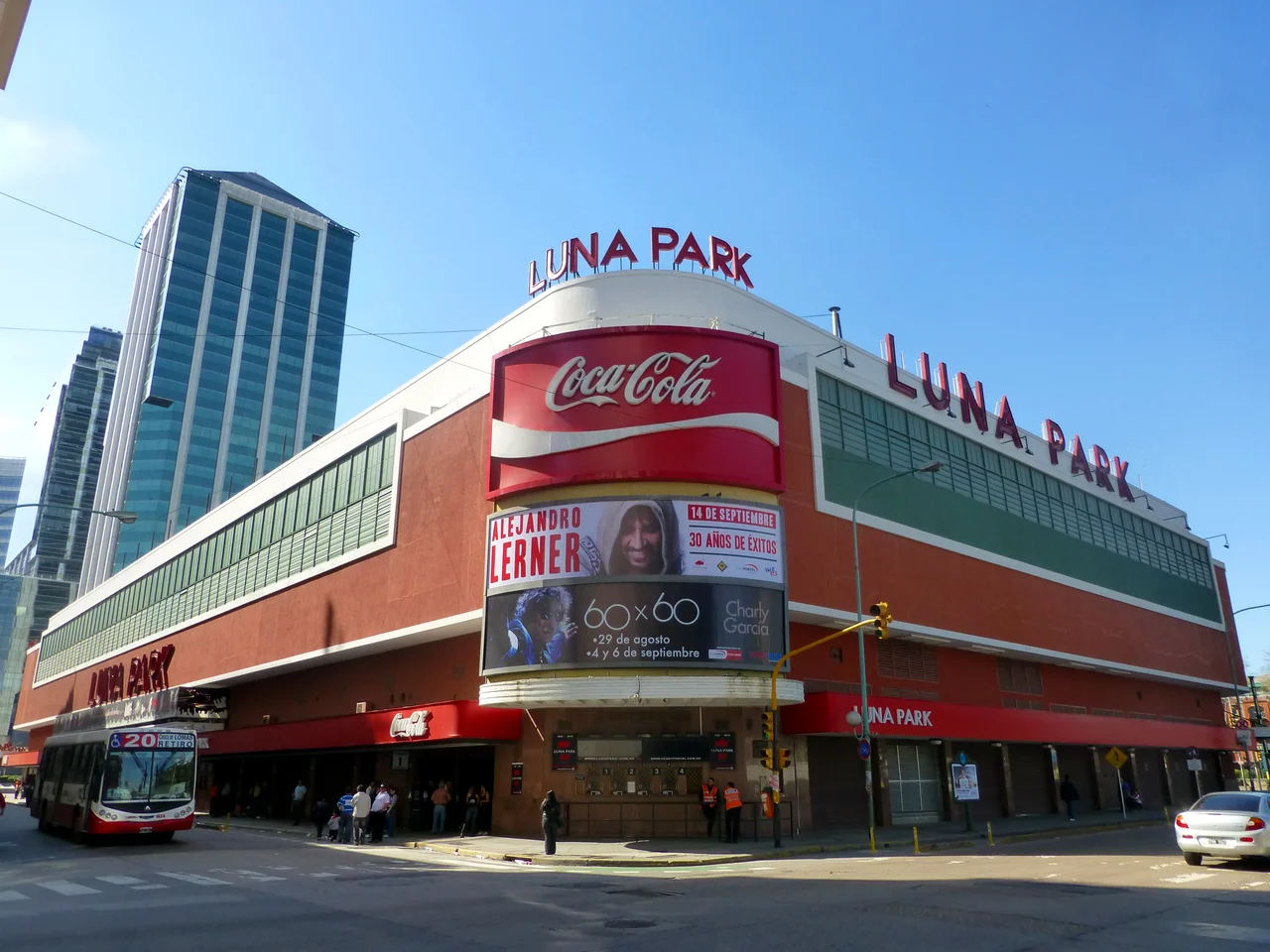

Estadio Luna Park
On a charity night in January 1944, a radio actress named Eva Duarte found herself seated beside an army colonel at a fundraiser for earthquake victims inside a boxing arena on Avenida Corrientes. The colonel was Juan Perón. What began as small talk between strangers in the Luna Park would become one of the most consequential partnerships in Argentine history - and it happened in a building better known for left hooks than love stories. For nearly a century, Luna Park has been the room where Argentina gathered: to fight, to grieve, to dance, and to be changed.
From Amusement Park to Cathedral
The name is older than the arena. In 1910 the Italian merchant Domingo Pace built the original Luna Park, an open-air street fair in the heart of the city that became a playground for Argentina's wealthy through the 1920s before falling into decline; by 1929 its rides stood abandoned. In 1931 Pace's son Ismael and the boxing figure José 'Pepe' Lectoure bought land at the corner of Corrientes and Bouchard with a bigger dream: an arena to rival Madison Square Garden and the Berlin Sportpalast. It opened in February 1932, seating 22,000, and before settling on 'Estadio Luna Park' it briefly wore the name that stuck in spirit anyway - the Catedral del Boxeo, the Cathedral of Boxing. The first fight was held on 5 March 1932, and for years a bout filled the place every Saturday night.
The Cathedral of Boxing
Boxing made Luna Park legendary. Through its ropes passed a roll call of Argentine world champions - Nicolino Locche, the untouchable defensive genius; Carlos Monzón, one of the greatest middleweights who ever lived; Santos Laciar, Hugo Corro, Juan Roldán, Julio César Vásquez, and Omar Narváez among them. The arena became sacred ground for Argentine sport in a broader sense, too: it hosted the 1950 FIBA World Championship in basketball, the final phase of the 1990 world championship, and the Six Days of Buenos Aires cycle races. Pope John Paul II appeared here. The Harlem Globetrotters clowned here. For a country that takes its sporting heroes seriously, this was the room where legends were made and witnessed.
Where the Nation Said Goodbye
Luna Park held Argentina's grief as readily as its glory. When the tango singer Carlos Gardel died in a plane crash in 1935, the nation in mourning brought him here for his wake, and crowds beyond counting came to say farewell to the voice of a generation. The arena later held the funerals of the tango singer Julio Sosa in 1964 and the heavyweight boxer Ringo Bonavena in 1976. Its history is not entirely gentle - during the Second World War the arena was rented out for Nazi and Fascist rallies, a dark chapter in a building that otherwise belonged to sport and song. Decades later, in happier news, Diego Maradona chose Luna Park for his wedding in 1989. Births, deaths, marriages, championships: the life of a country, staged under one roof.
The Sound of a New Argentina
In the 1950s the arena was remodeled in Art Deco style, its capacity reduced, and ownership eventually passed to Pepe Lectoure's nephew, Juan Carlos 'Tito' Lectoure, who steered Luna Park toward music. It became a cornerstone of the Argentine rock scene and a magnet for international acts, and the recordings prove it - Dream Theater captured a live album here in 2012, Tarja Turunen in 2013, and Emir Kusturica's No Smoking Orchestra in 2005. Declared a National Historic Monument in 2007, the arena took an unexpected turn after the death of Tito's aunt in 2013, when her will transferred ownership to the Argentine branches of the Salesians of Don Bosco and Caritas - two Catholic charities that today each hold half of the old Cathedral of Boxing. The fights are rarer now, but the lights still go up, and Corrientes still fills with people coming to see a show.
From the Air
Estadio Luna Park stands at 34.602 degrees south, 58.369 degrees west, at the corner of Avenida Corrientes and Avenida Bouchard in the San Nicolás neighborhood, close to the Río de la Plata waterfront and the redeveloped Puerto Madero docklands. From the air, the wide ribbon of Avenida Corrientes running into the city center and the basins of Puerto Madero just east make easy references. The nearest airport is Aeroparque Jorge Newbery (ICAO: SABE) on the riverfront, only about 3 km north - this is right under the approaches and departures of the city airport. Ministro Pistarini International Airport at Ezeiza (ICAO: SAEZ) lies roughly 23 km to the southwest. Best viewed in clear daytime conditions over the river.
Nearby Stories
- Ezeiza Massacre 1.9 km away
- Luján, Buenos Aires 5.1 km away
- Curutchet House 13 km away
- Colonia del Sacramento 17 km away
- Martín García Island 28 km away
- Atucha Nuclear Power Plant 37 km away
- Lobos 43 km away
- Cry of Asencio 87 km away