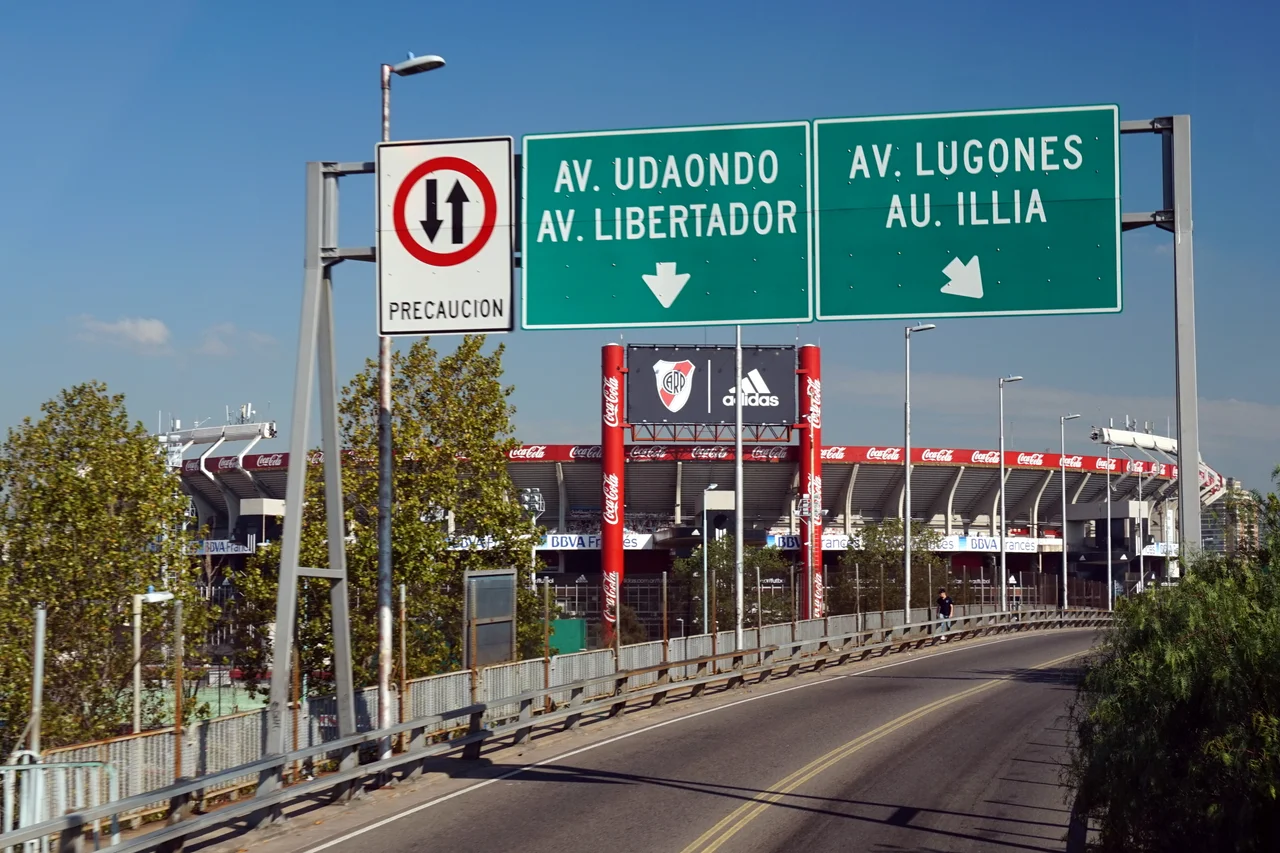

Estadio Monumental
On 25 June 1978, the home crowd buried the pitch in a blizzard of torn paper. Argentina had just beaten the Netherlands 3-1 in extra time to win its first World Cup, and the Estadio Monumental erupted as confetti rained down over the players. It was a moment of pure national joy - and a deeply complicated one, staged inside a stadium part-funded by the military junta then ruling the country, only blocks from places where the regime tortured its own citizens. The Monumental holds both truths at once: the largest stadium in South America, and a witness to the best and worst of modern Argentina.
The House the Millionaires Built
Club Atlético River Plate was founded in 1901, and by the 1930s it had earned a nickname: Los Millonarios, the Millionaires, after paying an eye-watering fee for the forward Carlos Peucelle. On 31 October 1934 the club bought land in the leafy northern neighborhood of Belgrano to build a stadium worthy of the name, and on 26 May 1938 the Estadio Monumental opened. It was christened after a former club president, Antonio Vespucio Liberti. Money, though, dictated its shape: the bank loan ran short, leaving the stands in an open horseshoe rather than a full bowl. The missing side was partially closed only in 1958, financed by the proceeds from selling the great Omar Sívori to Juventus of Italy - a stadium completed, fittingly, by the transfer of a star.
A World Cup Under a Shadow
When Argentina won the right to host the 1978 World Cup, the Monumental was finally remodeled to match its original grand design, with River borrowed money from the military government to do it. The stadium served as the tournament's headquarters, hosting the opening match and, ultimately, the final. The football was historic; the context was grim. Argentina was in the grip of a brutal dictatorship that 'disappeared' thousands of people, and the celebrations on the pitch unfolded a short distance from the regime's machinery of repression. Years later, that history would be confronted on the same ground: in 1998, the band U2 brought the Mothers of the Plaza de Mayo - women whose children had vanished under the dictatorship - onto the stage to perform 'Mothers of the Disappeared.' The stadium that hosted the junta's showcase also gave those mothers a stage.
The Largest in South America
Everything about the Monumental runs to scale. It is the largest stadium in Argentina and in all of South America, and it doubles as the home of the Argentina national team. It hosted the 1951 Pan American Games, four Copa América finals, and countless Copa Libertadores deciders. The numbers around it border on the absurd: the seating in its stands, laid end to end, stretches over 70 kilometers. Crowds have made history here too - around 100,000 packed in when River faced Racing for the title in 1975 after an 18-year drought. After recent renovations the capacity sits near 84,000 to 85,000, and in January 2026 the club announced a major expansion to raise it toward 101,000 and add a roof over the stands, a project estimated to take around three years.
When the World Comes to Buenos Aires
Football may be its soul, but the Monumental is also the room where the planet's biggest musicians come to play, simply because nothing else in Argentina is large enough. Sting was the first artist to sell it out, in 1987. Since then the roll call reads like a history of stadium music: the Rolling Stones, Michael Jackson, Madonna, Paul McCartney, U2, AC/DC, the Police, Soda Stereo. The records keep falling. Madonna once sold more than 263,000 tickets in three hours for a four-night stand. In 2022, Coldplay played ten shows here - the most by any act at the venue - drawing more than 626,000 people and setting a Latin American box-office record. From a World Cup final to a sea of cellphone lights, the Monumental remains the place where Buenos Aires gathers when the moment is too big for anywhere else.
From the Air
The Estadio Monumental stands at 34.545 degrees south, 58.450 degrees west, in the Belgrano district of northern Buenos Aires, right beside the Río de la Plata and the University of Buenos Aires' Ciudad Universitaria campus. From the air it is unmistakable - a vast open bowl on the riverbank, with the brown expanse of the Río de la Plata to the north and east making an obvious reference. The stadium sits almost directly between the city's two airports along the riverfront. The nearest is Aeroparque Jorge Newbery (ICAO: SABE), only about 4 km southeast along the coast - departures and approaches routinely pass near the stadium. Ministro Pistarini International Airport at Ezeiza (ICAO: SAEZ) lies roughly 30 km to the southwest. Best viewed in clear daytime conditions; the riverside setting can bring haze and low visibility in humid weather.
Nearby Stories
- Ezeiza Massacre 1.9 km away
- Luján, Buenos Aires 5.1 km away
- Curutchet House 13 km away
- Colonia del Sacramento 17 km away
- Martín García Island 28 km away
- Atucha Nuclear Power Plant 37 km away
- Lobos 43 km away
- Cry of Asencio 87 km away