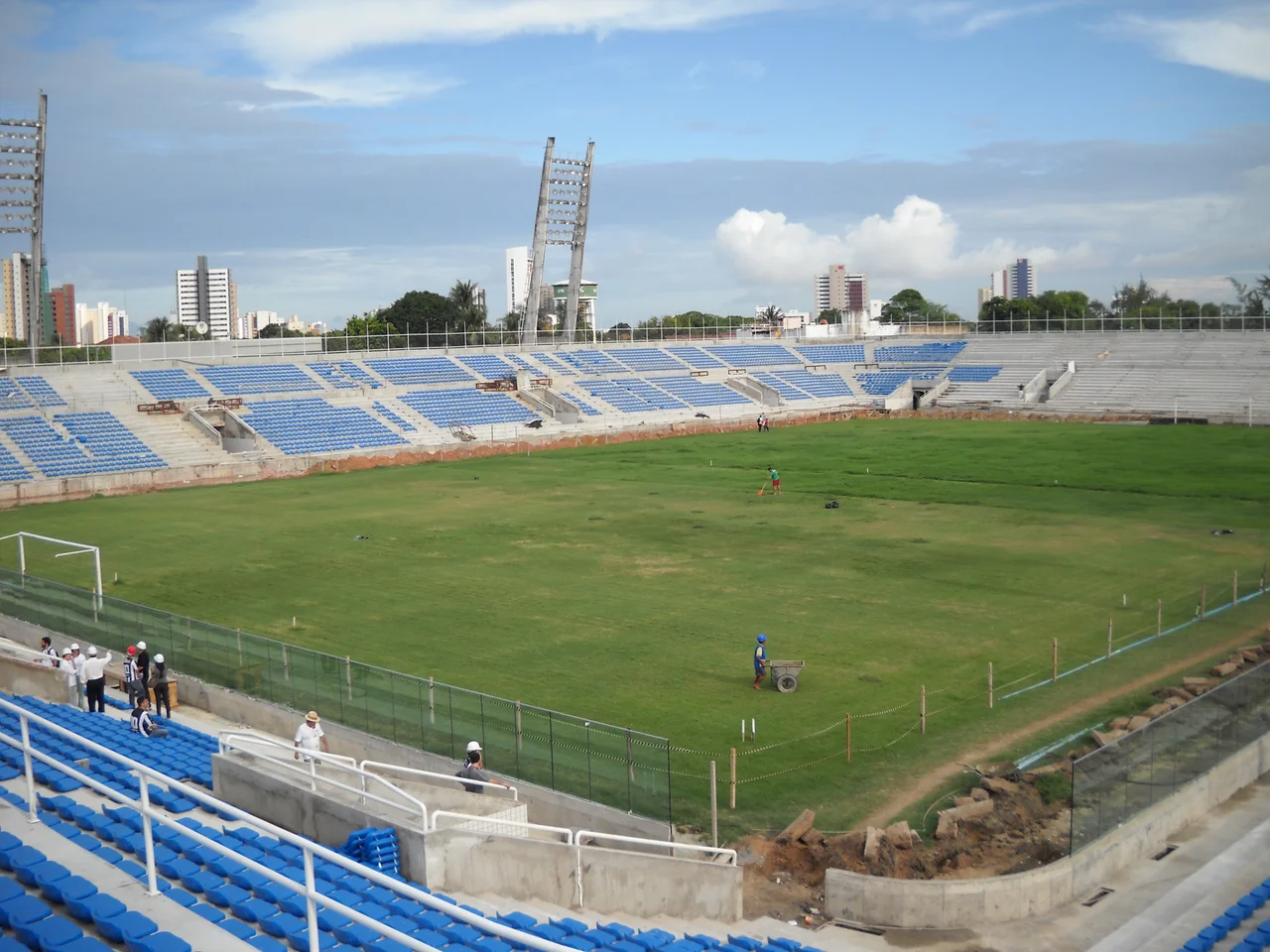

Estádio Presidente Vargas (Ceará)
The first match at Estádio Presidente Vargas was played on September 21, 1941. Ferroviário beat Tramways Sport Club of Pernambuco, 1-0. Up until that moment, every football field in Fortaleza had a clay surface that the groundskeepers moistened with water cans before each match so the dust would not blow into the players' eyes. The PV was the first stadium in the city with actual grass. Walled in. Wooden grandstands. A wooden fence separating fans from the pitch. It was, by the standards of northeastern Brazilian football in 1941, modern - and for the next thirty-two years, it was the biggest stadium in Fortaleza.
Named for the Strongman President
Getúlio Vargas ran Brazil for most of the mid-20th century - as provisional president from 1930, as dictator under the Estado Novo regime from 1937 to 1945, and again as democratically elected president from 1951 until his suicide in 1954. The 1941 naming of the Fortaleza stadium fell in the middle of his Estado Novo dictatorship. Municipal governments across Brazil named buildings, avenues, and public works after Vargas in that period, sometimes by conviction and sometimes by calculation. The Fortaleza City Hall, which owned then and owns now the PV, followed the pattern. Vargas's authoritarian reputation has complicated his legacy. The stadium, though, has long since outgrown its naming. Everyone just calls it the PV.
The Record Attendance
The official attendance record stands at 38,515, set on May 7, 1989, when Ferroviário and Ceará drew 1-1. A disputed record claims 41,099 showed up on a different day in 1971 for a Ceará vs. Corinthians match in the Brazilian Championship, but that figure has never been officially confirmed. Either way, the numbers tell you something about the building: it is small, old, and at its fullest it packed in more bodies than its designed capacity. Renovations have since reduced the official capacity to 20,000 to meet modern safety standards. A 38,000-person crowd in a 20,000-seat building is a fire marshal's nightmare. It was also, by all local accounts, one of the most exciting atmospheres in northeastern Brazilian football.
Renovation and the Orange Chairs
Between February 2008 and April 2011, the PV underwent a major renovation budgeted at R$48 million. The historic facade got preserved. The tunnels, ramps, changing rooms, administration offices, parking lot, and press room were rebuilt. An electronic scoreboard went in. Glass fencing replaced the old wooden barriers. Plumbing and electrical systems were ripped out and replaced. Structural beams were reinforced. New seats went in. That is where a small and entirely Cearense controversy erupted. Eight percent of the initial seats were orange. The other ninety-two percent were blue. Orange and blue together are close enough to the colors of Fortaleza Esporte Clube to enrage fans of Ceará Sporting Club, the city's archrival. To avoid a color war at a neutral venue, the city removed all 522 orange chairs and transferred them to Estadio Antony Costa, which was also under renovation. Blue chairs filled the gaps. Brazilian football rivalries run that close to the skin.
The Cauldron and the Clássicos
From 1941 until 1973, the PV was the biggest stadium in Fortaleza. Then the Castelão opened on the outskirts of the city, and the big matches moved. Castelão's 2013 reopening for the 2014 FIFA World Cup locked in the transition - the Caldeirão, as fans call that bigger stadium, now hosts the top-tier fixtures. The PV, though, still gets the games with the deepest local meaning. The Clássico-Rei pits Ceará against Fortaleza - the two biggest clubs in the state, whose rivalry defines the Ceará football year. The Clássico da Paz matches Ferroviário against Ceará. The Clássico das Cores, or Colors Clásico, puts Fortaleza against Ferroviário. Copa do Brasil matches, Série B and Série C fixtures for the second and third tiers of Brazilian football - all run through the PV. The stadium also occasionally hosts American football matches. It is the kind of old downtown building that every great football city keeps around, even when it is no longer the biggest or the newest - because it is where the history lives, and because some rivalries only feel right in the room where they started.
From the Air
Located at 3.75°S, 38.54°W in central Fortaleza, Ceará, about 3 km southwest of the Dragão do Mar cultural center and 7 km north of Pinto Martins International Airport. Best viewed FL050-FL100 to see the compact downtown stadium amid the city grid, distinctly different from the much larger Arena Castelão (the 2014 World Cup venue) about 6 km further southwest. Nearest airport: Fortaleza Pinto Martins International (SBFZ). Weather: hot tropical climate, rainy season January-May, strong trade winds August-January.
Nearby Stories
- Prainha do Canto Verde Extractive Reserve 28 km away
- Redenção, Ceará 33 km away
- Guajiru 39 km away
- Emboaca 71 km away
- Canoa Quebrada 89 km away
- Ceará 132 km away
- German submarine U-164 (1941) 198 km away
- Nadir Crater 2724 km away