
Canoa Quebrada
The logo came first. A star embraced by a crescent moon, carved into one of the red cliffs above the beach sometime in the 1970s by French travelers who thought they had found paradise. Since then the crescent-and-star has become the signature of Canoa Quebrada - printed on T-shirts, painted on pousada walls, stamped on sandals that sell for R$15 at stalls along Broadway. The name of the village, which means broken canoe, supposedly comes from a wrecked boat found on the beach long ago. But the logo is what people remember. It marks the hippie chapter that Canoa Quebrada spent decades living inside, and is still not quite done with.
A Village on a Cliff
Canoa Quebrada sits 160 kilometers southeast of Fortaleza, in the municipality of Aracati. The setting is dramatic: the village is installed directly on a long ridge of red sandstone cliff that drops straight to the Atlantic. From the top you look down at waves breaking on a sand beach that stretches out of sight in both directions. The cliffs are the same Barreiras formation that colors Morro Branco further down the coast, oxidized iron giving the sandstone its deep rust tone. Climbing up the back of the dunes at sunset, when the light turns the whole ridge copper, tells you everything you need to know about why the French travelers decided to stay.
The Hippie Era and Its Afterlife
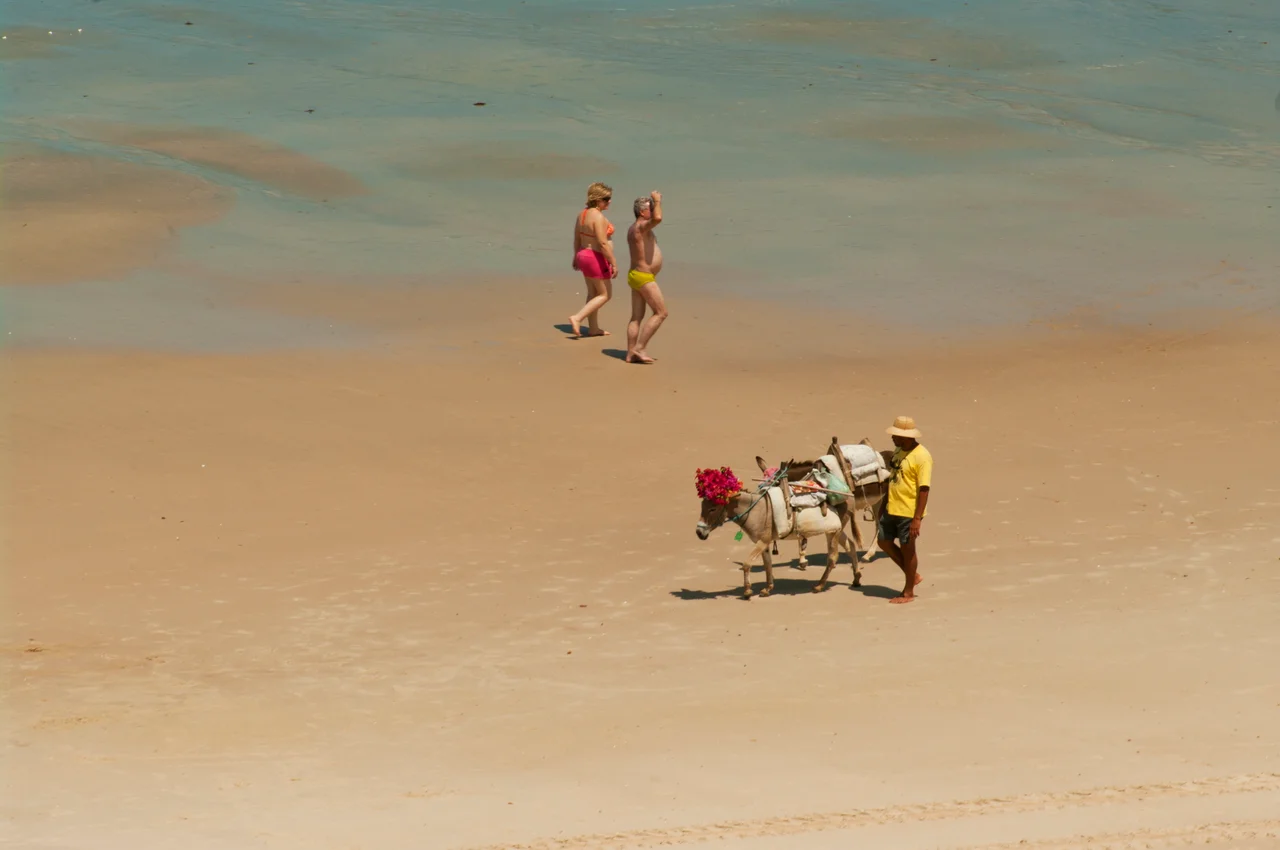
For roughly twenty years - the 1970s and 1980s - Canoa Quebrada was, by Brazilian standards, remote. A handful of foreigners and a smaller handful of Brazilians had discovered it. There were no roads to speak of, no electricity for most of its history, and no hotels. People arrived by horseback from Aracati. The main street, which now carries the hopeful nickname Broadway, was a dirt track lined with a few simple bars. The jangada fishermen launched their sailed rafts at dawn and brought back fish that the village ate for dinner. It was, for a while, the kind of place people imagine before they look up the word paradise. Then paved roads arrived. Then tour buses. Today pousadas fill the old dirt tracks, Friday night on Broadway fills with crowds pouring in from Aracati and beyond, and the village is still, somehow, trying to hold onto its earlier self. The jangada fishermen still put out. The hippies, some of them, are now grandparents who own the pousadas.
Things That Still Happen Here
The beach buggy has replaced the horse. Tours run up and down the coast for R$200 for a standard 2.5-hour ride, sand flying, engines whining, passengers grinning. Paragliding operators launch tandem flights from the clifftop for about R$50 per jumper - fifteen to twenty minutes riding the sea breeze over the beach. Kitesurfing schools have opened to exploit the same steady trade winds that made this coast a destination in the first place. The jangadas still take tourists out for short sails at R$10 per person. At sunset, when the sun moves west behind the village and the beach falls into shadow, the traditional move is to walk up the back of the highest dune to watch the last light turn the cliffs incandescent. Nobody has ever tried to charge for that.
Broadway and the Economics of Paradise
The commercial strip is compact - a single street and a few side alleys. The beach shacks selling lunch undercut the village restaurants on price but not on quality. A menu staple is Baião de Dois, the cearense rice-and-beans dish cut with melted cheese instead of gravy. Many restaurants add a 10 percent service charge that, locals will tell you, rarely reaches the servers. A few reais handed directly to a waiter at the end of the meal makes the difference. The waiters work on minimum wage, often without formal contracts. The ghost of the 1970s hippie economy, when nothing was priced and everything was shared, still haunts the relationships between visitors, residents, and the low-wage labor that keeps the village running. It is a quiet tension - not unique to Canoa Quebrada, but sharply visible here.
The Dune Sunset
At the end of the day the ritual is simple. You walk up the back of the sand dunes behind the village, pick a ridge, and sit. The Atlantic stretches to the east, the red cliffs drop to the beach below, and the sun sets somewhere behind your shoulder over the interior of Ceará. The beach empties. The palm trees darken into silhouettes. The star-and-crescent logo on the cliff face across the village holds the last light, then loses it. Below, Broadway is starting to stir for the evening. From up on the dune you cannot hear any of it. You can hear the wind, and the waves, and a stray dog barking somewhere a long way off. Canoa Quebrada, for about fifteen minutes each evening, returns to what it used to be.
From the Air
Canoa Quebrada sits at 4.53°S, 37.69°W on the Atlantic coast of Ceará, 160 km southeast of Fortaleza in the municipality of Aracati. The nearest airport is Jorge Amado / Dragão do Mar Regional Airport (SBAC) in Aracati, with Pinto Martins International Airport (SBFZ) in Fortaleza as the nearest major hub. The distinctive red sandstone cliff, roughly 30 meters tall and running along the village, is clearly visible from low-altitude approaches along the coast. Reliable southeast trade winds make this one of Brazil's premier kitesurfing destinations from July through December.
Nearby Stories
- Beberibe Cliffs Natural Monument 36 km away
- Beach Park 42 km away
- Furna Feia National Park 47 km away
- Redenção, Ceará 54 km away
- Quixadá Monoliths Natural Monument 79 km away
- Açu National Forest 99 km away
- Açu, Rio Grande do Norte 128 km away
- Atol das Rocas Biological Reserve 385 km away