
Quixadá Monoliths Natural Monument
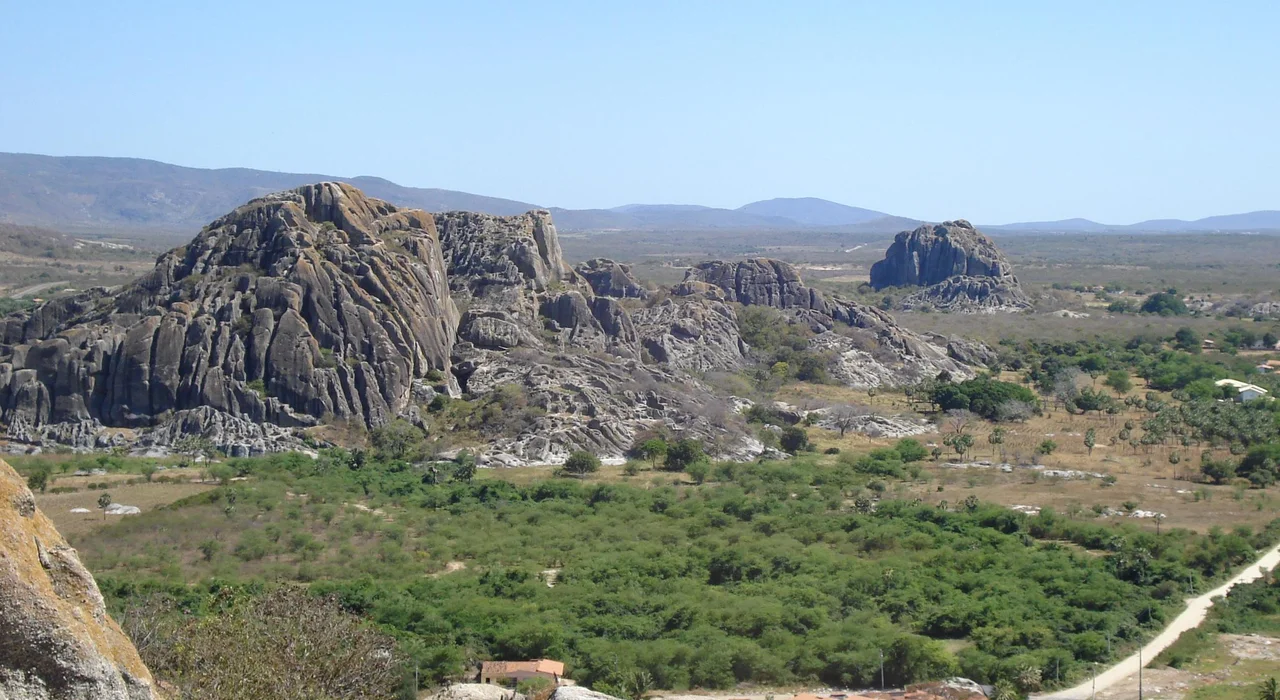
The land around them wore away first. What's left standing - bald granite domes rising 300 meters above flat scrub - are inselbergs, literally "island mountains," the harder cores of formations whose softer rock eroded over tens of millions of years. The most famous wears the profile of a hen sitting on her eggs, which is why locals call it Pedra da Galinha Choca, the Brooding Hen Rock. Sixteen thousand hectares of these towers and their dry Caatinga scrubland were designated a state natural monument in October 2002.
Residuals of a Vanished Landscape
The Sertão is the dry heart of Brazil's Northeast - a semi-arid plateau where the Caatinga biome holds on against ferocious drought and brief, violent rain. Through this landscape the inselbergs of Quixadá rise like leftover evidence. They are the same kind of formation that produces Stone Mountain in Georgia or Uluru in Australia: harder igneous rock that resisted while the surrounding substrate weathered away. At Quixadá the effect is concentrated. Dozens of domes rise across a landscape that is otherwise nearly flat, each one a geological survivor.
Ancient Hands
Cave paintings and other archaeological remains date human presence in these inselbergs to prehistoric times. The National Institute of Historic and Artistic Heritage (IPHAN) holds overlapping responsibility for the monument because of these sites, which remain little-explored. The paintings link the monoliths to the human story of the sertão - a region whose indigenous Kanindé and Jenipapo peoples lived here until conflicts with Portuguese settlers in the 18th century led to their destruction. The rocks outlasted both the peoples who painted them and the ones who displaced them.
Cedar Dam at the Foot of the Hen
At the base of Pedra da Galinha Choca sits one of the oldest large dams in Brazil: the Barragem do Cedro, the Cedar Dam, built between 1890 and 1906 of stone masonry, cement, and steel. The dam was a response to the devastating droughts of the late 19th century that drove whole populations off the land. On 30 January 2015 it was placed on Brazil's tentative list of UNESCO World Heritage nominations. The dam's silhouette, set against the 300-meter silhouette of the Brooding Hen, is a defining image of Ceará - industrial engineering and deep geological time framed in a single view.
What Protection Forbids
The natural monument is a fully protected conservation unit under IUCN category III. The rules are explicit: no one may remove, dismantle, or deface the rock formations or install equipment on them. Civil works, earthworks, and new roads are prohibited where they would cause substantial ecological change. The state environmental agency Semace manages the unit. The pressures are real - deforestation, burning, and illegal mining for construction stone all threaten the surrounding Caatinga. But the inselbergs themselves, too massive to quarry easily and too dramatic to lose, are probably safe. They have outlasted mountains. They will outlast us.
From the Air
Coordinates 4.96°S, 39.00°W. The monument covers 16,635 hectares in the central Sertão of Ceará, about 170 km southwest of Fortaleza. The inselbergs are distinctive from altitude - bare granite domes rising from otherwise flat Caatinga scrubland, often casting long shadows in low sun. Quixadá Airport (ICAO SNQX) is a regional facility; the nearest major airport is Fortaleza (ICAO SBFZ). The area is famous among paragliders and hang gliders, with record-attempt conditions drawing pilots every November. Visibility is generally excellent in the dry season (June through December); rainy summer months can reduce clarity.
Nearby Stories
- Castanhão Dam 51 km away
- Redenção, Ceará 59 km away
- Prainha do Canto Verde Extractive Reserve 64 km away
- Canoa Quebrada 88 km away
- Crateús 146 km away
- Açu National Forest 156 km away
- Ubajara National Park 201 km away
- Mirador State Park 660 km away