
Ceará
Ceará is where Brazil's trade winds land, and where its contradictions are served for lunch. The state holds nearly 9 million people, a third of them in the capital, Fortaleza. It runs along 573 kilometers of Atlantic coastline - broad beaches, red cliffs, white dunes - and then backs inland into the sertão, the dry interior that generations of Brazilian literature have described as the country's harshest country. You eat rice-and-beans here differently than in São Paulo. You drink coconut water for pocket change. You drive over beach sand in a buggy with a guide who grew up fishing the same coast. Twenty years ago, Ceará was among the poorest states in the country. Now it is a tourist economy with a kitesurfing reputation that reaches to Europe. The older Ceará has not gone anywhere. Both live here, side by side.
Trade Winds and Kitesurfers
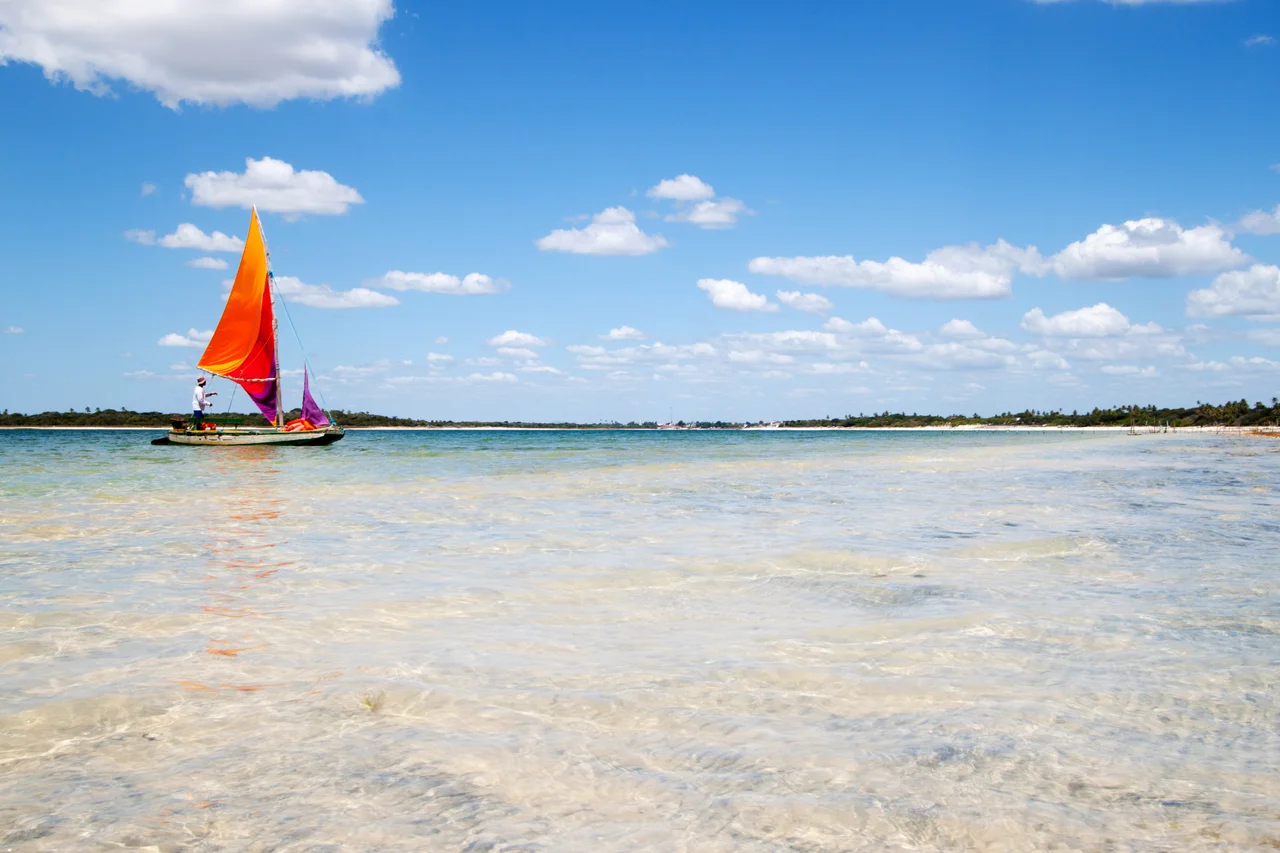
The steadiest trade winds in Brazil blow across Ceará between mid-July and mid-January, and the kitesurfing community has noticed. Prea Beach near Jericoacoara is regularly rated among the best kitesurfing locations on Earth, a 12-kilometer stretch of shallow flat water fronted by reliable side-onshore wind and backed by the otherworldly white dunes of the Jericoacoara National Park. Cumbuco and Flecheiras, closer to Fortaleza, draw huge crowds in the high season. The pousadas run by former European kitesurfers - Argentinians, Italians, Germans, Dutch - now dot the coast. The economy of entire fishing villages has been rebuilt around the sport. It is not unusual to see a traditional jangada fisherman hauling nets at dawn and a kitesurfer launching over the same waves by midmorning.
The Coast in Chapters
A classic itinerary in Ceará is the beach-buggy drive from Fortaleza to Natal, the capital of neighboring Rio Grande do Norte - four days of four-wheel-drive travel along the coast, stopping in Canoa Quebrada and several other small villages. Canoa, on its red sandstone cliffs 160 km southeast of the capital, was a 1970s hippie paradise that turned into a nightlife destination and remains both at once. Morro Branco and Fontes, in the municipality of Beberibe, draw visitors for their multicolored sandstone cliffs and for the artisans who still fill small glass bottles with naturally colored sand. Camocim, almost on the border of Piauí, is often described as the quintessential Brazilian fishing village, though less developed than what most tourists find. Guaramiranga, up in the cool hills inland, is the rare Ceará destination that has nothing to do with beaches.
The Cearense Table
Cearenses eat differently from other Brazilians, even by the flexible standards of Brazilian regionalism. The standard national lunch of rice and beans turns, here, into Baião de Dois - the same rice and beans but with the gravy replaced by melted cheese. Inland, you will find panelada, a stew made largely of tripe, that belongs to a much older tradition of not wasting a cow. On the coast, crab is the state's obsession. It arrives whole, with a tray and a wooden hammer, and is less a meal than a performance: you break the shell, extract the meat, and spend an afternoon doing so. Feijão verde is another local specialty - white beans in a creamy sauce of cheese and cream, sometimes with whatever else the cook decided to use. Peixe a Delicia pairs fish with fried bananas and a creamy cheese sauce. None of this is subtle. None of it was invented to please outsiders. All of it is served with a loose approach to timing that fits the coast.
Coconuts and Cold Water
The coconut is Ceará's unofficial mascot. Coconuts grow along most of the Brazilian coast, but in Ceará they grow in such quantity - and sell so cheaply - that the green coconut on ice with a straw has become shorthand for the state itself. At beachside kiosks along the Fortaleza coast or at rural stops in the interior, coconuts chilled and ready to drink sometimes sell for as little as 50 centavos, barely more than a token. The trade is old enough to have shaped a regional economy. After you drink the water, a vendor will often split the coconut with a machete so you can scoop out the tender flesh with a spoon. Two things in one object, served cold, on a beach that runs out of sight.
The Inland Ceará
Most tourists never leave the coast. Those who do find a different state entirely. Juazeiro do Norte in the south is the terminus of the state's only meaningful internal flight from Fortaleza and the center of a religious pilgrimage tradition built around the 19th-century priest Padre Cícero, whose statue towers over the city and whose cult draws millions of pilgrims annually. Sobral in the north is a center of agriculture and a regional hub in its own right. In between lies the sertão - the dry backcountry where the caatinga dominates, where the seasonal rivers run or don't, where centuries of drought and migration have shaped a culture that the coastal cities sometimes forget they share. The Castanhão Dam, Brazil's largest public reservoir, sits out here holding 6.7 billion cubic meters of the Jaguaribe River's water against the next dry spell. Every place worth knowing in Ceará is a compromise between too much sea and too little rain.
From the Air
Ceará is centered near 5.20°S, 39.30°W in Northeast Brazil, with its coastline running east-to-west along the Atlantic. The primary airport is Pinto Martins International Airport (SBFZ) in Fortaleza, with regional service to Jericoacoara Airport (SBJE) and Juazeiro do Norte Airport (SBJU). The state's defining features visible from altitude include the continuous Atlantic coastline of white and red sand beaches punctuated by sandstone cliffs, the vast Jericoacoara dune field in the northwest, and the broad basin of the Jaguaribe River in the interior. Reliable southeast trade winds from mid-July through mid-January make the coast a global kitesurfing destination.
Nearby Stories
- Castanhão Dam 26 km away
- Castanhão Ecological Station 51 km away
- Redenção, Ceará 93 km away
- Beberibe 102 km away
- Crateús 105 km away
- Ubajara National Park 183 km away
- Açu National Forest 250 km away
- Mirador State Park 618 km away