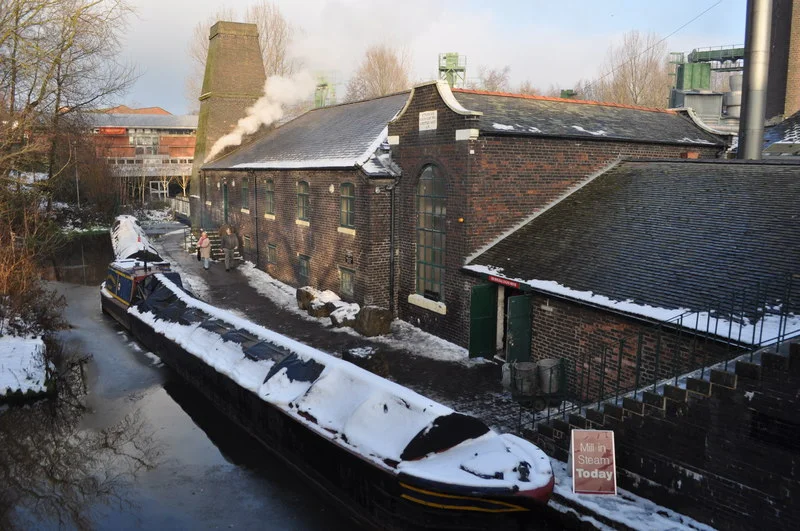

Etruria Industrial Museum
The steeplejack and television presenter Fred Dibnah opened the museum in 1991, and that fact alone tells you something about the place. Dibnah's life was the British industrial revolution in late retreat: chimneys, boilers, beam engines, all the great rumbling machinery he loved. When he stepped into the restored Jesse Shirley's bone and flint mill at Etruria that summer, he was opening a building that had ground the raw materials of Staffordshire pottery for more than a century and that still held, almost intact, the engine that had powered it. Princess, an 1820s beam engine, had been second-hand when the mill bought her in 1857. She is older than the building she lives in. She still turns.
Where the Canals Met
The mill sits in a corner of Stoke-on-Trent that the Industrial Revolution happened to and then abandoned. On one side runs the Trent and Mersey Canal, finished in 1777 to move pottery and raw materials between the Potteries and the great seaports. On the other side runs the Caldon Canal, whose Etruria staircase locks lift narrowboats up into the moorlands toward Leek. The waters meet here in a way that defines the geography of the whole pottery district. Bone and flint mills clustered at canalside because their raw materials were heavy and their finished products (powdered flint and calcined bone) were sold by weight to the potteries upstream. Built in 1857 by Jesse Shirley, this was the kind of small specialised mill that fed dozens of larger names: Wedgwood, Spode, Doulton.
How a Bone and Flint Mill Worked
Cattle bones, calcined to drive off the organic matter, became a fine white ash that was mixed with china clay to produce bone china (the translucent porcelain that defined nineteenth-century English ceramics). Flint, calcined and then ground wet under heavy iron-shod runners called edge-runners, produced the silica content that gave earthenware its hardness. Both processes were brutal on workers' lungs and demanded enormous mechanical force. The Princess engine, an 1820s beam-and-flywheel design, drove the millstones through a system of shafts and belts that connected every grinding pan in the building. A boiler at the back of the works provided steam for the engine and heat for drying the slip. When the Shirley family finally stopped milling in 1972, it ended a single family business that had run on the same site for more than a hundred years.
Volunteers and Restoration
The site was given heritage protection in the 1970s, initially as an ancient monument and now as a Grade II* listed building and scheduled monument. Restoration began in 1978, slowly and underfunded, until the work reached enough of a milestone for Fred Dibnah to open the museum in 1991. Much of the wider landscape around the mill was tidied in the mid-1980s as part of preparations for the 1986 Stoke-on-Trent Garden Festival, the second of the great UK garden festivals that reclaimed derelict industrial sites. Today the museum is run by volunteers through Shirley's Bone and Flint Mill Volunteer group, which in September 2015 actually bought the mill outright from the property company St Modwen, leasing it back to Stoke-on-Trent City Council to keep it as the heart of the Etruria Industrial Museum. Volunteers do everything. They steam the boiler, run the engine on open days, and explain to visitors how clay becomes porcelain becomes the cup on a Sunday breakfast tray.
The Canal Festival
Around the mill, the Etruria area has gentrified slowly. The Trent and Mersey Canal's course through the city is a linear conservation area, and the cluster of historic sites around Shirley's mill includes the staircase locks of the Caldon Canal, a circle of trees marking where the British Gas Light Company's gas-holder once stood (the first that lit and heated the city), and the site of the Old Dispensary and House of Recovery, Stoke-on-Trent's first hospital. Weight restrictions on the canal bridges keep traffic out, which has turned the area into a strangely peaceful park around the mill. The Etruria Canals Festival, generally held on the first weekend of June, fills the towpath with narrowboats and stalls and the working forge next to the museum's modern entrance throws sparks for the children. A century and a half after the last cattle bone was ground here, this remains a place where machinery is something you can hear and smell, not just read about.
From the Air
53.02 N, 2.19 W, at the foot of the Etruria staircase locks where the Caldon Canal meets the Trent and Mersey in Stoke-on-Trent. From 1,500 to 2,500 feet AGL the area is recognizable by the dark linear cluster of the mill alongside both canals, with the staircase steps visible just to the east. Nearby airports: EGNX East Midlands to the south-east, EGCC Manchester to the north, EGNR Hawarden to the west.
Nearby Stories
- National Memorial Arboretum 2.2 km away
- Stanlow Abbey 4.5 km away
- Alderley Edge 5.6 km away
- Lilleshall Abbey 7.2 km away
- Hope Cement Works 8.4 km away
- 2025 Wrexham National Eisteddfod 9.1 km away
- Tutbury Castle 16 km away
- Powis Castle 25 km away