
Etruria Works
Josiah Wedgwood named his new factory after a country he had never seen and a civilization that turned out not to have made the things he loved. The painted vases that Sir William Hamilton had begun shipping back from Naples in the 1760s were sold across Europe as Etruscan, and Wedgwood, lame from childhood smallpox and ferociously ambitious, looked at the engravings of them and saw the future of British ceramics. He paid three thousand pounds in 1767 for a site on the planned route of the Trent and Mersey Canal, hired the Derby architect Joseph Pickford, and opened his works in 1769 under a Latin motto that he meant absolutely: Artes Etruriae Renascuntur. The Arts of Etruria are reborn. That the vases were actually Greek, not Etruscan, would not be settled until decades later. The motto, and the name, had already stuck.
The Canal, the Hall, the Factory
The Trent and Mersey was Wedgwood's idea as much as anyone's. He had pushed for the canal in the 1760s, knowing that pottery was heavy and that road transport across the Midlands shattered as much as it carried. The new site at Ridgehouse Estate sat directly on the canal's route. Wedgwood built his house, Etruria Hall, on one bank, and the factory directly across the water on the other. Pickford's design for the works was unusually systematic for its time: long parallel ranges of brick buildings with separate sections for each stage of production. Wedgwood ran the factory by division of labour, breaking each pot's making into specialised hands. Workers were timed and supervised. Quality was uniform. It was the first time anyone had built a pottery factory as something resembling a modern industrial plant, and the way Wedgwood organised his workforce later became the subject of a famous 1961 study by the economic historian Neil McKendrick.
The Vases That Were Not Etruscan
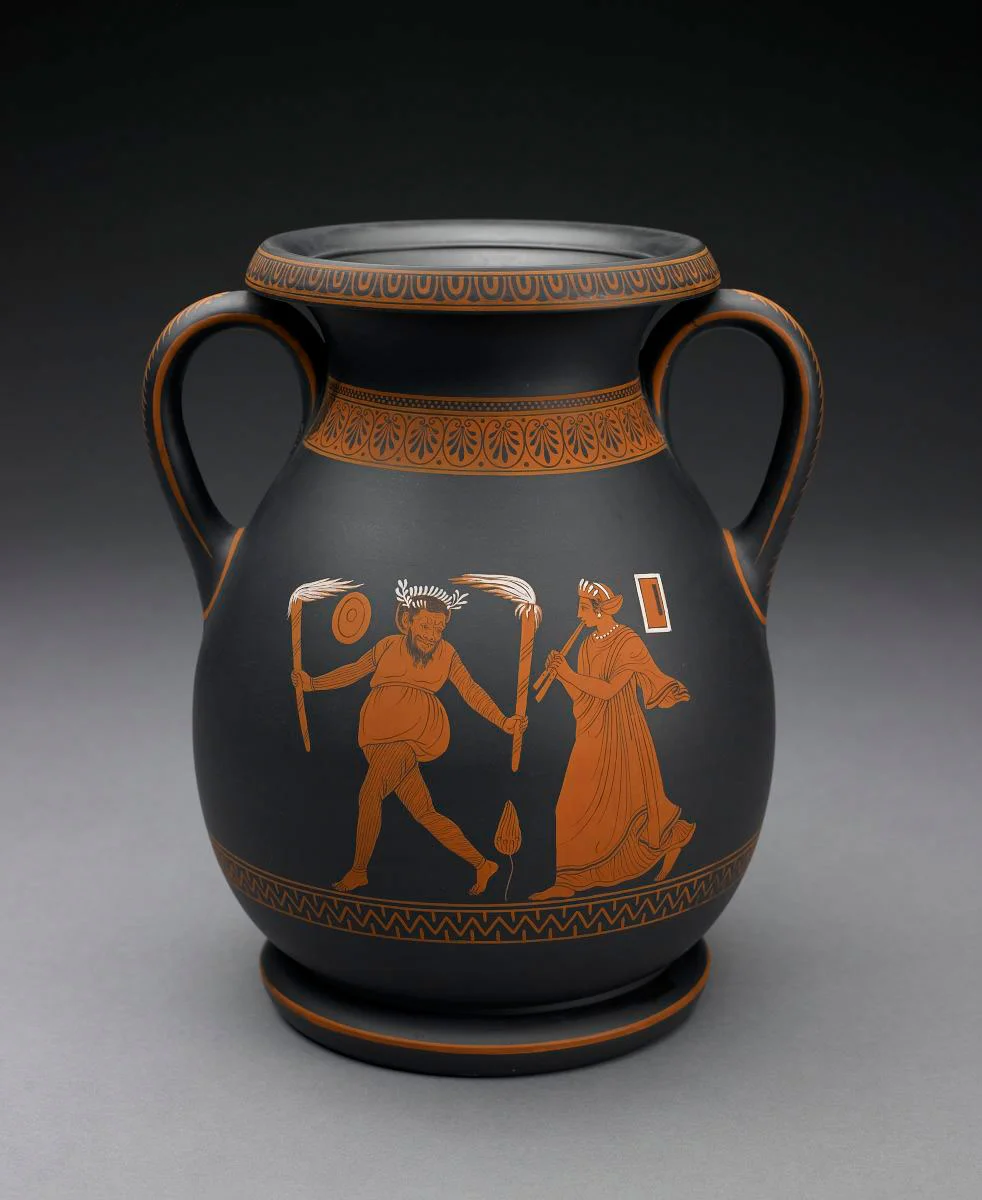
When Hamilton's collection was published, the term Etruscan covered most painted pottery from ancient Italy. Wedgwood absorbed every plate. He was drawn especially to the red-on-black figure painting and to the matte black stoneware of what we now recognise as Greek vases. His most authentically Etruscan-inspired body, the Black Basaltes that came on the market in 1768, did imitate the genuinely Etruscan bucchero pottery: black, burnished, unglazed, fired in a reducing atmosphere where closed vents starved the flames of oxygen and drew the colour deep into the clay. The colour was darkened further by adding manganese. Out of this body Wedgwood and his designer John Flaxman produced vases, plaques, and busts that found buyers from London to Saint Petersburg. Catherine the Great commissioned a vast Wedgwood dinner service. Some of Flaxman's designs are still in production.
Jasperware and the Eighteenth-Century Showroom
It is Jasperware, more than anything else, that the Etruria Works is remembered for: the matte-finished pale blue (or sage green, or lilac) stoneware decorated with white classical reliefs in low relief, instantly recognisable as Wedgwood from the moment a tourist sees the first cameo brooch. Jasperware was Wedgwood's most original contribution to ceramic chemistry. He spent years perfecting the body, experimenting with thousands of small trials, finally arriving at a stoneware that could be coloured throughout rather than just on the surface and that took crisp, almost paper-thin applied decoration. The Victoria and Albert Museum holds a Jasperware vase and cover made at Etruria around 1790 (V&A no. 2416-1901) that shows what the works could produce at its peak. Wedgwood was selling neoclassicism to a Europe newly obsessed with the antique.
Subsidence and Departure
The works ran for 180 years, but the ground underneath them turned out to be a problem. Stoke-on-Trent sits on coal seams that were heavily mined through the nineteenth and early twentieth centuries, and by the 1930s the Etruria site was suffering visible mining subsidence. J.B. Priestley, passing through on the journey that became English Journey (1934), wrote a description of Etruria already going quiet. The company built a new factory at Barlaston, some miles south on the same canal, between 1938 and 1940, and moved production there. Most of the old Etruria Works was demolished through the rest of the twentieth century. One structure survives as a listed building. From 1986 to 2013 the local newspaper The Sentinel was based on part of the cleared site, printing not just its own pages but the northern editions of the Daily Mail and Mail on Sunday. The factory that gave its name to a whole district of Stoke is gone. The district kept the name.
From the Air
53.02 N, 2.20 W, in the Etruria district of Stoke-on-Trent on the Trent and Mersey Canal. From 1,500 to 2,500 feet AGL the original factory footprint is largely gone, but the canal alignment and the cluster of red-brick industrial buildings that remain mark the area; the Etruria Industrial Museum is immediately adjacent. Look for the staircase locks where the Caldon Canal branches east. Nearby airports: EGNX East Midlands to the south-east, EGCC Manchester to the north, EGNR Hawarden to the west.
Nearby Stories
- National Memorial Arboretum 2.2 km away
- Stanlow Abbey 4.5 km away
- Alderley Edge 5.6 km away
- Lilleshall Abbey 7.2 km away
- Hope Cement Works 8.4 km away
- 2025 Wrexham National Eisteddfod 9.1 km away
- Tutbury Castle 16 km away
- Powis Castle 25 km away