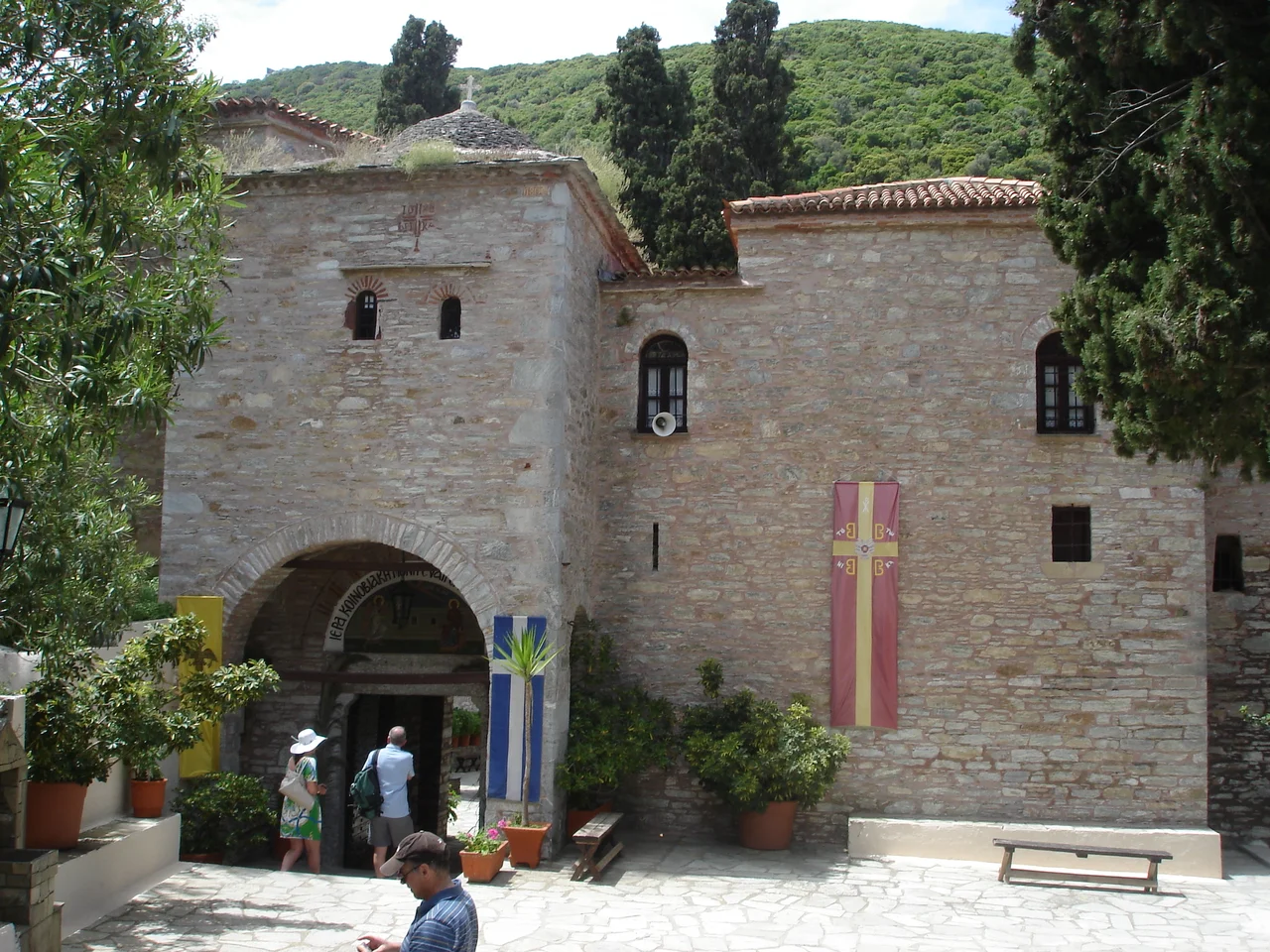

Evangelistria Monastery, Skiathos
On a loom inside this monastery, a length of cloth took shape that would one day fly over a free Greece. The year was 1807, and the men gathered on the hillside above Skiathos town had not yet won a war or a country. They had a white cross, a sky-blue ground, and an oath. Four kilometers north of the harbor, screened by pine and silence, the Monastery of the Annunciation - Evangelistria - was the kind of out-of-the-way place where rebels could plan a revolution without the Ottoman authorities looking over their shoulders.
The Monks Who Walked Away
Evangelistria began with a quarrel about how to worship. In 1794, a group of Kollyvades monks left the great monastic republic of Mount Athos after disagreements over Christian ritual - chiefly the proper day for memorial services. Rather than yield, they came to Skiathos. Their leader was Niphon of Chios, an ordained monk, and among them was Gregorios Hatzistamatis, a local who had inherited land on the island from his father. On that inherited ground they built their refuge and dedicated it to the Annunciation of the Virgin Mary, the moment in Christian belief when Mary learns she will bear Christ. The Annunciation falls on 25 March - a date that would later carry a second meaning for every Greek, as the day the War of Independence is said to have begun.
A Flag Before a Nation
Thirteen years after its founding, the monastery became a forge for something larger than itself. In 1807, Greek freedom fighters met here and swore the Oath of Freedom on a newly designed flag - a white cross on a sky-blue field, woven on a loom at the site. Among the men who bound themselves to it were Theodoros Kolokotronis, who would become the war's most celebrated general, and the naval commander Andreas Vokos Miaoulis, alongside Thymios Vlachavas, Nikotsaras, and others. The flag was designed, woven, blessed, and raised here, years before the revolution it promised. The cross-and-blue design is the ancestor of the flag Greece flies today, and the original loom still stands in the monastery museum - an ordinary wooden frame that helped weave a national symbol.
Inside the Walls
At the center of the complex stands the Catholicon, a Byzantine-style cross-in-square church with three aisles and three domes. Its iconostasis - the carved wooden screen separating nave from sanctuary - bears icons painted in the 17th and 18th centuries, their gold grounds darkened by candle smoke and time. The museum holds priests' vestments, manuscripts and rare books from the 1600s, gospels from the 1700s, silver and wooden crosses, and Byzantine icons, along with a photographic record of the War of Independence that raged from 1821 to 1829. Some buildings here fell to ruin over the centuries, but the church and the living quarters have been restored, and the place breathes again.
Wine, Quiet, and the Living Monastery
Faith on Skiathos keeps a slower rhythm than the beaches below. The monks tend vineyards that produce Alypiakos, a red Muscat named for Father Alypos, the monastery's fourth abbot - a grape the island has cultivated since the 5th century BC, used now on religious occasions. Today only four monks live here, with three others associated from elsewhere; the community is small, but the calendar still turns. Each 25 March the ceremony of the Annunciation fills the church. You reach Evangelistria on foot up a steep paved road from town, or by the minibus that climbs from the Skiathos bus terminus, and entry is usually free - an open door at the place where a flag became a country.
From the Air
Evangelistria Monastery sits at 39.190 degrees N, 23.480 degrees E, roughly 4 km north of Skiathos town on a pine-clad hillside. The nearest airport is Skiathos 'Alexandros Papadiamantis' National (ICAO LGSK), about 6 km northeast near the island's eastern tip. From a light aircraft at 2,000-3,000 ft, look for the monastery's pale walls and red-tiled domes nestled in dark green pine, inland from the developed southern coast. The neighboring island of Skopelos lies to the east; Euboea and Skyros appear in clear conditions. Summer brings strong, gusty meltemi winds funneling through the Sporades.
Nearby Stories
- Battle of Halmyros 5.4 km away
- Monastery of Saint David the Elder 8.4 km away
- Alonnisos 11 km away
- Opuntian Locris 14 km away
- Kymi, Greece 29 km away
- Tempi Train Crash 60 km away
- Battle of Potidaea 92 km away
- Battle of Athos 117 km away