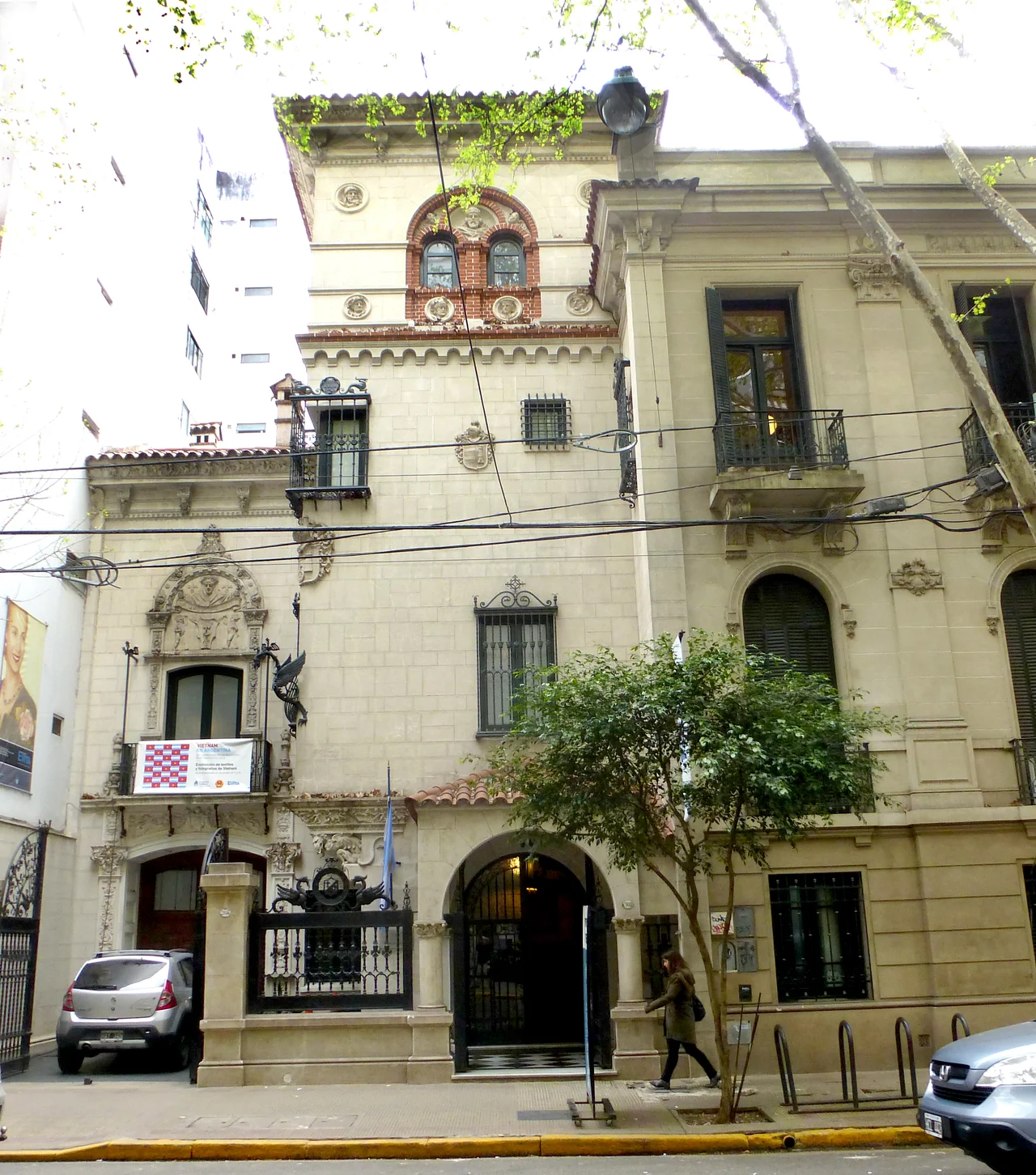

Evita Museum
In one glass case rests a small national identity document, the kind every Argentine carries. This one belonged to Eva Peron, and it was the first ever issued to a woman in Argentina. She used it to cast a vote in the country's 1951 elections, the first in which Argentine women could vote at all, and she did it from a hospital bed, already gravely ill with the cancer that would kill her the following July. The card sits in a building that tells her whole story, a Spanish Colonial mansion in the Palermo neighborhood that she once turned into a shelter for the poor. To walk through it is to follow one woman from a small farming town to the center of a nation's heart, and into its longest argument with itself.
The House That Changed Hands
The building has lived several lives. Known as the Carabassa Building, it was completed in 1923 to a design by the architect Estanislao Pirovano, who built it as a residence for the Carabassa family, a family of bankers. After 1941 it passed to a series of charitable organizations, and in 1948 the Eva Peron Foundation acquired it for a purpose that suited Eva's ambitions perfectly. She turned the mansion into a temporary shelter for impoverished families passing through Buenos Aires, one of many such facilities she established across Argentina. There is a sharp irony in the address: a banker's grand home, refitted to house pregnant women and the destitute who needed medical care in the capital. When the military government known as the Revolucion Libertadora ousted Peronism in 1955, the shelter was closed, and the Argentine state put the building to other uses for decades.
A Museum Half a Century in the Making
It took a long time for Eva to get her museum. In the 1990s a movement formed to dedicate the old Carabassa Building to her memory. Renovation began in 1998 under an initiative of President Carlos Menem, who declared the site a Historical Landmark of Argentina and, in 1999, signed the decree establishing the Eva Peron National Institute, a center for academic research into her life and impact. The museum itself opened on 26 July 2002, a date chosen with care: it marked exactly fifty years since Eva's death. The galleries were designed to recreate the house as it looked when the foundation ran it as a shelter, so that visitors do not merely read about her charity but stand inside the rooms where it happened.
The Woman in the Collection
The exhibits move through her life in order, and the order is its own kind of drama. The first room is given to her childhood in Los Toldos, a town on the pampas where she was born poor and illegitimate. From there the story turns to her early career as a radio and film actress, then to her first meeting with Juan Domingo Peron, complete with their private correspondence. The later rooms belong to the woman the world remembers: the First Lady, the foundation that built hospitals and schools for the underprivileged, the fierce campaigner for women's suffrage. Among the displays are gowns she wore at the height of her fame, including designs by Christian Dior and by the Argentine couturier Paco Jamandreu. The clothes and the ID card sit only rooms apart, the glamour and the politics that her admirers and her enemies have never managed to separate.
Still Argued Over
Few figures divide a country the way Eva Peron still divides Argentina. To the descamisados, the shirtless poor she championed, she was a saint who gave them dignity and a voice. To the aristocracy and the military that overthrew her husband, she was a demagogue, and after her death they hid her embalmed body for years to keep it from becoming a shrine. The museum does not pretend the argument is settled. It shows the propaganda alongside the charity, the Dior gowns alongside the shelter beds, and lets visitors weigh a life that ended at thirty-three but has refused, for more than seventy years, to fade. The restaurant and gift shop downstairs do a brisk trade, but the heart of the place is upstairs, in the rooms where a banker's mansion briefly belonged to the poor.
From the Air
The Evita Museum stands at 2988 Lafinur Street in the leafy Palermo district of Buenos Aires, at 34.5807 degrees south, 58.4147 degrees west. The mansion itself is too small to pick out from altitude, but it lies just south of the great green expanse of the Bosques de Palermo and Parque Tres de Febrero, with the saucer-shaped Galileo Galilei Planetarium and the Buenos Aires Botanical Garden nearby to orient by. The site sits roughly 4 km west of Aeroparque Jorge Newbery (ICAO SABE) on the Rio de la Plata waterfront, the closest airport to the city center, with Ministro Pistarini (Ezeiza) International (ICAO SAEZ) about 25 km to the southwest. Buenos Aires lies essentially at sea level, and clear, low-altitude conditions give the best view of Palermo's parks and grid.
Nearby Stories
- Ezeiza Massacre 1.9 km away
- Luján, Buenos Aires 5.1 km away
- Curutchet House 13 km away
- Colonia del Sacramento 17 km away
- Martín García Island 28 km away
- Atucha Nuclear Power Plant 37 km away
- Lobos 43 km away
- Cry of Asencio 87 km away