
Exercise Tiger
On a tank recovered from the seabed and lifted onto a plinth at Slapton Sands, the rust still shows. The tank belonged to the 70th Tank Battalion. It sank in the early hours of 28 April 1944, six weeks before D-Day, when German E-boats slipped through the dark of Lyme Bay and tore into a convoy of American landing ships that should not have been there alone. Within minutes, hundreds of soldiers and sailors were in the water. Within six minutes, one ship was gone. By dawn, 749 American servicemen were dead, and their families would not be told the truth for years.
A Beach That Looked Like Utah
Slapton Sands was chosen because it lied so well. A gravel beach, a strip of low land, a freshwater lake behind - the topography matched Utah Beach in Normandy with a fidelity that would later make Hitler suspicious. In late 1943 the British government cleared the area of its civilians. About 3,000 people from the villages around Slapton were given notice and a few short weeks to leave. Some of them had never been outside their parish. They packed what they could carry, abandoned what they could not, and watched their homes recede behind them as American troops moved in to use the empty fields and farmhouses for practice. The Americans came in the tens of thousands. Force U, the units tasked with taking Utah Beach, would rehearse here under live fire because Eisenhower insisted his men be hardened to the sights and smells of real combat before they faced the real thing.
Friendly Fire at Dawn
The first practice assault, on 27 April, went wrong before the second one became a catastrophe. H-hour was set for 07:30, with naval guns firing live shells over the heads of the incoming troops. When several landing ships were late, the commanding admiral delayed H-hour by an hour. Some craft never got the message. They came in to the beach at the original time and were caught in the live bombardment meant for empty sand. The exact toll has never been settled - rumors in the fleet spoke of 450 dead - but the men hit by their own shells were the first to die on Slapton Sands. Their deaths set a pattern that the next morning's disaster would magnify. The system that was supposed to protect them was the system that killed them.
Lyme Bay, Half Past One
Convoy T-4 left for the rehearsal landing late on 27 April with eight LSTs full of vehicles and combat engineers from the 1st Engineer Special Brigade. The convoy had been promised two escorts. Only one was actually with them. A British corvette led the ships in a straight line - a textbook target. The second escort, an aging destroyer, had collided with one of the LSTs and limped to Plymouth for repairs. Because the British headquarters and the American LSTs were transmitting on different radio frequencies, the Americans did not even know they had been left undefended. Nine German E-boats, fast and lethally armed, had slipped out of Cherbourg just after midnight. At about 0130, six of them spotted the strange dark ships and split into three pairs to attack with torpedoes. LST 507 caught fire and burned for hours. LST 531 was torpedoed and sank in six minutes. Men trapped below decks went down with the ship. Men who got off found the English Channel in April was cold enough to kill on its own.
The Forgotten Dead
By dawn, 551 American soldiers and 198 sailors were dead - 749 men in a single rehearsal, more than would die taking Utah Beach itself on D-Day. The survivors were sworn to silence. Eisenhower, briefed on 29 April, was less troubled by the body count than by ten BIGOT-cleared officers who had been aboard and were missing - any one of them, captured alive, could have given away the D-Day plan. Divers searched the water until all ten bodies were recovered. The dead men's families received the standard telegrams: killed in action, no further details. Many would not learn where or how their sons and husbands died until decades later. SHAEF eventually released a casualty figure in August 1944 - timed to disappear inside the news of D-Day itself - and the number was wrong. Whatever the bureaucratic reasoning, the effect on the families was the same. They mourned in the dark.
A Tank Comes Home
In 1974 a local Devon hotelier named Ken Small began noticing what local fishermen had been pulling up in their nets for years - shell casings, fragments, military debris. Diving offshore, he found a Sherman tank from the 70th Tank Battalion sitting upright on the seabed. He spent a decade and his own money buying the rights from the US government and raising the tank. In 1984 it came ashore for the first time since 1944. Today it stands on a plinth at Slapton Sands, water-darkened steel and rust, with a plaque listing the men killed. In 2019, for the 75th anniversary, the artist Martin Barraud laid 749 pairs of bootprints across the sand. The tide came in and went out around them. The men they represented finally had a place where their names were spoken out loud.
From the Air
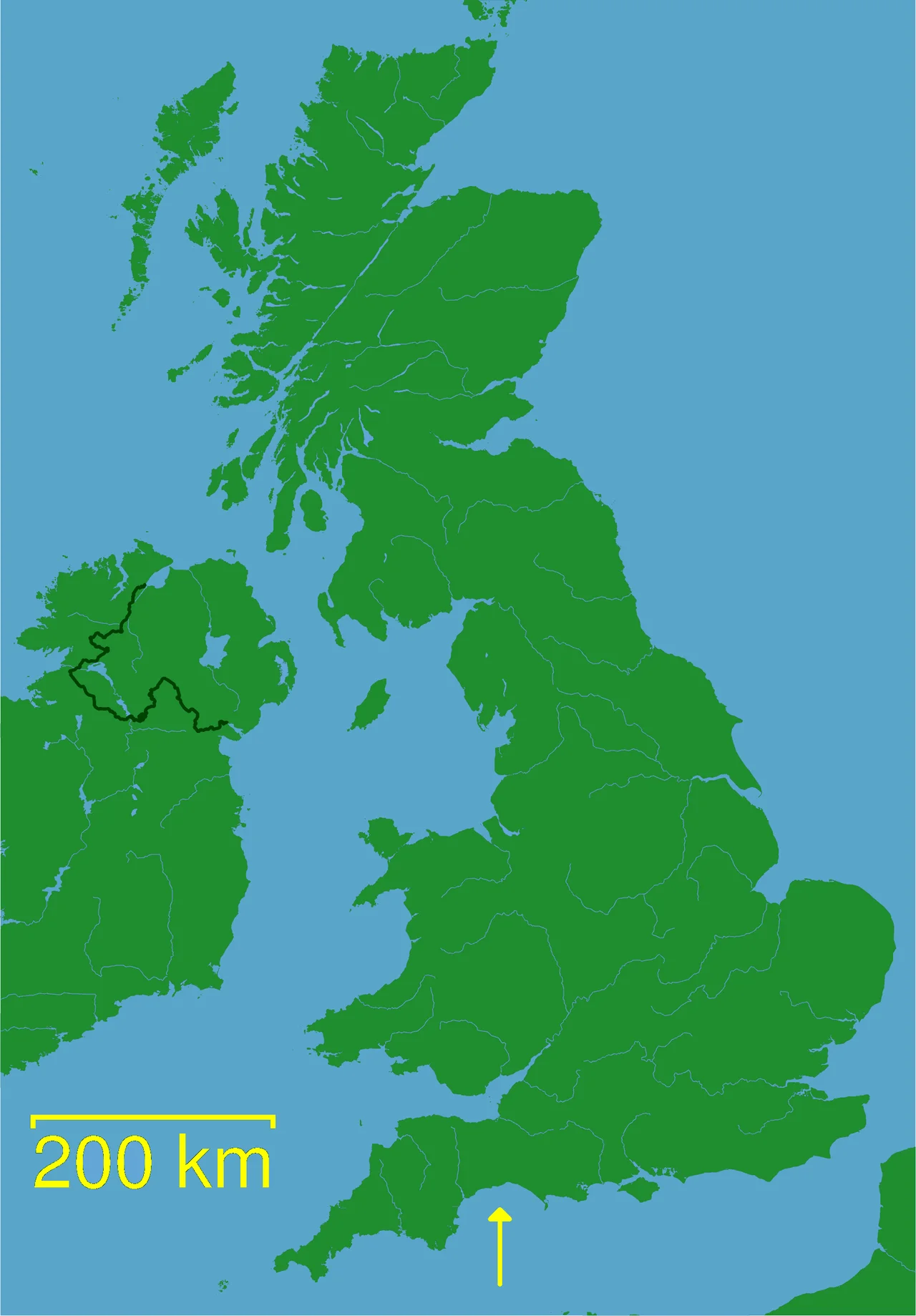
Coordinates 50.28 N, 3.65 W. The Slapton Sands beach and freshwater Slapton Ley lake sit on the south Devon coast, about 6 nm south-southwest of Dartmouth and 28 nm south of Exeter Airport (EGTE). Best viewed at 2,000-3,000 ft AGL in clear weather - the long arc of the beach and the dark line of Slapton Ley behind it are unmistakable. Nearest GA fields are Exeter (EGTE) to the north and Plymouth (former EGHD) to the west. Lyme Bay opens to the east; the convoy track ran roughly between Portland and Slapton.
Nearby Stories
- St Germans Priory 7.6 km away
- Launceston, Cornwall 9.6 km away
- Castle Drogo 12 km away
- HMS Formidable (1898) 17 km away
- Siege of Lyme Regis 19 km away
- Battle of Plymouth (1652) 40 km away
- German Submarine U-672 48 km away
- Goonhilly Satellite Earth Station 69 km away