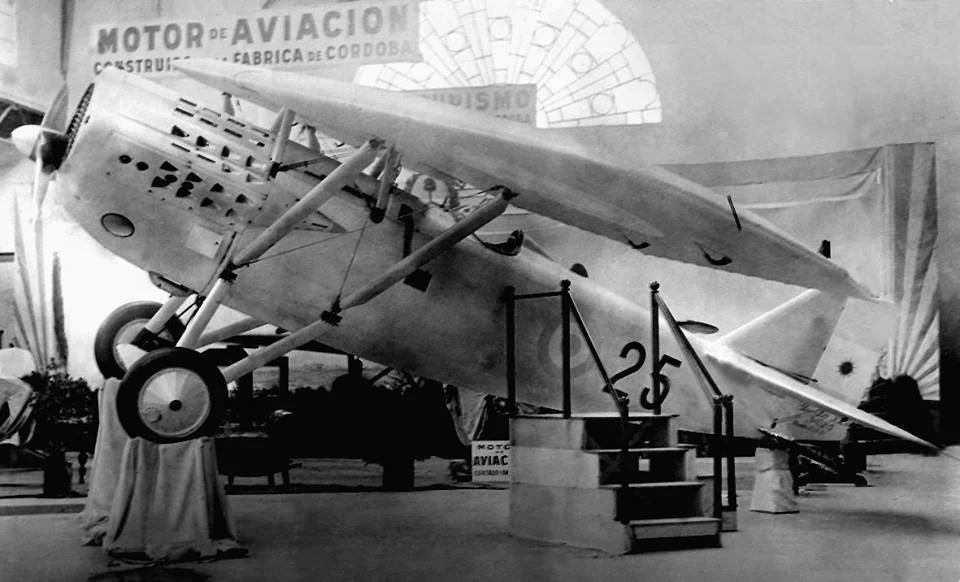

Fábrica Argentina de Aviones
On July 18, 1928, a small biplane lifted off a Córdoba runway, and a country that had never built an aircraft suddenly had. The plane was a license-built Avro 504 trainer with a hundred-horsepower engine, modest by any measure, but it marked the first aircraft produced in this factory, the oldest of its kind in Latin America. The works on the western edge of Córdoba would go on to build jets designed by men who had fled postwar Europe, prototypes that pushed Argentina into a club of nations that could be counted on two hands. Almost a century later, the factory is still here, still building, having survived wars, dictatorships, privatization, and nationalization without ever quite closing its doors.
A Nation Learns to Fly
The factory was formed on October 10, 1927, under the name that would define it for most of its life: the Fábrica Militar de Aviones, the Military Aircraft Factory. Its first product, that 1928 Avro 504 Gosport, cruised at 140 kilometers per hour and could stay aloft for two hours, enough to teach a generation of pilots their trade. From there the factory churned out a steady mix of indigenous designs and licensed foreign types, most of them for the military. Each era left its initials on the aircraft: Ae for the earliest period, then F.M.A., then I.Ae., and finally simply IA. Behind those quiet prefix changes lay an institution slowly building something rare in the developing world of its day, a genuine domestic capacity to design and manufacture flying machines from the ground up.
The Exiles and the Jet
After the Second World War, Argentina did something audacious. It hired the people who had built the losing side's aircraft. The French designer Emile Dewoitine led the work on the Pulqui I, flown in 1947. Then came the German engineer Kurt Tank, formerly the technical chief at Focke-Wulf, who had emigrated to Argentina with dozens of his colleagues to rebuild his career. Tank's design, the swept-wing Pulqui II, first flew in 1950 and drew directly on his unbuilt wartime Focke-Wulf Ta 183 project. It was the first swept-wing jet fighter developed and built in Latin America, and with it Argentina joined the small handful of nations then capable of producing jet fighters of their own design. The achievement came at a price. The Pulqui II proved unstable and difficult, two of its four prototypes were lost in fatal crashes, and the program never reached mass production. But the expertise it built did not vanish.
Pumas, Pucarás, and the Long Workhorses
The factory's real legacy is not the spectacular prototypes that never flew in numbers, but the sturdy aircraft that did. In the 1960s it produced the Guaraní light transport and, most famously, the IA 58 Pucará, a rugged twin-turboprop counterinsurgency aircraft. The 1980s brought the IA 63 Pampa jet trainer. The Pucará and the Pampa both remained in service with the Argentine Air Force decades after they first flew, the kind of quiet endurance that rarely makes headlines. The pattern across the factory's history is consistent: ambitious Argentine economics often strangled its boldest designs before they could mature, yet the institution kept finding ways to put practical, conventional aircraft into the sky. Innovation here was always in tension with the realities of a national budget that rose and fell with the country's fortunes.
Sold, Reclaimed, Renamed
The factory's recent history is a small drama of Argentine politics. In 1995, under President Carlos Menem, the military factory was privatized and handed to a Lockheed Martin subsidiary, which ran it largely as a maintenance and upgrade operation for the next fourteen years. Then in 2009 the government of Cristina Fernández de Kirchner brought it back into public hands, paying compensation and writing into law that the state could never again surrender control of the plant. It was renamed for Brigadier Juan Ignacio San Martín, the air force engineer who had laid the foundations of Argentine aviation industry in Córdoba in the 1940s. As of late 2009 the United States formally recognized the transfer, and the institution emerged as the Fábrica Argentina de Aviones it remains today, the latest name on a factory that has been building airplanes in Córdoba since before most of the world had figured out how.
From the Air
The Fábrica Argentina de Aviones occupies a site at 31.44°S, 64.27°W, on the western edge of Córdoba, adjacent to the main airport. From the air it appears as a large industrial complex of hangars, workshops, and aprons, with aircraft often parked outside. The nearest airport, sharing the area, is Ingeniero Aeronáutico Ambrosio L.V. Taravella International (ICAO: SACO, also known as Pajas Blancas, field elevation 1,604 ft), Argentina's third-busiest, roughly at the city's northwest. The wooded Sierras de Córdoba rise to the west, while the city grid spreads east. Visible from cruising altitude in clear weather; best identified by the runway and the cluster of large hangars on the city's western flank.
Nearby Stories
- Jesús María, Argentina 16 km away
- Alta Gracia 26 km away
- Pampa de Achala 31 km away
- Mina Clavero 31 km away
- Mar Chiquita Lake 116 km away
- Battle of Quebracho Herrado 135 km away
- Villa San Agustín 271 km away
- Predelta National Park 289 km away