
Fairy Lochs
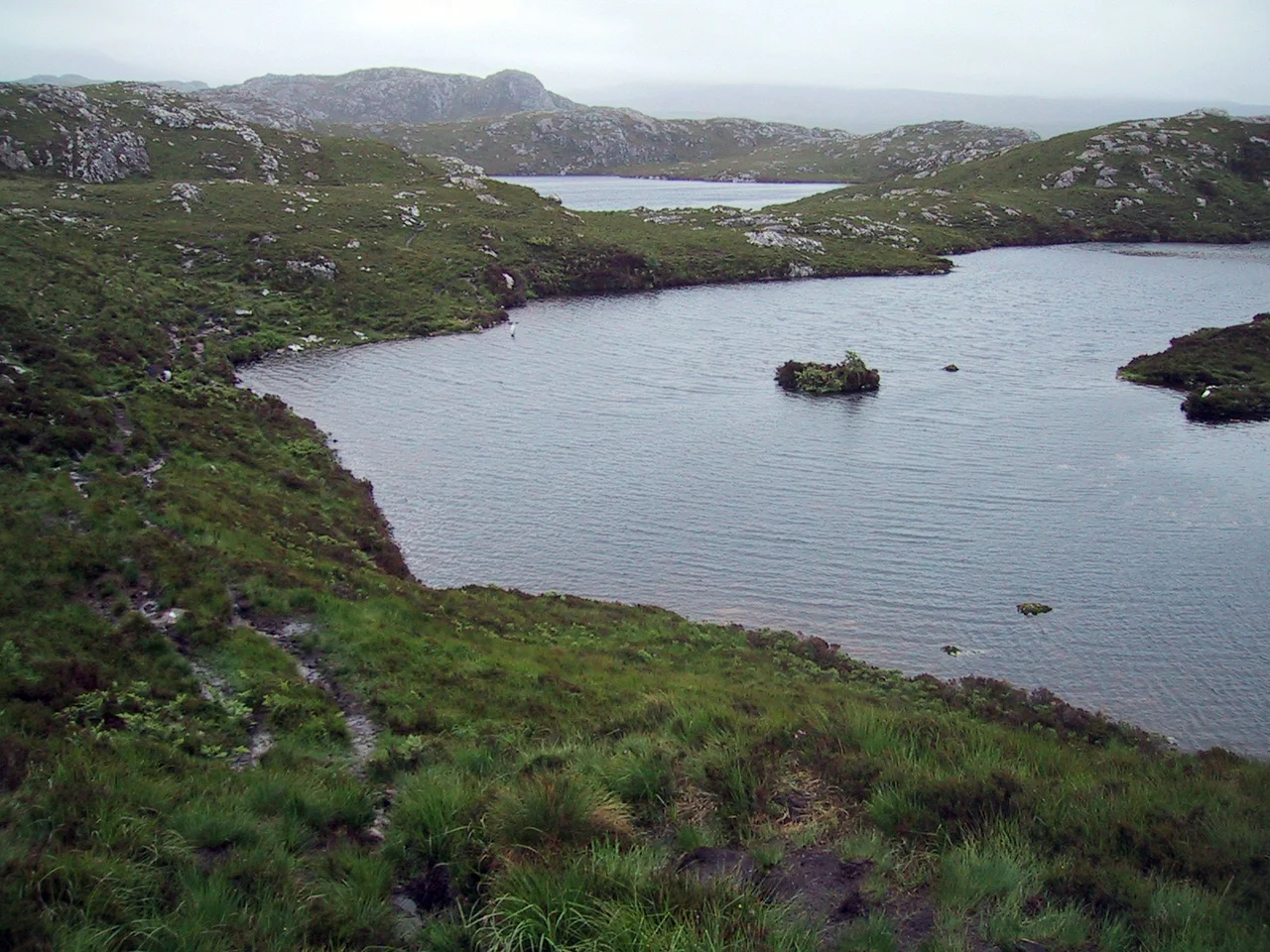
A propeller still rises from the water of one of these little freshwater lochans, two miles south-east of Badachro in Wester Ross. Pieces of fuselage lie scattered in the surrounding bog. On 13 June 1945, five weeks after VE Day, a USAAF B-24 Liberator carrying fifteen men, nine crew and six passengers, crashed into the hill above the lochs and broke apart against the rocks before sliding into the water. The wreckage was never cleared. The Scottish Office designated the site a war grave. Now the families come, and walkers from Badachro come, and the wreckage stays exactly where it fell.
Na Lochan Sgeireach
The Gaelic name, Na Lochan Sgeireach, simply means 'the rocky lochans,' a small chain of freshwater pools strung across the slopes south-east of Badachro. The modern English name comes from the nearby hill Sìthean Mòr, the Big Fairy Mound, sìth being the Gaelic word for the otherworldly people who live under the hills. The lochans drain through marshy ground into Loch Bràigh Horrisdale, which flows on into the Badachro River and eventually into Loch Gairloch. Several waterfalls cut through the surrounding crags. Without the crash, the place might be known only to local walkers and a handful of anglers. With it, the lochans have become something else: a place people walk to deliberately, often quietly, sometimes carrying flowers.
13 June 1945
B-24H Liberator serial 42-95095 lifted off from Prestwick on the morning of 13 June 1945, bound first for Keflavík in Iceland, then onward to the United States. The war in Europe was over. The crew belonged to the 66th Bombardment Squadron and were flying home; the six passengers from Air Transport Command were going with them. The planned route should have taken the aircraft over Stornoway on Lewis, well out into the Atlantic. For reasons that have never been explained, the Liberator flew east instead, over the mainland of Scotland. Crossing Wester Ross it began to lose altitude. It struck the summit of Slioch, 980 metres above Loch Maree, shedding parts of its bomb bay doors before flying on. The pilot appears to have attempted a forced landing on the moor near the Fairy Lochs. The aircraft hit the rocks instead, broke up, and scattered wreckage across the slope and into the lochan. All fifteen men aboard were killed.
The Names
The plaque on the rock above the largest piece of wreckage lists every man who died: pilots, navigator, radio operator, gunners, the six passengers from Air Transport Command. It was put there by families and friends, not by any government, in the years after the war. They were young men, most of them, with parents and wives and brothers and sisters waiting for them in towns whose names are not on this Scottish hillside. They had survived combat over Europe. They were going home. The Wester Ross weather had other plans, or perhaps something went wrong in the cockpit that nobody on the ground could ever reconstruct. The official record gives no cause. The wreckage simply tells you they came down here, and the plaque tells you who they were.
A War Grave on the Moor
The site is now classified by the British government as a war grave, and visitors are asked not to disturb the wreckage. The propeller and one engine remain visible in the lochan. Twisted aluminium lies among the heather. A small footpath leads in from the road at Shieldaig, climbing across boggy farmland and through marsh. There is nothing dramatic about the approach. You come over a low rise and suddenly the wreckage is there, smaller than you expect, more weathered, more silent. The loss of 42-95095 was not the only such accident in this corner of the Highlands; in 1951 an Avro Lancaster crashed on Beinn Eighe across Loch Maree, killing all eight men aboard. The mountains here have a way of catching aircraft that the maps don't quite warn about. The Fairy Lochs are now, among other things, a memorial to that.
From the Air
The Fairy Lochs (Na Lochan Sgeireach) sit at 57.68 N, 5.68 W, about 3 nm south-east of Badachro on the Gairloch peninsula in Wester Ross. The site is on rough hill ground between Loch Bràigh Horrisdale and Sìthean Mòr (281 m). The terrain is the same kind that took 42-95095: low cloud, gradually rising ground, scattered tarns, no obvious landmarks once you are in the murk. Approach should be visual in good weather only. Nearest airfields: Plockton (private grass strip) 30 nm south, Inverness (EGPE) 65 nm east-southeast, Stornoway (EGPO) 50 nm northwest. Slioch (980 m), where the Liberator first struck terrain, lies 9 nm east-northeast across Loch Maree.
Nearby Stories
- BUTEC 4.3 km away
- Duntulm Castle 6.9 km away
- An Teallach 7.1 km away
- The Minch 11 km away
- Eilean Chaluim Chille 13 km away
- Suilven 14 km away
- Dunvegan Castle 16 km away
- Glen Affric 30 km away