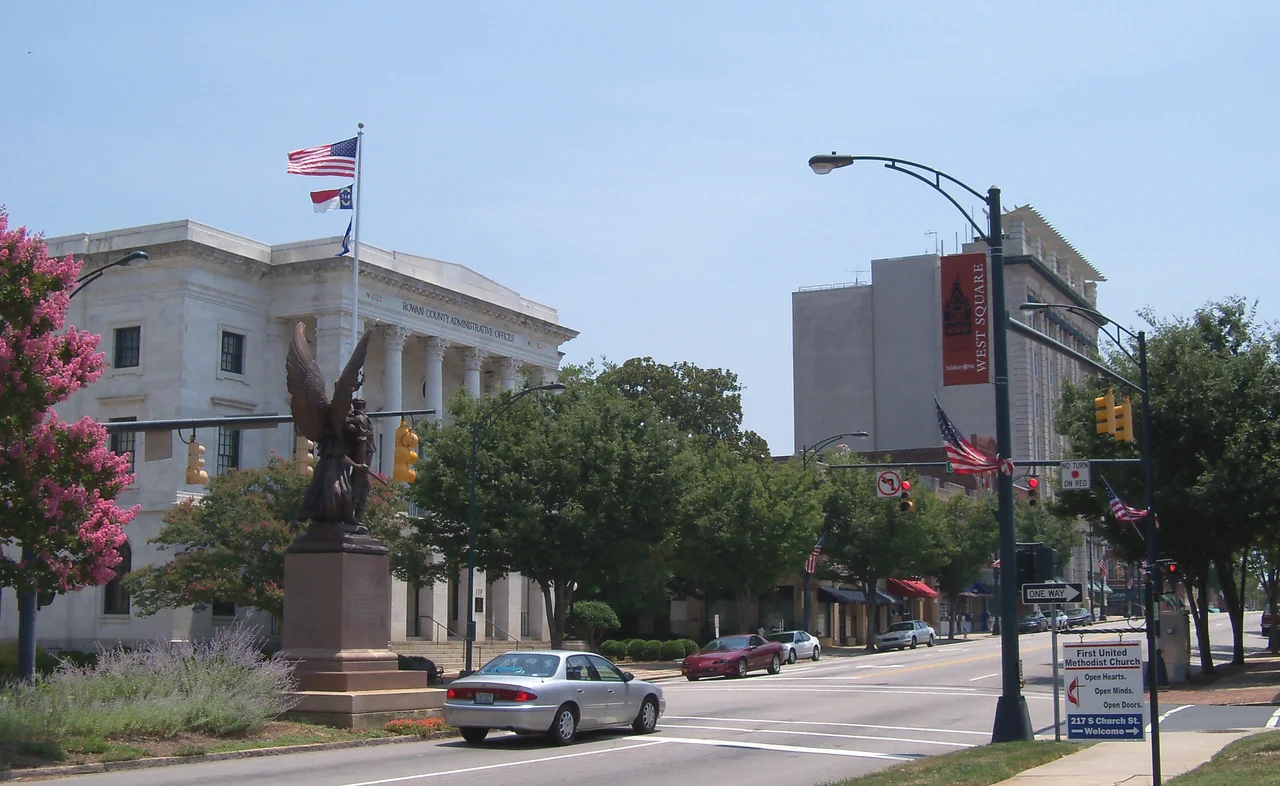

Fame (Confederate Monument)
For 111 years, a bronze angel with outstretched wings stood on a pink granite pedestal in the median of West Innes Street in downtown Salisbury, North Carolina. She held a dying Confederate soldier in one arm and a laurel wreath in the other. The statue's original French name was 'Gloria Victis,' meaning 'glory to the defeated.' Salisbury called it 'Fame.' On July 6, 2020, in the months following the murder of George Floyd, the statue was lifted off its pedestal and trucked away. It was the end of a long argument that had been running, in one form or another, since the monument was dedicated.
Glory to the Defeated
The statue itself was not made for Salisbury. The 'Gloria Victis' grouping was sculpted by Frederick Ruckstull, a French-born sculptor working in New York, who was deeply inspired by an 1874 French original of the same name by Antonin Mercié. Ruckstull cast two nearly-identical versions of his grouping in Brussels in 1891. One made its way to a New York City studio, where the United Daughters of the Confederacy purchased it for use as a memorial. The chapter raised nine thousand dollars for the statue and fifteen hundred for the pink granite base, which was quarried at nearby Granite Quarry, North Carolina. The dying soldier was modeled from an 1861 photograph of Lieutenant Henry Howe Cook of Franklin, Tennessee. The monument was dedicated on May 10, 1909, which was Confederate Memorial Day. By then the Civil War had been over for forty-four years, but Reconstruction had also been over for thirty-two, and the era of Jim Crow was at its full and unbroken height.
What Monuments Like This Were For
Fame was one of dozens of Confederate monuments raised across the South in the first decades of the twentieth century, a wave of memorialization that historians have shown was tied directly to the consolidation of legal segregation. The United Daughters of the Confederacy, organized in 1894, became the most effective Lost Cause organizer in the country, placing statues, textbooks, and memorial-day customs into schools, courthouses, and public squares. These monuments were not neutral remembrances of the dead. They were assertions about whose history a community honored and whose history it did not. In Salisbury, an online petition during 2020 noted that the monument 'memorializes a treasonous government whose founding principle was the perpetuation and expansion of slavery.' Defenders organized as the Fame Preservation Group called the statue part of Salisbury's identity. Both statements were true, in different senses, and that was the problem.
A Century of Tension
Safety concerns about the West Innes location had been raised as early as 1948, 1959, and 1964, when traffic patterns changed and the statue stood awkwardly in a busy median. The cultural arguments came later. On August 18, 2018, days after Ku Klux Klan flyers were distributed in Salisbury's Black neighborhoods, the monument was splashed with white paint. In March 2019 it was vandalized again with yellow paint. A public hearing followed, and Catawba College history professor Gary Freeze proposed a compromise: leave a marker on the original site and commission new artwork to occupy the space. The city wrestled with the question of whether it even had legal authority over the land. A 1908 document signed by then-mayor A.H. Boyden had stipulated that 'said site shall be used perpetually for said monument.' The question of perpetuity, in this country, has a way of coming up for renegotiation.
Summer 2020
By June 2020 a petition to remove the statue carried more than seven thousand signatures. The Salisbury City Council voted unanimously on June 16 to relocate the monument, citing public safety. Five days later the United Daughters of the Confederacy signed an agreement allowing the move. On July 6, 2020, with workers and police and a small crowd present, Fame was hoisted off her pedestal and trucked to storage. On July 23, 2021, after months of preparation, she was installed at the Old Lutheran Cemetery on North Lee Street, where 176 Confederate soldiers are buried with tombstones placed in 1996. The statue now stands among the actual graves of the men she was made to represent, rather than at the center of a city for which she had become a daily flashpoint.
What Remains
The median where Fame stood for 111 years is now an empty stretch of grass on West Innes Street, with West Council and South Church Streets nearby. Salisbury continues to debate what, if anything, should replace it. The Fame Preservation Group, which became a 501(c)(3) nonprofit in 2023, raises money to maintain the statue and the Old Lutheran Cemetery, and says its name stands for Faith, Ancestry, Monuments and Education. The conversation about what monuments mean, and to whom, did not end when the crane lifted the bronze off its base. It just moved to other streets, in other towns, with other names on other pedestals. Salisbury has had a longer chance than most communities to think about whose story gets to occupy the center of the road.
From the Air
Fame's original location on West Innes Street in downtown Salisbury was at roughly 35.670 degrees N, 80.479 degrees W. Its current location at Old Lutheran Cemetery is on North Lee Street nearby. Best viewed from 2,000 to 4,000 feet AGL. Mid-Carolina Regional Airport (KRUQ, Salisbury) is just south of downtown. From altitude, look for the grid of downtown Salisbury between Interstates 85 and the Yadkin River, with Salisbury National Cemetery (Civil War-era) also visible.
Nearby Stories
- Richard Childress Racing Museum 8.7 km away
- Lake Norman 9.6 km away
- Charlotte Speedway 13 km away
- Reed Gold Mine 14 km away
- Greensboro Massacre 23 km away
- North Wilkesboro Speedway 37 km away
- Richmond County, North Carolina 37 km away
- Tobacco Road 46 km away