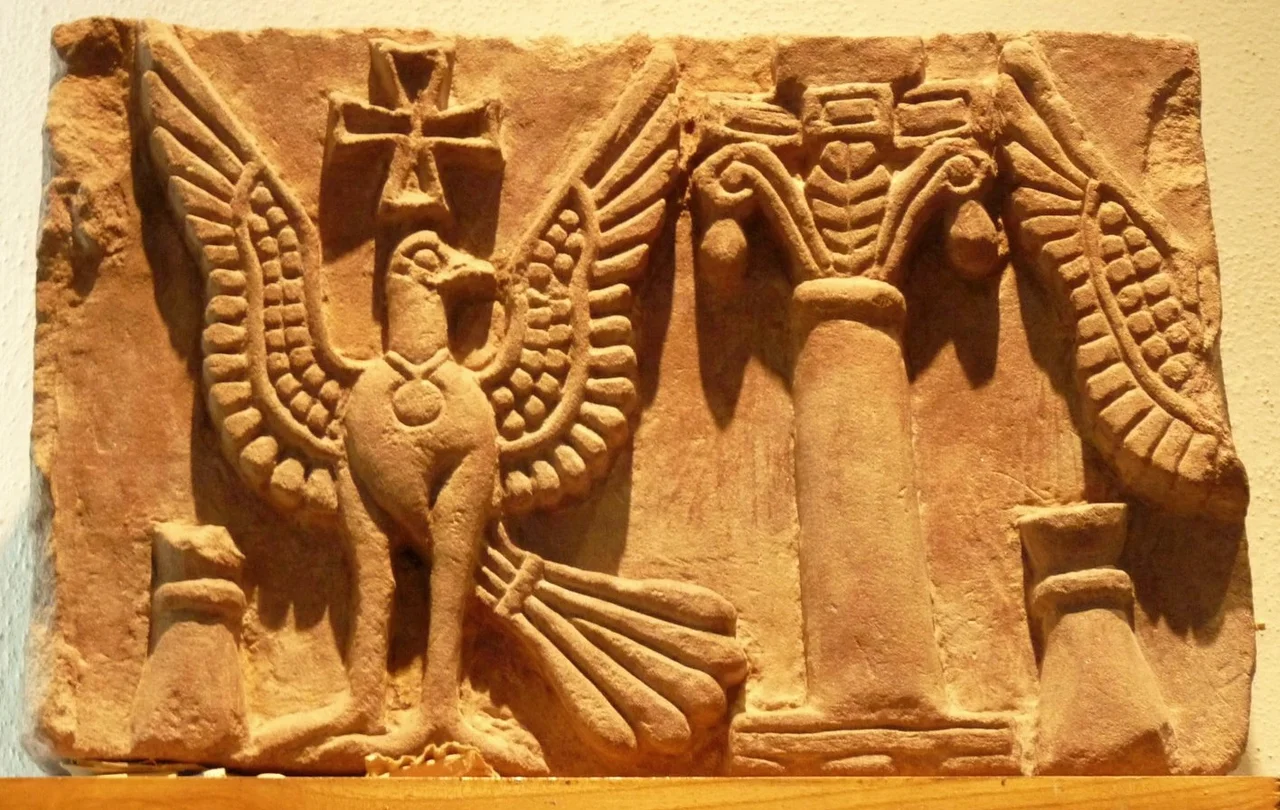

Faras
In 1961, Polish archaeologists opened up a hill at Faras and found a cathedral inside it. They had come expecting to excavate a late antique town before the rising reservoir drowned it. What they found was a buried Christian basilica whose walls were still covered in tempera paintings - archangels, bishops, Nubian queens, a black Saint Anne holding a black Virgin - some of the most dazzling medieval art in all of Africa. Over the next four years, racing the water, the team cut 120 of the 169 frescoes off the walls. Sixty-six are now in Warsaw, the rest in Khartoum. The cathedral they were painted on is underwater.
Pakhoras on the Border
Faras - Pakhôras in ancient Greek, Pakhoras in Old Nubian - was already a major town in the Meroitic period, the southern Kushite kingdom that succeeded Napata. When Egypt controlled Nubia, Faras became an administrative center; a major temple was built here, and the cultural influence of Egypt was strong. Upriver lay Abu Simbel, downriver lay the second cataract. Faras sat on what would eventually become the Egyptian-Sudanese border - on the Wadi Halfa salient, a thumb of Sudan that reaches into Egypt's southern edge. During the Christian period of Nubia, starting in the mid-sixth century, Faras flourished. It became the capital of the basiliskos (king) Silko of Nobadia. When Nobadia was absorbed into the larger kingdom of Makuria, Faras remained the most prominent center of the north, seat of the eparch who governed the northern province.
The Cathedral Beneath the Hill
The cathedral at Faras was founded by Bishop Aetios in 620 AD, expanded by Bishop Paulos at the beginning of the eighth century, and rebuilt again by Bishop Petros I at the end of the tenth. The later buildings were named for these bishops. The walls inside were plastered and painted, and then replastered and painted again, for roughly six centuries - tempera on dry plaster, in layers dated from the eighth to the fourteenth century. The subjects tell the story of a Christian African kingdom that drew on Byzantine and Coptic traditions while making its own visual language. There are archangels, Michael chief among them. There are portraits of the bishops themselves. There are Nubian kings and queens, their brown skin and their ceremonial dress rendered with a care that refuses to flatten them into generic figures. There is the Virgin Mary, there are saints, there are Biblical scenes. There is a List of Bishops of Faras that has allowed art historians to date individual paintings by the episcopate of the bishop portrayed.
Racing the Dam
In 1960, UNESCO launched the Nubian Salvage Campaign. The Aswan High Dam was rising, Lake Nasser would soon fill, and the monuments of Lower Nubia had to be saved or documented before they disappeared. The Polish portion of this effort was entrusted to Professor Kazimierz Michałowski, who had founded what would become the Polish Centre of Mediterranean Archaeology at the University of Warsaw. Michałowski's team worked at Faras from 1960 to 1964. They dug, they documented, they photographed, and most remarkably, they detached paintings from their walls. Taking a fresco off a wall without destroying it is a delicate operation - you plaster the surface, peel the painted skin away in a sheet, and reattach it to a new backing. They succeeded with 120 of the 169 paintings they had uncovered. In 1964 the water rose over the cathedral. Faras is now underwater - somewhere beneath the surface of Lake Nasser, on what was once the Egypt-Sudan border.
Two Galleries, One Drowned City
The saved paintings live in two museums. Sixty-six are at the National Museum in Warsaw, where the Faras Gallery is one of Poland's cultural treasures - a permanent exhibition of Nubian Christian art in the heart of Europe. The rest are at the Sudan National Museum in Khartoum, where they are closer to the land that made them. A major pottery workshop was also found, adding to the picture of Faras as a production center, not just a religious one. In the turbulent last century of Christian Nubia, the administrative role passed from Faras to Qasr Ibrim, which was easier to defend. Faras declined, but it was the frescoes that ultimately made the city famous - bright, dignified portraits of a Christian African civilization. From the air today, where Faras was, there is only water: the broad blue-green expanse of Lake Nasser, crossed by the invisible border between two countries.
From the Air
Original coordinates 22.2°N, 31.46°E, now submerged beneath Lake Nasser at the Egypt-Sudan border near Wadi Halfa. Nearest airports: Aswan International (HEAS) in Egypt, Wadi Halfa (HSSW) in Sudan. Recommended viewing altitude 10,000-15,000 feet to see the full sweep of Lake Nasser and the drowned landscape of Lower Nubia.
Nearby Stories
- Buhen 20 km away
- Qasr Ibrim 57 km away
- Kulb 105 km away
- Kulubnarti 135 km away
- Temple of Dendur 139 km away
- Bi'r Tawīl 180 km away
- Bir Tawil 184 km away
- Kharga Oasis 308 km away