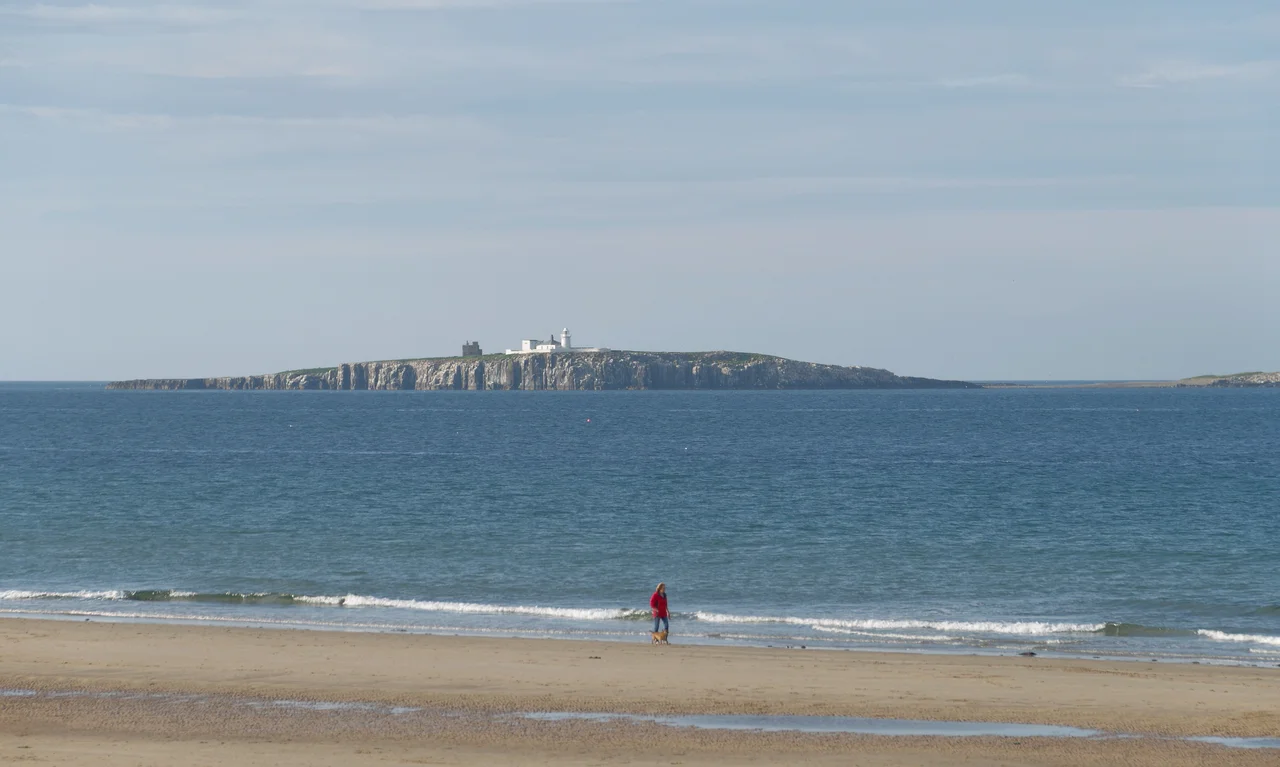

Farne Lighthouse
For nearly a century, ships approaching the Farnes at night looked for two lights, not one. Both stood on the same small island. The Inner Farne High Light revolved; the Low Light, an octagonal tower a hundred and fifty metres away, showed a fixed beam. When a ship's helmsman could line them up vertically - one directly above the other - he knew he was on a specific safe approach past the Megstone rocks. When the lights drifted apart in his sights, he was off course. The arrangement was clever, almost surgical. It also depended on a keeper trekking back and forth across the island in the dark to keep both lights burning. By 1910 the system was obsolete, the Low Light went dark, and was demolished soon after.
Captain Blackett's Coal Fire
Before Trinity House took over the Farnes, the lights were lit privately. In December 1778, Captain John Blackett established a coal-burning beacon on top of Prior Castell's Tower on Inner Farne - the medieval pele tower built around 1500 for the Prior of Durham, repurposed by Blackett as a lighthouse base. He built another at the same time on Staple Island. The Inner Farne beacon worked. The Staple Island one was wrecked by a storm in 1784. Blackett's coal lights were tended by hand, the fuel hauled up the tower in baskets, the flames coughing smoke and embers into the wind. They were better than nothing. They were not very much better.
Daniel Alexander's Pair
In 1811, the Corporation of Trinity House replaced the Blackett system with two purpose-built lighthouses, both designed by the architect Daniel Alexander - whose other work included Dartmoor Prison and the original London Docks warehouses. The pair on Inner Farne worked together. The High Light, on the southern tip of the island, was a stone tower with a revolving lamp array showing a flashing white light. The Low Light, 150 metres to the north-west and only 8 metres tall, showed a fixed beam from a single Argand lamp through an aperture in the rear of its structure - monitored by the keeper from the High Light through a clever sight line, so that one man could effectively run both. The lights aligned to indicate the safe approach past the Megstone, an isolated rocky stack just under a mile north-west.
Automation, 1910
Lighthouse automation came earlier than most people think. By the early twentieth century, Trinity House was experimenting with acetylene gas burners and sun valves - devices that automatically lit the lamp at dusk and extinguished it at dawn using thermal expansion. In 1910, Farne Lighthouse became one of the first Trinity House lighthouses to be automated. Acetylene was generated on site from calcium carbide and water in a producer plant beside the tower. The spent calcium carbide was thrown down the cliff for decades, leaving the distinctive white chalk streak that still marks the rock face today - a stain that looks like seabird guano from a distance but is actually the chemical residue of a now-vanished technology. A new third-order Fresnel lens was installed, and a red sector added to mark hazardous approaches. The Low Light, no longer needed, was discontinued and soon demolished.
Sold for £132,000
On 6 June 2005, Trinity House sold Farne Lighthouse - the tower, the keeper's quarters, the land it stood on - to the National Trust for £132,000. The Trust already owned the rest of Inner Farne, and the sale rolled the lighthouse into the existing nature reserve. Trinity House leased back the operational areas for a peppercorn rent so that the light continued to function. In 2022 they were granted permission to replace the lamp with an LED light source designed to fit inside the original Fresnel lens - so that from a passing ship, the light looks exactly as it did, but inside the lantern room a low-power LED has replaced the older filament. The lighthouse is still owned, in effect, by the seabirds. It just happens to keep working as a navigational aid as well.
From the Air
55.62N, 1.66W on the southern tip of Inner Farne, the closest and largest island of the Farne archipelago, 1 mi off the Northumberland coast near Seahouses. From altitude, the lighthouse is the white round tower at the south end of Inner Farne; the white streak of spent calcium carbide is still visible on the cliff below. Longstone Lighthouse (red-and-white striped) lies 2 mi northeast. Nearest ICAO: Newcastle (EGNT) 50 mi south. Best photographed at 2,000-3,000 ft AGL. The Megstone rocks 1 mi northwest are the navigational hazard the lighthouse exists to warn against.
Nearby Stories
- St Abbs Lifeboat Station 1.2 km away
- Etal Castle 1.6 km away
- Warkworth Castle 3.4 km away
- Otterburn Training Area 12 km away
- Eyemouth Disaster 28 km away
- German submarine U-2367 79 km away
- Saltburn Pier 117 km away
- Alexander L. Kielland (Platform) 265 km away