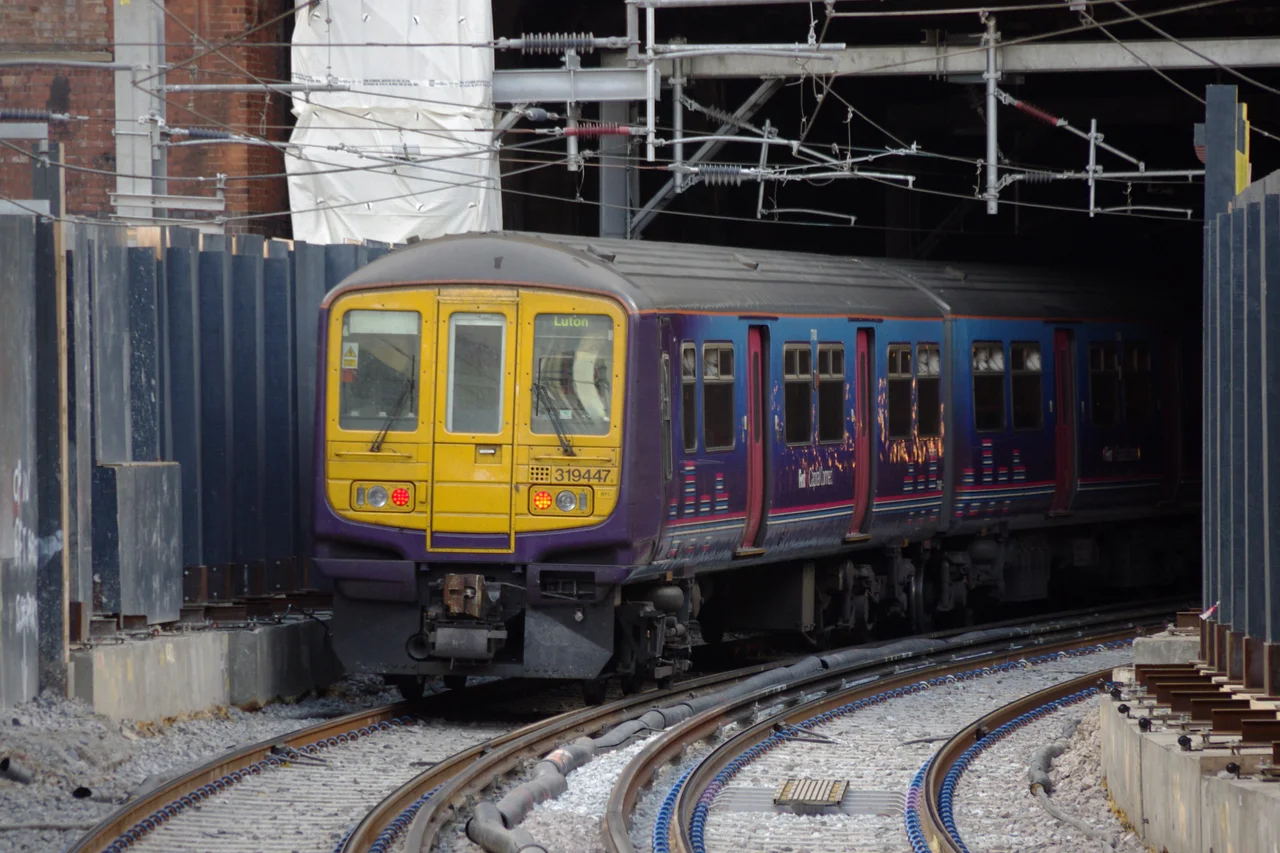

Farringdon Station
On 10 January 1863, the Metropolitan Railway opened the world's first underground passenger railway, and Farringdon Street station was its terminus. The original line ran just under four miles, from Paddington to Farringdon, and it carried 38,000 passengers on its first day. The concept was so new that people were genuinely uncertain whether it would work — whether the air in underground tunnels would be breathable, whether the darkness would cause panic, whether passengers would tolerate the experience at all. Within months, the question was settled. The Metropolitan Railway was one of the great successes of Victorian engineering, and the station at Farringdon stands as one of the oldest surviving underground railway stations in the world.
A Station Beside the Fleet
The lines running north from Farringdon toward King's Cross travel alongside the Fleet ditch — the buried river that flows from Hampstead Heath south to the Thames, culverted since 1734. The station building above ground is unusually well-preserved early 20th-century London Underground architecture, retaining a sign for a parcel office on the outer wall and some original signage from its 1922–1936 name, Farringdon and High Holborn. Adjacent to the original station, a freight branch served the nearby Smithfield Market: livestock were brought to a slaughterhouse via cattle ramps whose remains are still visible on West Smithfield. Smithfield was redesignated as a wholesale deadmeat market in the 19th century, and the freight line was last used in the 1920s.
The Power Switch
One of the stranger technical features of Farringdon is the power transition that happens each time a Thameslink train departs southbound. North of London, the Thameslink route runs on 25 kilovolt AC overhead power; south of the Thames, it uses 750-volt DC third-rail supply. Trains switch between the two electrical systems while standing at Farringdon's platform. This is not instantaneous — the pantograph on southbound trains is normally lowered as they leave the station, and the transition point is critical enough that warning signs are installed for drivers. The Network SouthEast sector of British Rail installed this dual-current capability in May 1988. Underground trains serving Farringdon, on a separate infrastructure below the surface, use the London Underground's own four-rail 630-volt DC system.
Art Embedded in the Station
In 2019, a memorial to Edward Johnston was unveiled in the London Underground concourse at Farringdon. Johnston designed the typeface that the Underground has used since 1916 — those clean, geometric letters on the roundel signs that have defined London's transit identity for over a century. The memorial, designed by Fraser Muggeridge, consists of the letters of the alphabet set in Johnston typeface on wood type. More recently, as part of the Elizabeth line's Crossrail Art Programme, British artist Simon Periton created two site-specific works: at the eastern entrance, glass panels printed with patterns echoing the Victorian ironmongery of Smithfield Market opposite; at the western entrance, giant diamond shapes referencing the jewellers of nearby Hatton Garden.
The Hub It Became
The station that opened in 1863 as a single-platform terminus is now one of the most connected stations in Britain. It sits at the intersection of the Circle, Hammersmith and City, and Metropolitan lines; the Thameslink north-south rail route; and the Elizabeth line, which began calling here in May 2022. The Elizabeth line runs east-west from Reading and Heathrow through central London to Shenfield via Stratford. No other station in Britain combines both the north-south Thameslink service and the east-west Elizabeth line in a single interchange. At peak hours, Farringdon handles a departure every 20 seconds. The station building that Charles Walter Clark designed in 1922, with its stucco facade still carrying the old name, stands at the centre of this new complexity like a reminder of how much has changed and how much of the original ambition endures.
From the Air
Located at 51.521°N, 0.105°W in Clerkenwell, just outside the City of London boundary. Smithfield Market is visible immediately to the north. London City Airport (EGLC) is approximately 8 miles east, London Heathrow (EGLL) is approximately 15 miles west.
Nearby Stories
- Stevenage 5.7 km away
- Malling Abbey 5.7 km away
- 1952 Farnborough Airshow Crash 7.7 km away
- Ingatestone Hall 8.2 km away
- Hellfire Caves 9.1 km away
- The Carrington Event: The Solar Storm That Could Happen Again 9.8 km away
- Bletchley Park 16 km away
- Castle Hedingham 23 km away