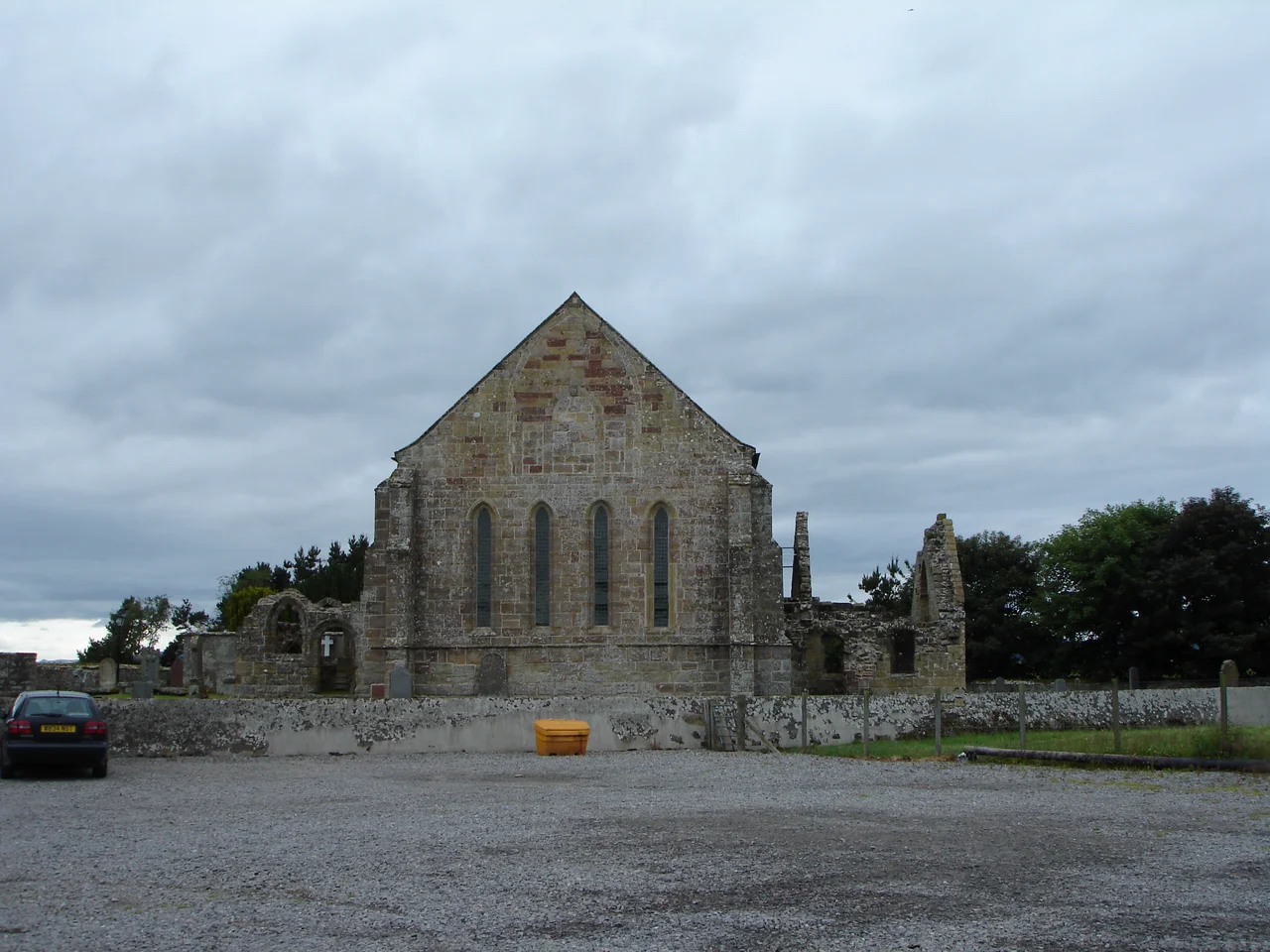

Fearn Abbey
On a Sunday in 1742, the flagstone roof of Fearn Abbey gave way during a service. Nearly fifty members of the congregation were killed where they sat or stood. The Lamp of the North - so called because this had been one of Scotland's oldest pre-Reformation churches, a beacon of learning in the far north - became, in a single instant, the site of a parish tragedy. The abbey today stands rebuilt and quiet on a low rise southeast of Tain, and the rope of the bell has worn a deep crevice into the stones of the tower where it has been pulled for centuries.
The White Canons Come North
Fearchar, 1st Earl of Ross, founded the abbey in the 1220s, bringing Premonstratensians - the white canons of Whithorn Priory - to plant a monastic community in his northern lands. The first site was abandoned within a generation. In 1238, under the abbey's second leader, Malcolm of Nigg, the entire foundation was moved ten miles southeast to its present location. The reasons recorded are practical: the original site sat among lands made dangerous by the turbulence of the northern clans, and the new ground offered richer soil for the agriculture that supported the community. The abbey remained under the protection of the Earls of Ross, who maintained and defended it through the medieval centuries.
A Simple, Strong Building
The church itself is deliberately plain. Oblong in shape, 96 feet long and 26 feet wide internally, it uses tall lancet windows for light - four equal lancets in the east gable, paired openings between the buttresses around the walls. The eastern end was partitioned off as the burial vault for the Ross of Balnagown family. Side chapels were added over the centuries: the south wing, dedicated to St Michael, was probably built by Abbot Finlay McFead before his death in 1485, and his canopied tomb still bears the inscription *Hic jacet Finlaius McFaed abbas de Fern qui obit anno MCCCCLXXXV*. The cloister and domestic buildings of the abbey are long gone; only the church survives, with the bell-rope groove worn deep into the stonework outside the tower.
Reformation and Disaster
The early sixteenth century brought political upheaval. Patrick Hamilton, a boy when he became commendator of Fearn, adopted Reformation principles as he grew up. He was burned at the stake as a heretic in 1528, age twenty-four. By 1560, the abbacy was a secular office; Nicholas Ross, who held it after 1545, sat in Parliament and voted to abolish Catholicism in Scotland. The abbey passed through Crown grants and bishop's hands through the seventeenth century. It continued as a parish church through it all. Then came that day in 1742, when the heavy flagstone roof failed mid-service. Nearly fifty members of the congregation - neighbours, farmers, families - died beneath the stone they had been singing beneath.
Rebuilt, Restored, Continuing
The replacement church built next to the ruined abbey was itself ruinous by the 1770s. In 1772 the parishioners rebuilt the original abbey shell instead - the structure that stands today, incorporating medieval fabric within an eighteenth-century restoration. Ian G. Lindsay & Partners restored it again in 1971, and Historic Scotland led further conservation work in 2002-2003. The congregation maintained links with Church of Scotland mission projects in Ekwendeni, Malawi, and the Tabeetha School in Israel. Regular services ended in 2023; in 2024 the parish was united with Tarbat and Tain into the new Easter Ross Peninsula Church of Scotland. Among those buried within the abbey walls are Fearchar himself, the founder, dead 1251, and General Charles Ross of Balnagown, honored for service to William III, dead 1732 - ten years before the roof came down.
From the Air
Fearn Abbey sits at 57.77°N, 3.96°W on the Fearn peninsula in Easter Ross, southeast of Tain. Best viewed at 1,500-2,500 ft AGL to pick out the rectangular abbey on its low rise above farmland. Nearest ICAO airport is Inverness (EGPE) approximately 30 nm south. The Moray Firth lies to the south-east; the Cromarty Firth to the south. The abbey is a small but distinctive structure - oblong with a tower at the west end - set among the patchwork fields of the peninsula.
Nearby Stories
- Moray Firth 1.1 km away
- Culloden Viaduct 1.2 km away
- Cardhu Distillery 9.5 km away
- Clynelish Distillery 10 km away
- Alladale Wilderness Reserve 15 km away
- Corrimony Chambered Cairn 18 km away
- Ardvreck Castle 31 km away
- Hill o' Many Stanes 40 km away