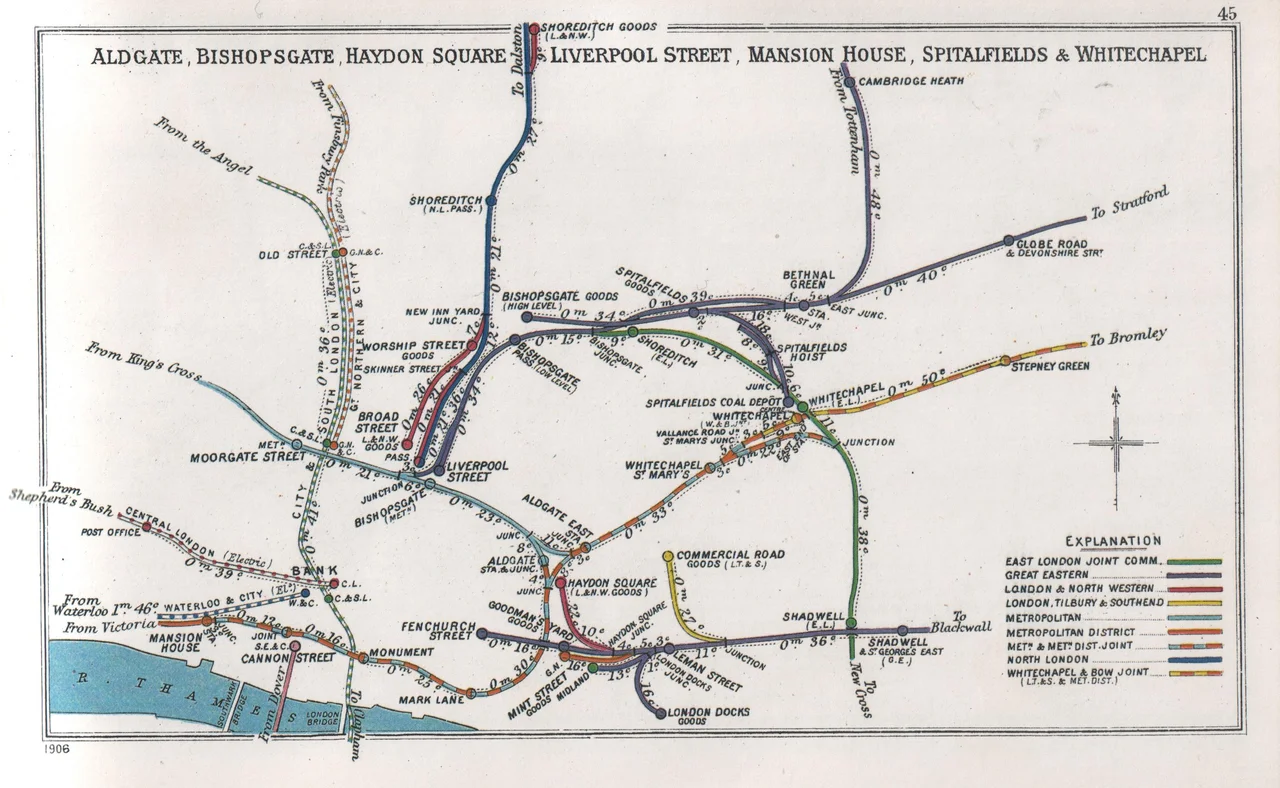

Fenchurch Street railway station
The name comes from the Latin faenum, meaning hay. Hay markets had stood in this corner of the City since long before any railway. In 1840, when the Corporation of London had been refusing entry to one railway company after another, it finally granted permission to the London and Blackwall Railway to build a terminus inside its boundaries, a tiny piece of land in the southeastern corner of the City. William Tite designed the original building. It opened on 20 July 1841. Steam locomotives were not allowed near it for the first eight years, and trains rolled in by their own momentum after being released downhill from the Minories. Fenchurch Street has been a quietly strange place ever since.
Trains by Gravity
Before 1849 the L&BR had a particular method of operation. Trains were hauled uphill from Blackwall by cable to the Minories terminus, then released downhill on a long shallow grade so they could reach Fenchurch Street under their own momentum. The reverse trip required manual pushing from railway staff. It worked because the line was short and the engines were tiny. William Marshall opened a railway bookstall at the station in 1841, the first in the City of London, beginning the long British tradition of buying paperbacks at the platform end. When steam locomotives were finally permitted in 1849 the operation became more conventional, but for those first eight years Fenchurch Street was probably the strangest large station in London.
The First Railway Murder
On the evening of 9 July 1864, Thomas Briggs, a 69-year-old chief clerk at a City bank, boarded a North London Railway train at Fenchurch Street to travel home to Hackney. He was found later that night on the tracks near Hackney Wick, dying from head injuries. He had been beaten and robbed. The murder was the first ever to take place on a British railway, and it provoked a national panic about the new vulnerability of railway carriages. The killer was identified as Franz Müller, a German tailor, who had fled to New York. British detectives pursued him on a faster steamer, arrested him on his arrival, and brought him back for trial. He was hanged on 14 November 1864 outside Newgate Prison before a crowd of 50,000. British railway carriages were redesigned after the murder, with the introduction of communication cords and visible upper windows.
The Vaulted Roof and the Berkley Hall
The original Tite station was rebuilt in 1854 to accommodate the London, Tilbury and Southend Railway, a joint venture between the L&BR and the Eastern Counties Railway. The new design was by George Berkley and featured a trussed-arch vaulted roof 32 metres by 91 metres, two new platforms, and a circulating area for both companies' traffic. The zig-zag canopy on the façade is an addition from the 1870s. The vaulted roof was dismantled in the 1980s when high-rise office blocks were built directly above the station, leaving only the 1854 façade intact. The station has been Grade II listed since 1972. It has four platforms arranged as two islands elevated on a viaduct, making it one of the smallest London terminals in physical terms, yet one of the most intensively operated.
The Misery Line
By the late 1980s the former LTSR line was carrying over 50,000 passengers a day on infrastructure fifty years old. The trains were dirty, the trains were crowded, the trains were late. The line became known as "the misery line." In 1989 Sir Robert Reid called the service from Fenchurch Street "wholly unacceptable." Teresa Gorman, the MP for Billericay whose constituents commuted on this line every day, called it "one of the disgraces of our public railway service for many years." In July 1994, shortly before privatisation, the station closed for seven weeks for an £83 million overhaul of signals, track, and electrification. It was the first significant closure of a London terminal station in living memory, planned and temporary, but the misery had become a political issue. Since 1996 the station has been operated by c2c, which has slowly rehabilitated the line's reputation.
Monopoly and Douglas Adams
Fenchurch Street is the smallest and oldest of the four railway stations on the standard British Monopoly board, alongside King's Cross, Marylebone, and Liverpool Street. All four were once LNER terminals. The poet John Betjeman, who failed to save Euston Arch but saved much else, called Fenchurch Street a "delightful hidden old terminus" while passing through it on day trips to Southend. It has the curious distinction of being the only London terminal with no direct connection to the Underground. The nearest stations are Tower Hill, 0.2 miles southeast, and Aldgate, 0.3 miles northeast. In Douglas Adams's novel So Long, and Thanks for All the Fish, the third book in the Hitchhiker series, the character Fenchurch is named because she was conceived in the queue at the station. Sixteen million passengers pass through it each year. None of them, presumably, are conceived there anymore.
From the Air
Located at 51.5117 degrees N, 0.0786 degrees W in the southeastern corner of the City of London, between the Tower of London and Aldgate. The station is partially hidden beneath modern office blocks built above it in the 1980s, recognisable from above by its elevated viaduct platforms running east to west. Nearest airport: London City (EGLC) about 5 nm east. Best viewed from 2,000 to 3,000 feet on an approach following the Thames.
Nearby Stories
- Stevenage 5.7 km away
- Malling Abbey 5.7 km away
- 1952 Farnborough Airshow Crash 7.7 km away
- Ingatestone Hall 8.2 km away
- Hellfire Caves 9.1 km away
- The Carrington Event: The Solar Storm That Could Happen Again 9.8 km away
- Bletchley Park 16 km away
- Castle Hedingham 23 km away