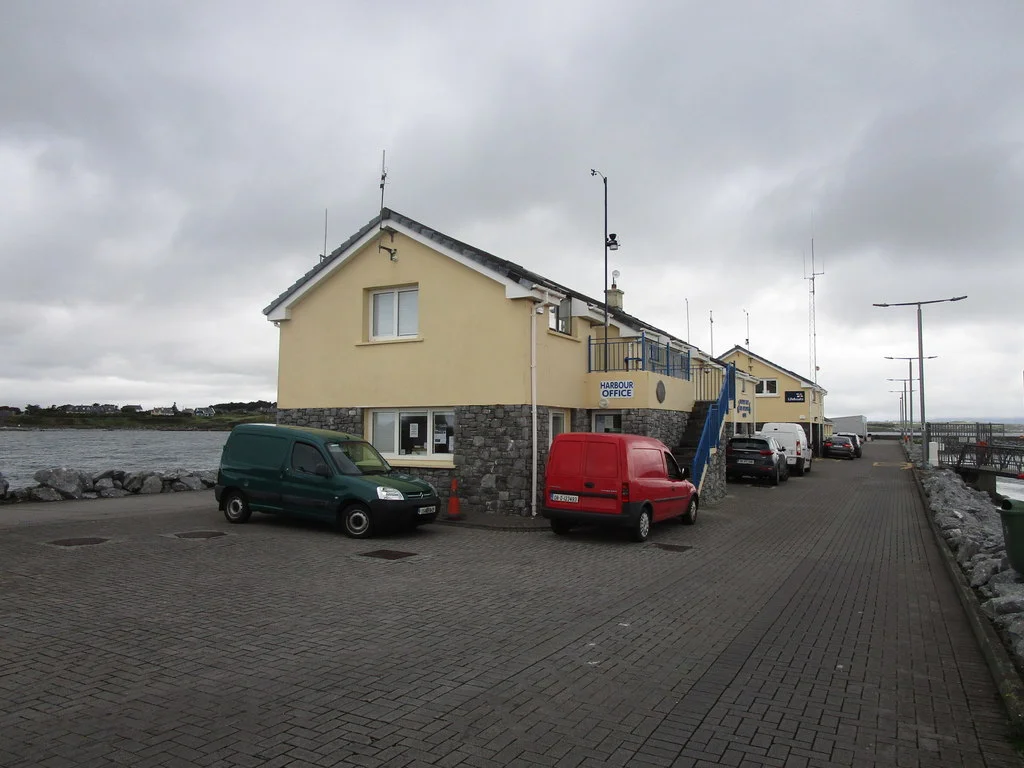

Fenit Lifeboat Station
On a night in November 1850, the Italian brig Enrichetta - carrying cargo from Barletta on the Adriatic toward Falmouth in Cornwall - ran aground in heavy surf off the County Kerry coast. There was no lifeboat at Fenit. There was no organised rescue service of any kind on this stretch of shore. Twelve men were on board the brig, and twelve men would almost certainly have drowned, except that John Town, the local coastguard chief, gathered a party of his men, waded into the surf, and brought the crew off the wreck by hand. The Royal National Institution for the Preservation of Life from Shipwreck - the body that would become the RNLI four years later - awarded Town its Silver Medal. Three decades later, after years of local petitioning, the RNLI finally placed a lifeboat at Fenit. It has been there, with one long pause, ever since.
1879: The Boathouse on Kelly's Lane
After residents had applied for years, the RNLI established Tralee Bay Lifeboat Station at Fenit in 1879. A boathouse went up at the top of the lane to Kelly's beach, on land granted by John Hurly of Fenit House, at a cost of 393 pounds and fifteen shillings. The first lifeboat - a thirty-four-foot self-righting craft with sails and ten oars, designed for the technology of its era - cost 363 pounds. The launch carriage cost another 137 pounds and ten shillings. The City of Cork Steam Ship Company carried the boat free of charge from London to Cork, and the Great Southern and Western Railway brought it the rest of the way to Tralee. At the opening ceremony on the twenty-sixth of June 1879, the lifeboat was named Admiral Butcher. A stone tablet inside the station commemorated the dedication. In 1892 the station was formally renamed Fenit (Tralee Bay) Lifeboat Station.
Medals and the Long Pause
Four RNLI Bronze Medals were awarded at Fenit over the decades that followed - the first in 1920 to a young boy who tried to rescue his drowning friend, the next three in 1930 to fishermen who saved the three-man crew of the steamship Co-operator of Tralee. The Admiral Butcher was replaced by successive boats: the Louisa and Emma in 1890, the John Willmot in 1895, the James Stevens lifeboat in 1923, and a Watson-class boat in 1928. At some point in the twentieth century, as motor vessels improved and shipping patterns shifted, the station was closed. For decades, the west coast of Ireland between the surviving lifeboat stations north and south had no Fenit boat to call on. Local skippers crossed their fingers.
1994: The Reopening
At an RNLI management meeting on the twenty-fourth of November 1993, somebody finally said what everyone on the coast had been saying for years: the west of Ireland needed another all-weather lifeboat. The station at Fenit, dormant for decades, was the logical site. The old boathouse on Kelly's lane was no longer fit for purpose, so a temporary Portakabin went up on the quay and the harbour was dredged for a deeper mooring. In 1994 the lifeboat Ralph and Bonella Ferrant arrived to begin a one-year trial. She passed her first test before she even arrived on station - en route from England, she responded to a mayday from the motor cruiser Mayfly off Salcombe in Devon. The trial extended. The station never closed again.
The Boats and the Names
Lifeboats carry the names of the people whose bequests bought them. In 1999, Fenit's current all-weather boat arrived: the fourteen-metre Trent-class Robert Hywel Jones Williams. That same year an inshore lifeboat, the Ann Speed, joined her at the station. In 2010, after the back-to-back deaths of station mechanic Bradley Burns from cancer in 2005 and his wife Sonia, the lifeboat administrator, suddenly the following year, the crew raised thirty-nine thousand euros to fund a new inshore boat named Bradley and Sonia. She served until 2022, when she was retired and replaced by Lizzie - funded from the legacy of Elizabeth Joan Finch, better known as Liz Fraser, the British film and television actress who played opposite Peter Sellers in I'm All Right Jack and appeared in many of the Carry On films. Fraser had no obvious Kerry connection. Her bequest, made quietly, simply funded an inshore boat where one was needed. The dedication ceremony was held at Fenit harbour on the twenty-ninth of May 2022.
Why the Station Matters
The waters around Tralee Bay and out toward the Shannon estuary include some of the busiest small-craft channels on Ireland's west coast and some of the most exposed Atlantic seaboard in Europe. Fishing boats work the lobster grounds. Yachts cruise the Wild Atlantic Way. Container ships and tankers transit the Shannon estuary to and from the deep-water terminals at Foynes. When something goes wrong - and on this coast it goes wrong with a depressing regularity - it is Fenit that launches. The crew is mostly volunteers, as it has been since 1879. They live in the village, work jobs ashore, train in the evenings, and answer the pager whenever it goes. They have answered, in different forms, for nearly a hundred and fifty years.
From the Air
Located at 52.27 degrees N, 9.86 degrees W at Fenit Harbour on the south side of Tralee Bay, north of the Dingle Peninsula. Recommended viewing altitude 1,500 to 3,000 feet AGL to see the lifeboat moored at the quay, Fenit Island just to the north, and Tralee Bay opening west to the Atlantic. Nearest airport is Kerry (EIKY), about twenty kilometres southeast near Farranfore. Tralee town lies just east of the harbour. Atlantic weather affects the area year-round - expect strong winds and reduced visibility in winter.
Nearby Stories
- Castleisland 7.4 km away
- Kilrush 9.1 km away
- Ring of Kerry 12 km away
- Kilgarvan 15 km away
- Inishtooskert 18 km away
- SM U-68 27 km away
- Kilkee 29 km away
- RMS Carinthia (1925) 74 km away