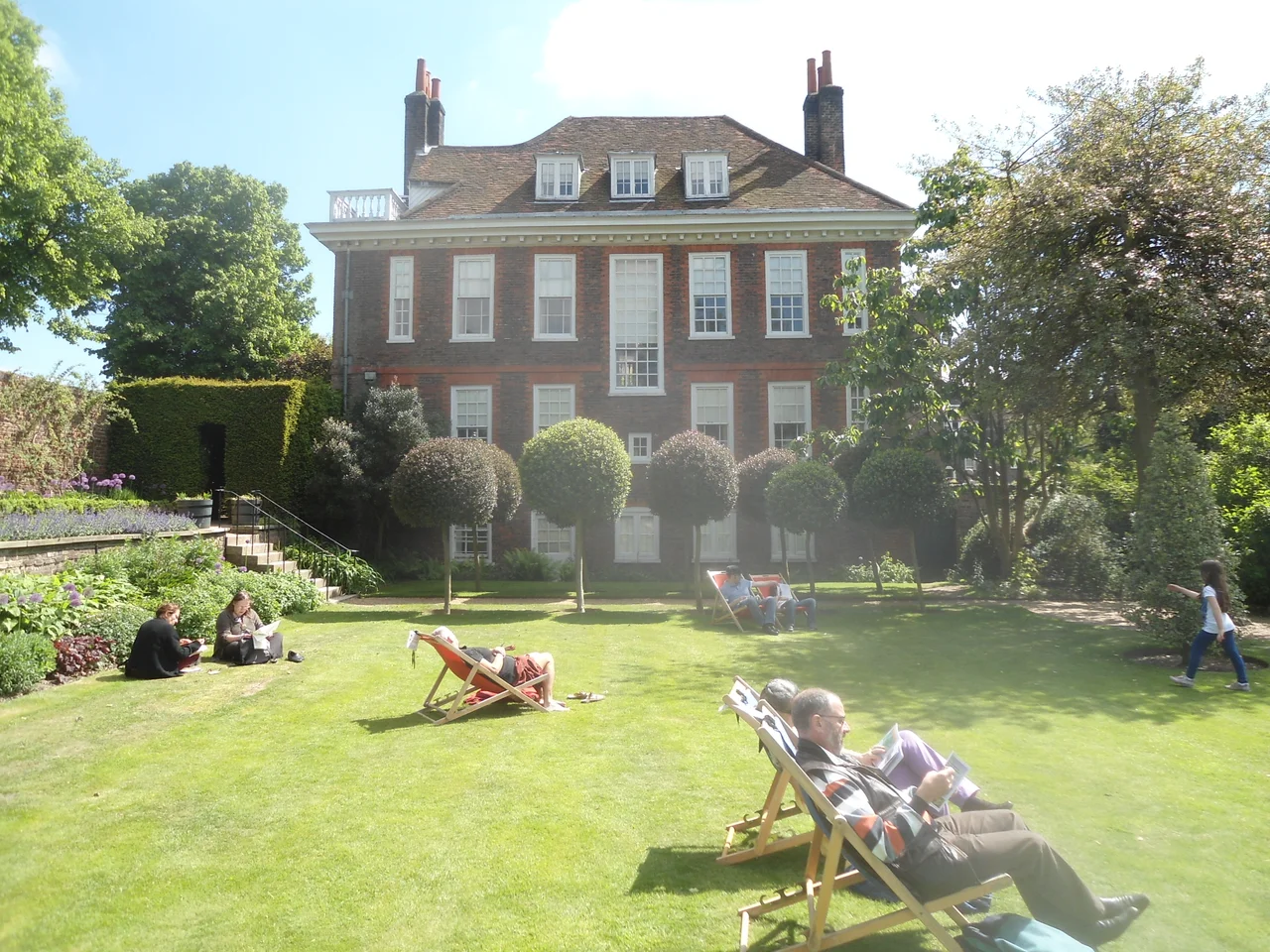

Fenton House, Hampstead
The date 1693 is inscribed on the chimney breast, and the brick walls that surround it are consistent with that age. Fenton House has been standing on the western side of Hampstead Grove for over three hundred years — through the expansion of London from a city into a metropolis, through the development of the heath below it, through two world wars. It is a detached house with a walled garden large by any London standard, containing a sunken garden, a kitchen garden, and an orchard where around thirty varieties of apple trees still flower and fruit as they have for centuries. The National Trust holds it now, as it has since Lady Binning bequeathed it in 1952.
The Riga Merchant's Mark
The house takes its current name from Philip Fenton, a merchant who traded from Riga on the Baltic coast and bought the property in 1793. In the 19th century he ordered the remodelling that shaped much of what visitors see today: alterations to the interiors and roof, the addition of the ornate portico and pediment over the entrance, new window frames and glazing. The balustraded parapets on the sides of the building date from the 18th century. The original staircases, with their twisted balusters, survived the remodelling. Main rooms retain their original panelling, corner cupboards, and decoratively carved marble fireplaces. The house passed through several more owners before reaching Lady Binning, its last private resident.
The Instruments
Upstairs, Fenton House holds the Benton Fletcher collection of early keyboard instruments — harpsichords, spinets, virginals, clavichords, and early pianos gathered by Major George Henry Benton Fletcher and donated to the National Trust in the 1930s. What makes this collection unusual is that the instruments are not merely displayed; during operational hours, musicians sometimes play them for visitors. A harpsichord built in 1612, a spinet from the 1730s, instruments that predated the modern piano entirely and produced sounds that concert halls no longer hear — these are still sounding, still in use, maintained as working objects rather than relics. The chance to hear one is not guaranteed, but the possibility is part of what makes Fenton House a different kind of visit.
The King and His Mistress
Among the paintings at Fenton House are portraits of King William IV and Dorothea Jordan, the Irish actress who was his mistress for twenty years and bore him ten illegitimate children before he ended the relationship to marry a royal. The house also holds portraits of two of their sons, Lord Frederick FitzClarence and Lord Adolphus FitzClarence, and of William IV's brother George IV. The presence of this family grouping in a National Trust property — a king, his long-term mistress, their children — is quietly remarkable. William IV eventually became king in 1830. Dorothea Jordan died in poverty in France in 1816, never having received adequate financial support after the separation.
High Ground, Old Garden
Hampstead's elevation above the rest of London gives Fenton House a particular relationship with the city below. The heath that stretches to the south and east has been common land for centuries, protecting the view across London's skyline. The walled garden, large enough to feel genuinely rural within the confines of the capital, contains the old orchard where the 30 varieties of apple were already well-established by the time of the National Trust's acquisition. In spring, the blossom fills the walled enclosure; in autumn, the apples are harvested. The house sits at the end of Holly Hill, in one of the few parts of London where it is still possible to hear birdsong without traffic as background noise.
From the Air
Located at 51.559°N, 0.180°W on Hampstead Grove in Hampstead, North London. The house is near the top of Hampstead Heath, one of the highest points in London. Hampstead Heath itself is visible from altitude as a green expanse north of the city. London Heathrow Airport (EGLL) is approximately 18 miles west.
Nearby Stories
- Stevenage 5.7 km away
- Malling Abbey 5.7 km away
- 1952 Farnborough Airshow Crash 7.7 km away
- Ingatestone Hall 8.2 km away
- Hellfire Caves 9.1 km away
- The Carrington Event: The Solar Storm That Could Happen Again 9.8 km away
- Bletchley Park 16 km away
- Castle Hedingham 23 km away