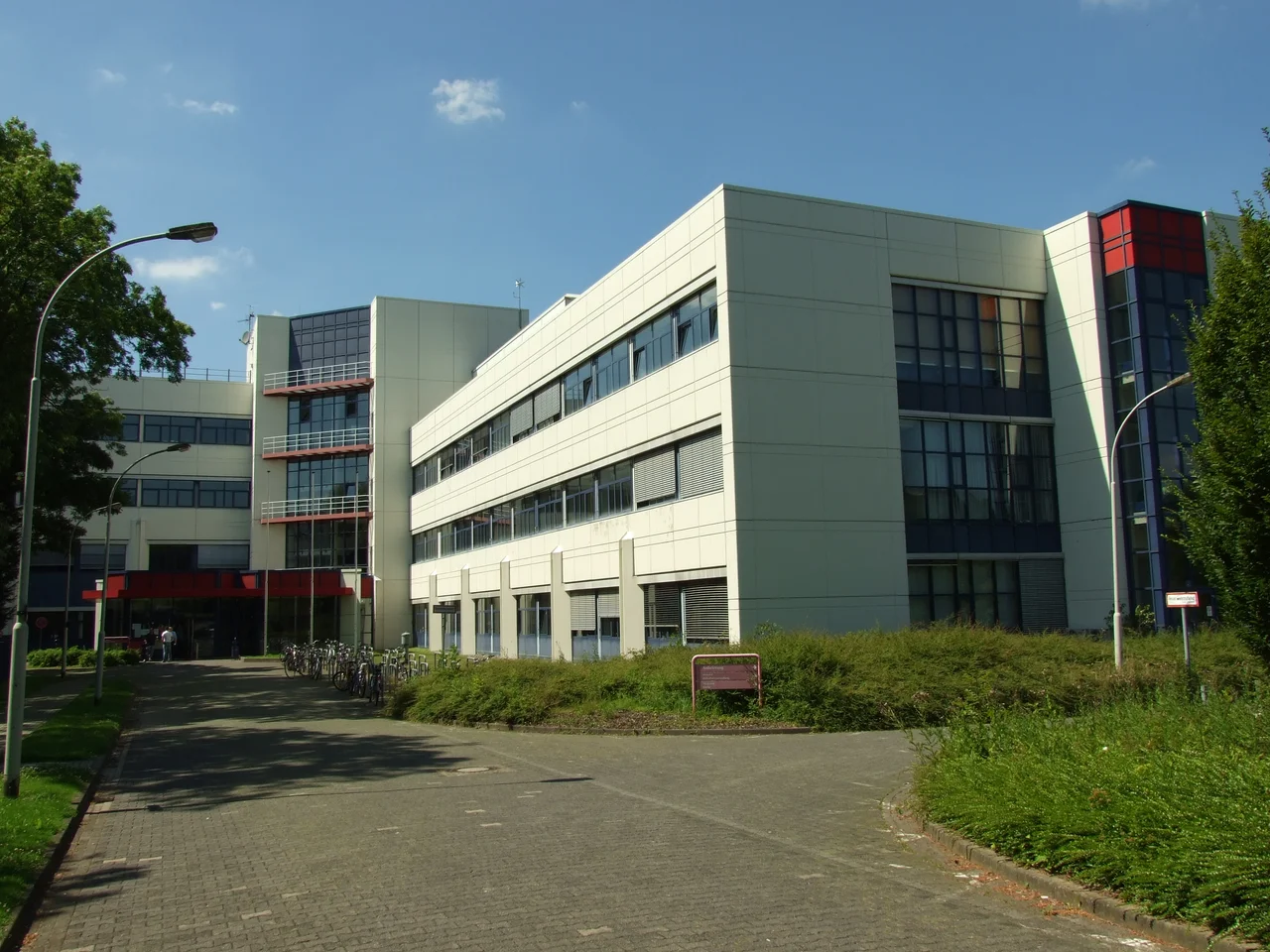

FH Aachen
Every October, on a former boarding-school campus in the small town of Geilenkirchen near the Dutch border, about three hundred young people from countries like China, Iran, Indonesia, Morocco, and Mongolia arrive to spend a year learning what they need to know to attend a German engineering university. They sit in classrooms once used by German schoolboys. They eat in a cafeteria run for German schoolboys. Some of them have never studied in any language other than their mother tongue. By the following autumn, the survivors will be sitting in lecture halls in Aachen, Julich, Duisburg, Dortmund, or Bochum, taking notes in German on quantum mechanics or strength of materials. This is the Freshman Institute, the strangest and most consequential part of FH Aachen.
The Applied Sciences Bet
FH Aachen was founded in 1971 when several existing universities of applied sciences and vocational training centers were folded together. The Federal Framework Law for Education in 1976 placed Fachhochschulen on equal legal footing with traditional research universities, and FH Aachen used the new autonomy aggressively. Today roughly 15,000 students, 250 professors, 470 contract lecturers, and 340 assistants work across ten faculties. The school ranks first among German universities of applied sciences in electrical engineering, mechanical engineering, and informatics - three of the fields that define German industry. Seven faculties operate in Aachen itself, scattered across the city in buildings that include the Bayernallee campus, the Eupener Strasse complex for business and electrical engineering, the Goethestrasse mechanical engineering building, and the Hohenstaufenallee aerospace facility. Three more faculties - chemistry and biotechnology, medical technology and applied mathematics, and energy technology - operate from a more compact campus 30 kilometers northeast in Julich, next door to Forschungszentrum Julich, one of Europe's largest research centers.
The Faculty That Builds Things
Faculty 6 is Aerospace Engineering. Faculty 8 is Mechanical Engineering and Mechatronics. Faculty 4 is Arts and Design. Faculty 10 is Energy Technology, working closely with the Solar Institute in Julich and the Institute NOWUM-Energy. The applied-sciences model means students spend a heavy fraction of their time on practical work - in workshops, in industry placements, in lab projects with real industrial partners. The university runs research institutes in industrial aerodynamics, thermoprocess technology, innovative mechanical engineering, applied polymer chemistry, bioengineering, nano- and biotechnologies. The pattern across all of these is the same: a small institute, often a GmbH, embedded in the school and embedded simultaneously in a working industrial sector. Aachen graduates do not generally go on to write theory papers. They build things, and the school is structured to build people who build things.
Geilenkirchen and the Freshman Program
The Freshman Institute began in 2001 as a project of Professor Herman-Josef Buchkremer, then rector of the FH. Thirty students from China arrived for the first full program. By 2007 the institute had been formally established as a central organization of the university. By 2015, five hundred students from thirty countries were enrolled. The course is technically a Studienkolleg - a German preparatory college - but its purpose is unusual: it lets students start in English and progress into German, replacing the standard German university admission requirements with an internal entrance exam given in the students' home countries. Partner universities accept Freshman graduates directly into bachelor programs - FH Aachen itself, the University of Duisburg-Essen, the South Westphalia University of Applied Sciences, FH Dortmund. The Geilenkirchen campus is residential. Students live in former boarding-school dormitories. They eat together. They take classes together. For nine months, several hundred eighteen-year-olds from very different places share the same address.
The Program Survives Everything
The Freshman Institute has run continuously through every disruption that has hit international higher education in this century. The 2002 SARS outbreak shrank enrollment after the German embassy in Beijing established its Akademische Pruefstelle. A campus in Linnich opened in 2006 and closed in 2013. A campus in Bedburg-Hau opened in 2012 and closed in 2018. A program opened in Kenitra, Morocco in 2018. The pandemic in 2020 brought travel bans and embassy closures, but the 2020-21 cohort started in October anyway, with online classes for students stuck in their home countries and physical classes for the half who had managed to reach Geilenkirchen. By December 2020 more than half the cohort was on the German campus. In 2021 the program added an English-language Feststellungspruefung track that opens English-taught bachelor's programs across North Rhine-Westphalia. The instability of the larger world has been mostly absorbed by the program rather than ending it.
The Quiet Pipeline
The big names in German higher education are the research universities - RWTH Aachen, just up the road, with its global reputation in engineering. FH Aachen does not get the same headlines. But the applied-sciences sector quietly trains a substantial fraction of the German engineering workforce, and FH Aachen's Freshman Institute has become one of the largest pipelines in Europe for taking talented international students from outside the German education system and placing them inside it. The numbers are not enormous - a few hundred Freshmen per year - but the model has been copied across the country, and the institute's partnership with 170 universities around the world means a Freshman graduate's options are not limited to one school or one city. The campus in Geilenkirchen is small, and quiet, and surrounded by farmland near the Dutch border. The lives that pass through it scatter across the world.
From the Air
Coordinates: 50.7570°N, 6.0952°E. FH Aachen does not have a central campus - its seven Aachen faculties are spread across the city in distinct building complexes, with prominent locations along Bayernallee, Eupener Strasse, Goethestrasse, and Hohenstaufenallee in the southwestern quadrant of Aachen. The main coordinates fall near the Eupener Strasse cluster. The Freshman Institute campus at Geilenkirchen lies about 30 km northeast. The Julich faculties cluster another 30 km east of Geilenkirchen near the Forschungszentrum. Recommended viewing altitude: 2,500-4,500 ft AGL over Aachen's urban core. Nearest airports: Maastricht Aachen (EHBK) 30 km NW; Geilenkirchen NATO E-3A base (ETNG) near the Freshman campus; Cologne-Bonn (EDDK) 75 km E.
Nearby Stories
- Heinsberg-Lindern Railway 7.8 km away
- Baptismal font at St Bartholomew's Church, Liège 7.8 km away
- Federal Office for the Protection of the Constitution 16 km away
- Limburg (Belgium) 17 km away
- F.L.Y. 17 km away
- Marcinelle Mining Disaster 84 km away
- Fort Jeanne d'Arc 148 km away
- Marmoutier Abbey 202 km away