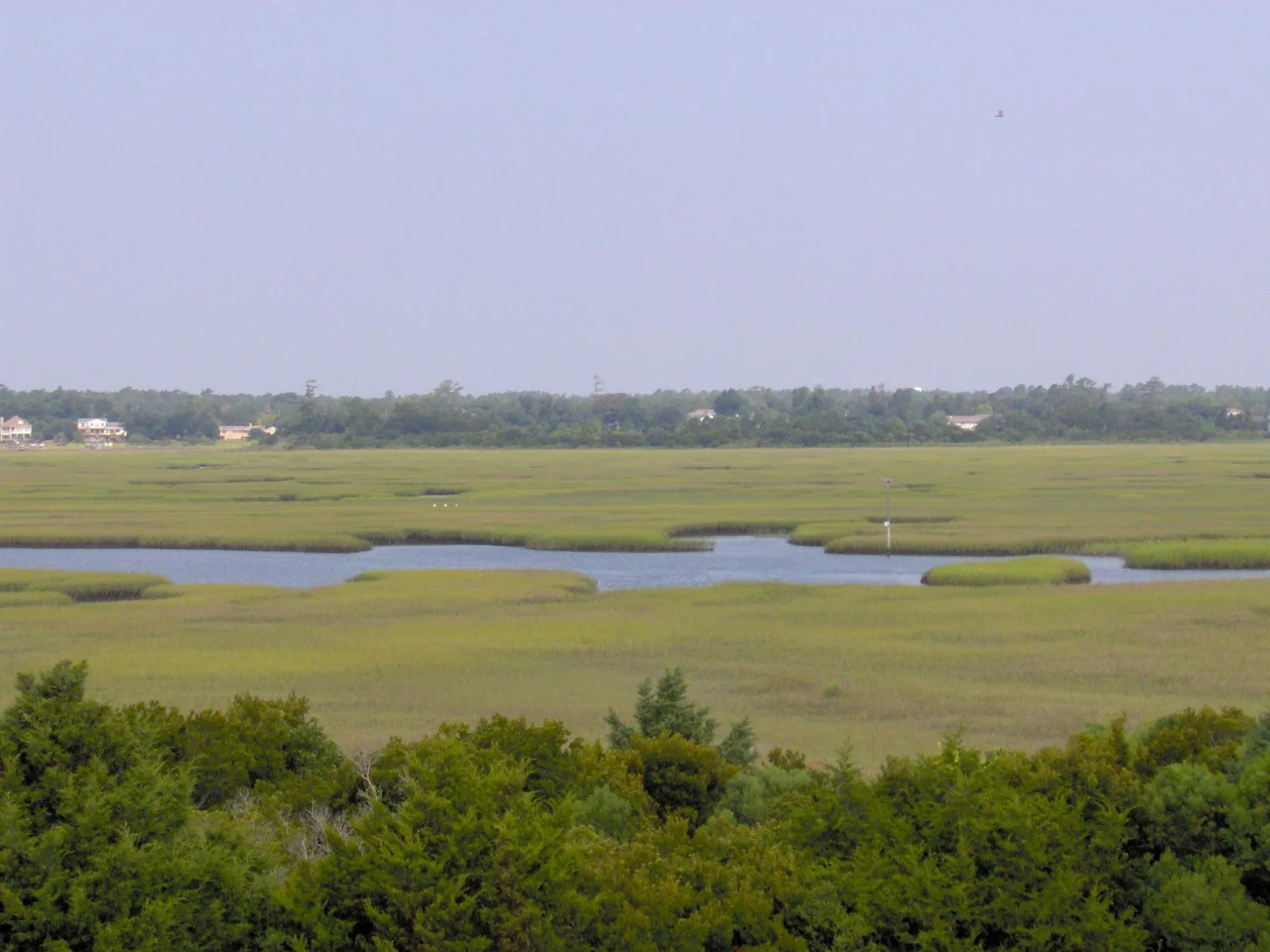

Figure Eight Island
There is one way onto Figure Eight Island that doesn't involve a boat: a guarded causeway and swing bridge, the only private bridge over the Intracoastal Waterway in the American Southeast. A uniformed gatekeeper checks your name against a list. If your name isn't there, you don't drive on. Thirteen hundred acres of sand, marsh, and oceanfront house sit on the other side, and the people who own those houses include former vice presidents, Wall Street executives, and Hollywood actors who needed a place to live during the months they were filming in Wilmington. In July 2024, an oceanfront house here sold for $13.9 million, the highest residential sale ever recorded in North Carolina.
Phantom and Wild Dayrell
Before the gated bridge, before The Hamptons of the South nickname, the waters around Figure Eight were where Confederate blockade runners died. On September 21, 1863, a Confederate screw steamer called Phantom, slipping toward Wilmington with rifle muskets, cannons, lead, whiskey, and gin, was chased into the shallows by USS Connecticut. The crew set fire to their own ship and abandoned her. A U.S. Navy landsman who approached the burning Phantom to put out the flames was shot and killed by Confederate sharpshooters from shore. Five months later, on February 1, 1864, another runner, the Anglo-Confederate Trading Company steamer Wild Dayrell, wrecked in Rich Inlet at the island's north end. The two wrecks are now part of the Cape Fear Civil War Shipwreck Discontiguous District, a registered group of sunken vessels whose remains still rest in the sand and current.
From Royal Grant to Foy Island
Figure Eight first appears in the colonial record in 1762, during the reign of George III, when the British Crown granted it as part of a larger tract to James Moore Jr., brother of Roger Moore of Orton Plantation. In 1775 it passed to American revolutionary Cornelius Harnett, who renamed it The Banks. In 1795 James Foy bought it at auction, attached it to Poplar Grove Plantation, and renamed it Foy Island. It stayed under the Foy/Poplar Grove ownership for the next 160 years, used mostly for grazing and the occasional fishing camp. During World War II, the Coast Guard kept a small structure and water tower on the island and patrolled it on horseback. Republic P-47 Thunderbolts and Bell P-39 Airacobras flying out of Bluethenthal Field, now Wilmington International, used the island as a strafing target.
How It Became Exclusive
Development started in earnest in the 1960s, with the first bridge built on top of a surplus landing ship tank. The island grew slowly, with no commercial buildings, no hotels, no restaurants. Just houses. After Dino De Laurentiis opened his film studio in Wilmington in 1984, a long list of actors and directors made Figure Eight their off-set housing: Alec Baldwin and Kim Basinger, Kathy Bates, Robert Downey Jr. and Susan Downey, Andy Griffith, Richard Gere, Barbra Streisand, Paul Newman. Former Vice President Al Gore vacationed here. Wall Street executive John J. Mack owns property. So does textile heir William Johnston Armfield. Roughly 90 percent of the houses are second homes. Fewer than a hundred are ever on the rental market. The average property value exceeds $2 million. In October 2020, a house sold for $5.5 million, a state record at the time. Three years later a $13 million home broke it. In July 2024, The Whale, a 6,700-square-foot oceanfront house, sold for $13.9 million.
Birds, Plovers, Whales
For all the wealth piled onto it, Figure Eight is still a barrier island ecology. The National Audubon Society has recorded 104 bird species here. Rich Inlet on the north end is considered the southernmost nesting area for the critically endangered Great Lakes piping plover, a population that breeds along the Great Lakes shore each summer and overwinters along the Atlantic and Gulf coasts. Loggerhead turtles nest on the beach. The island has never been put under the water quality advisories that periodically affect nearby Wrightsville Beach. In November 2016 the Homeowners Association voted against pursuing a terminal groin, the kind of hardened structure that often reduces erosion at one beach by accelerating it at the next one down the coast. In June 2023, the bodies of a pygmy sperm whale and her calf washed up. In June 2025, the rib and jaw bones of a baleen whale, with cut marks indicating human contact, were reported, and NOAA opened an investigation. The island is exclusive, but the ocean does not check the guest list.
From the Air
Figure Eight Island lies at 34.271 N, 77.743 W along the Atlantic coast, about 8 miles north-northeast of downtown Wilmington and immediately north of Wrightsville Beach. From 3,000-5,000 feet AGL the island reads as a roughly figure-eight-shaped strip of sand and houses between Mason Inlet (migratory, to the south) and Rich Inlet (stable, to the north). The Intracoastal Waterway runs along its western edge; the private swing bridge crossing it is visible as a thin line connecting the island to the mainland. Wilmington International (KILM) lies about 8 miles southwest.
Nearby Stories
- Ocean Isle Beach house fire 4.7 km away
- Pender County, North Carolina 6.6 km away
- Bald Head Island 13 km away
- Marine Corps Base Camp Lejeune 16 km away
- Lake Waccamaw, North Carolina 17 km away
- The Robesonian Takeover 59 km away
- Swansboro 59 km away
- Mercury-Redstone 4 726 km away