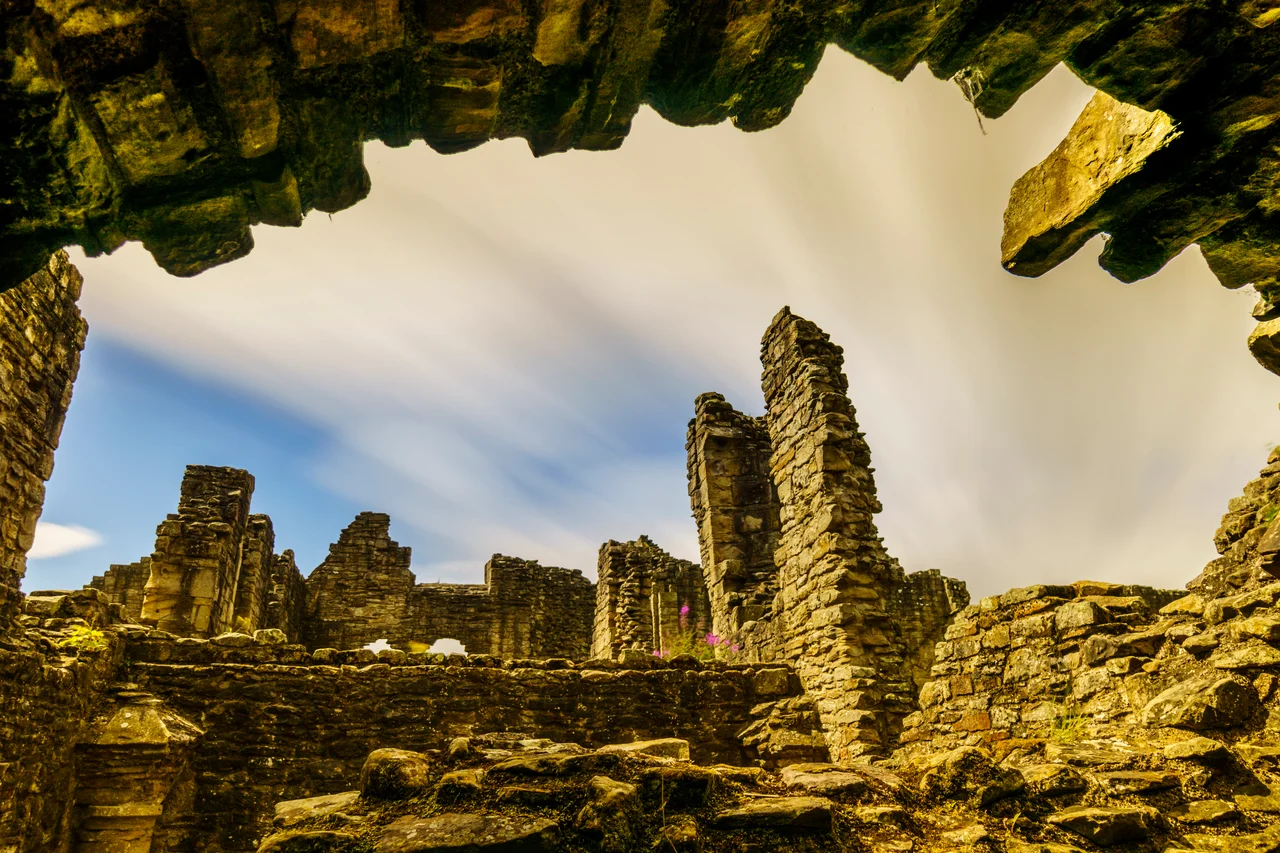

Finchale Priory
Godric started life as a merchant. He sailed, he traded, he went on pilgrimage as far as Jerusalem and Rome. Then around 1112, in his early forties, he gave up the world. He had been working as a doorkeeper at the hospital church of St Giles in Durham when he persuaded Bishop Ranulf Flambard to grant him a small piece of land by the River Wear, four miles north of the city. There Godric built a hermitage and dedicated it to St John the Baptist. He lived there for fifty years, sleeping outdoors, rejecting comfortable cloth and good food, eating sparingly. He died on 21 May 1170, almost a hundred years old. The priory that grew up after his death never forgot whose grave it was built around.
The Hermit of Wolsingham
Before Finchale, Godric had tried hermit life at Wolsingham in upper Weardale, sharing a remote cave with an older religious recluse. He had also spent time at Carlisle and on the island of Lindisfarne, drawn to places where the inhabited world thinned out into wilderness. The Durham years and the doorkeeping job at St Giles were his last engagement with city life. Once Bishop Flambard granted him Finchale, Godric set up a hermitage in a wooded loop of the River Wear and rarely left. His biographer, the monk Reginald of Durham, recorded his austerities in unflinching detail. Godric wore a hair shirt, stood for hours in cold river water, prayed through the night. Whether these accounts are exaggerated hagiography or accurate description, they made Godric famous. Pilgrims started arriving while he was still alive.
The Bedridden Saint
For almost a decade before his death in 1170, Godric was confined to his bed, possibly because of damage done to his body by fifty years of ascetic practice. The monks of Durham Cathedral took over his care. He had become a celebrity by then, a man whose visions and prophecies were taken seriously even by kings. After he died he was buried at Finchale, then moved briefly to Durham, then returned to Finchale to lie in the church that would soon rise above his grave. Two Durham monks moved out to Finchale to maintain the site, and within twenty years the bishop had decided to formalise the arrangement. Godric became a saint by acclamation, though he was never formally canonised by Rome.
Priory and Rest House
In 1196, Bishop Hugh Pudsey and his son Henry endowed Finchale as a priory dependent on Durham Cathedral. The first prior was Thomas, formerly the sacrist of Durham. The priory was small, never wealthy, but by the mid-15th century it had become the richest of Durham's dependent houses. Eight monks lived here under their prior. Construction continued for over a century after 1196, with the church developing across the 13th century and modifications continuing through the 14th. During the 1360s and 1370s the nave and chancel were narrowed by removing the aisles. The Hospitium, the guest house, dates from the mid-15th century. Most distinctively, Finchale operated as a rest facility for the Durham monks. Four monks at a time would travel out for a three-week stay, sharing the work and the relative freedom of country life.
Stone Carving and Stillness
What survives at Finchale today is mostly the late medieval phase of the priory. The ruins show heavily decorated capitals on the original arcade columns, tracery in the filled-in nave arches of the church, and on the south wall a double piscina and two carved sedilia seats where priests once sat during long services. The site has a quietness that visitors often comment on, partly because the River Wear forms a natural enclosure around the ruins, partly because the ruins themselves are not large. Finchale was never an architectural showpiece like Rievaulx or Tintern. It was a working priory and a retreat, and the buildings reflect that modesty. The site is managed by English Heritage. The precinct surrounding the ruins is now a caravan park, an unlikely but oddly fitting use for a place that has always been about temporary residents.
Dissolution and Afterlife
Finchale lasted until 1536, when Henry VIII's dissolution of the lesser monasteries ended its life as a religious community. Across its history the priory had 52 priors, and accounting records survive for much of the period from 1303 to 1535. Several of its priors went on to higher office: Robert of Stitchil and Robert de Insula both became Bishop of Durham. Henry de Stamford was elected Bishop of Durham in 1316 but never confirmed. Richard Bell, prior from 1457 to 1464, became Bishop of Carlisle. After the dissolution the buildings fell into ruin and the stone was robbed for local construction. By the 19th century the site had become a place of resort for Durham residents looking for a peaceful spot beside the river. That is largely what it remains today.
From the Air
Finchale Priory sits at 54.82 degrees north, 1.54 degrees west, on the north bank of the River Wear about 4 miles north-east of Durham city centre. Newcastle Airport (ICAO: EGNT) is 14 miles north. Teesside International (EGNV) is 28 miles south-east. The site is enclosed by a tight loop of the river in a wooded valley. From cruising altitude the priory is small and hard to identify directly, but the meander of the River Wear is distinctive and the nearby Cocken Wood and Lambton Estate provide green corridors. The A1(M) motorway runs about 1 mile east of the site. Look for the village of Pity Me and Brasside as orientation points. River fog can settle over the Wear valley on calm mornings. The North Pennines AONB rises 15 to 20 miles west; the North Sea coast is about 12 miles east.
Nearby Stories
- Hadrian's Wall Path 1.8 km away
- Killingworth 2.2 km away
- Allenheads 9.2 km away
- Nine Standards Rigg 11 km away
- Catterick Bridge Explosion 12 km away
- Rosedale Abbey 19 km away
- Saltburn Pier 20 km away
- Alexander L. Kielland (Platform) 306 km away