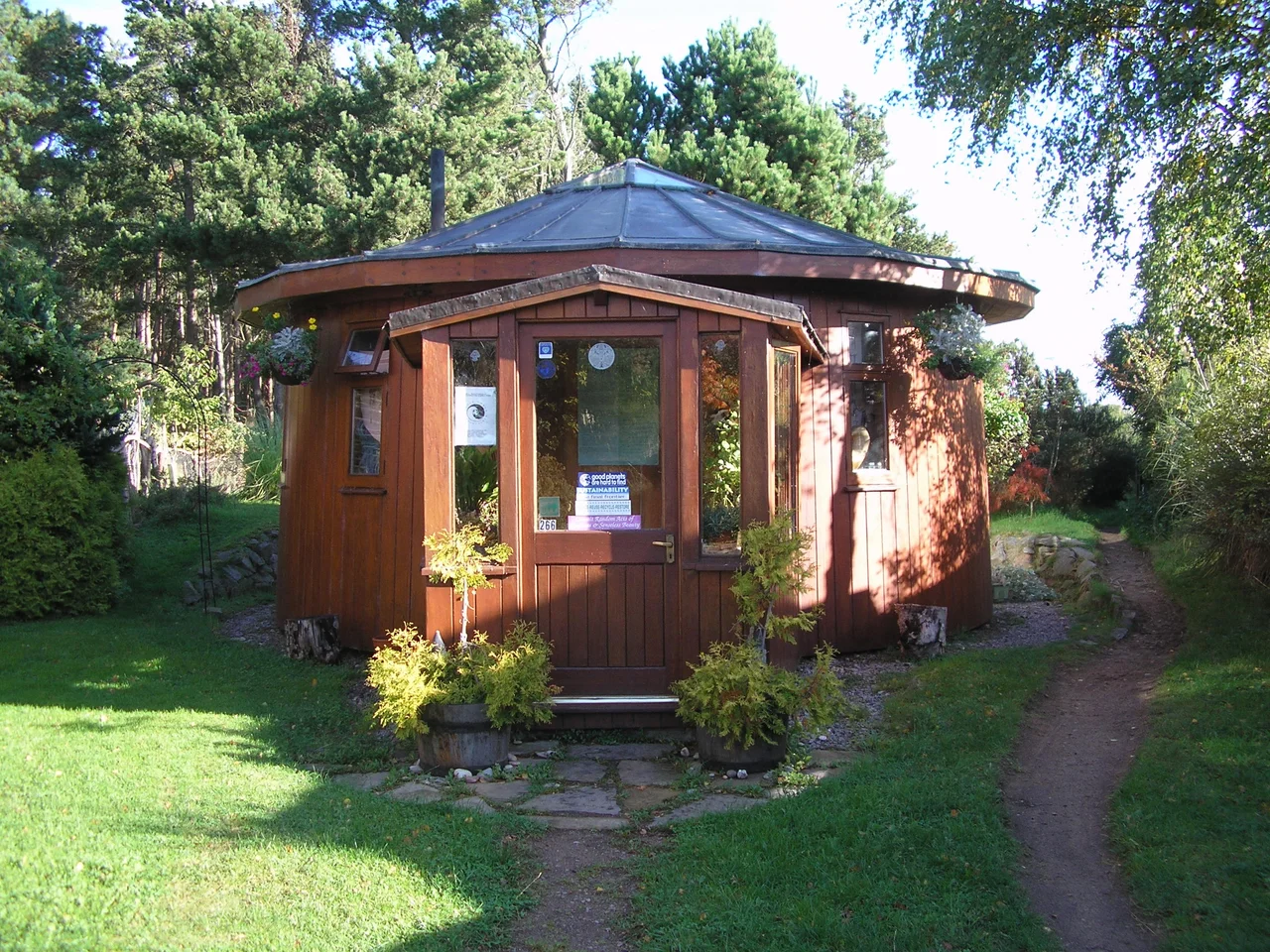

Findhorn Ecovillage
The independent study put it bluntly: nobody lives lighter on the planet than the people of Findhorn. The residents of this small intentional community on Scotland's Moray coast were measured to have the lowest ecological footprint of any community in the industrialized world - half the UK average. Then the study's authors noted, quietly, what had not been counted: the Scope 3 emissions created by the thousands of guests who flew in each year to attend Findhorn's spiritual education courses. The community is aware of the paradox and trying to resolve it. Findhorn began in 1962 as a caravan parked on a windy patch of sand dunes; ecovillage work seriously began in the early 1980s; UN-Habitat declared it a Best Practice in 1998 and again in 2018. It is one of the longest-running experiments in actually living the lifestyle that most ecological writing only describes.
From a Caravan to an Ecovillage
The October 1982 conference "Building a Planetary Village," hosted by the Findhorn Foundation, marked the formal start of trying to demonstrate a settlement that could be considered sustainable in environmental, social, and economic terms. The community at Findhorn had existed since 1962, drawing seekers, artists, and gardeners who believed something different was possible. The term "ecovillage" itself came later, and in 1995 Findhorn hosted the first international conference of ecovillages - the gathering that gave rise to the Global Ecovillage Network. At first most of the work was done by the Foundation or its trading arm. From 1990 onward, independent charities, businesses, sister communities, and practitioners grew up around the original community, extending the ecological projects in both size and variety. By 2005 the ecovillage had around 450 members, most centred on The Park - the main campus on the southern edge of Findhorn village - with others scattered across the nearby town of Forres and elsewhere in Moray.
Sewage as a Garden
In 1995 the environmental campaigner Jonathon Porritt opened Europe's first Living Machine at The Park. The Living Machine - sometimes called Eco-Restorers in the UK - is an ecologically engineered wastewater treatment system invented by the Canadian scientist John Todd. Rather than running sewage through chemical processes, the Living Machine moves it through a series of tanks filled with communities of bacteria, algae, microorganisms, plants, trees, snails, and fish that progressively break down the waste. The Findhorn installation handles sewage from a population of up to 350 people and doubles as a research and educational facility. It was constructed with assistance from the European Union. Inside the greenhouses where the tanks sit, the air is humid and the smell is faintly green rather than what visitors expect - the system works well enough that the difference between this and conventional sewage treatment is the entire point of why people come to study it.
Wind, Wood, and 70% of the Food
Four Vestas wind turbines on the Park site can generate up to 750 kilowatts - enough to make Findhorn a net exporter of electricity to the National Grid. The first V17 went up in 1989; three V29s followed in March 2006. Because the site was originally a caravan park, the ecovillage has its own private electricity grid. Smallholdings associated with the community contribute to a community-supported agriculture box scheme that provides more than 70 percent of the community's fresh food requirements, much of it grown using permaculture techniques. Phoenix Community Stores, based at The Park, is one of the largest organic retailers in northern Scotland. Most new buildings use passive solar - south-facing windows, conservatories, minimal openings on north walls - and breathing-wall construction that exchanges air and water vapor in a controlled way. Sustainably harvested wood heats many of the homes. Some of the most important factors in the low footprint are not technologies at all but the attitudes of residents who actually share laundry, kitchens, and lounges instead of duplicating them privately.
Fire, Restructuring, and a Community Buy-Out
On 12 April 2021 a major fire destroyed the community centre and main sanctuary. Police Scotland arrested a 49-year-old man, and on 6 July Joseph Clark, the community centre manager who had worked at Findhorn for sixteen years, admitted setting the fire after being made redundant. He was ordered to perform 300 hours of unpaid community work. The Sunday Post later reported that he had been one of fifty staff facing layoffs in a restructuring that left widespread hurt and anger in the community. COVID-19 and its associated loss of conference revenue accelerated changes that were already underway. In September 2023 the Findhorn Foundation stopped offering courses, conferences, and educational programmes after sixty-one years. In November 2024 the community organized a buy-out via Ecovillage Findhorn Community Benefit Society, raising 400,000 pounds in inward investment through a community bond issue. The Universal Hall and a number of other areas now belong to the community society rather than to the Foundation. The experiment continues, in a more decentralized form than before.
From the Air
Findhorn Ecovillage is at 57.65N, 3.59W, on the southern edge of Findhorn village just north of the town of Forres on the Moray coast. The site is identifiable from low altitude by its four Vestas wind turbines and the cluster of barrel houses and ecological dwellings at The Park. Kinloss Barracks (former RAF Kinloss) lies immediately south. Inverness Airport (EGPE) is 20 nm west. Findhorn Bay sits north of the site. Best viewing 2,000 to 3,500 feet AGL.
Nearby Stories
- Black Isle 2.8 km away
- Strathspey Railway (preserved) 5.7 km away
- Tarbat Ness Lighthouse 6.2 km away
- Gordon Castle 7.4 km away
- Bonar Bridge 9.7 km away
- Loch Ness Monster 14 km away
- Kildrummy Castle 17 km away
- Battle of Tannach 65 km away