
Fintona
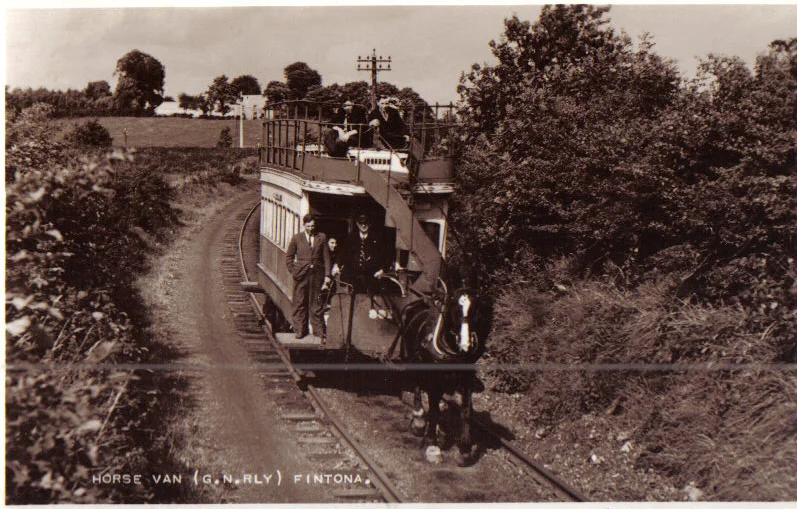
The horse was always called Dick, regardless of its sex. From 1855 until 30 September 1957 - over a century of continuous service - a horse-drawn tram ran the single mile between Fintona village and Fintona Junction railway station, hauling passengers between the village centre and the main line of the Londonderry and Enniskillen Railway. First and second class passengers travelled inside the tram. Third class sat exposed on the top, weather permitting. When Fintona's tram made its final trip in October 1957, it was the second-last working horse-drawn tram in the British Isles - only the one on Douglas promenade in the Isle of Man outlasted it, and that one is still running. The Fintona tram now sits in the Ulster Transport Museum. The village still announces itself with road signs showing Dick pulling his van, the driver, the conductor, and a third class passenger up top. No village in Ireland identifies itself quite so charmingly.
Fionntamhnach: White Field
The name Fintona derives from the Irish Fionntamhnach. Fionn can mean white, bright, blonde, or fair-coloured. Tamhnach can mean a field, a clearing, an oasis, a grassy upland, or an arable place in a mountain. The combination is usually translated 'white field,' but the more poetic reading might be 'bright clearing' or 'fair upland.' Local human activity goes back about four thousand years - the area around Fintona is dense with burial places, standing stones, stone circles, and graves from prehistoric Ireland. The current village grew from an O'Neill fortress built in 1431, making it one of the older settlements in Tyrone. After the Plantation of Ulster, the Eccles family became the dominant landowners; by 1668 they were established, and their manor house was built in 1703 on what is now the Fintona Golf Club and Ecclesville Park. The estate name - Ecclesville Demesne - still anchors the village's geography.
Dick the Horse
The Fintona horse tram operated on the single-mile spur line from the village to Fintona Junction station from 1855 onwards. By 1957, the rest of Ireland's tram and railway networks had been thoroughly modernised - electric trams, diesel locomotives, and bus services had replaced almost every horse-drawn passenger conveyance. Fintona had simply never bothered. The villagers called it 'the van' rather than the tram. Dick, the horse, would lean into the harness and walk the mile, one way and then the other, six days a week, hauling tourists and farmers and post and the occasional surprised passenger from elsewhere who could not quite believe the British Isles still had this. When the Omagh-to-Enniskillen line closed on 30 September 1957, the tram closed with it. The very last Dick was retired to a pasture; the tram itself went to the Ulster Transport Museum. The village's road signs are essentially a town logo, a quiet boast about being charmingly out of step with the twentieth century.
Two Mountains and a River
Fintona lies in the civil parish of Donacavey in south-west County Tyrone, hard against the County Fermanagh border. The village sits on a series of gentle hills, with Main Street climbing up and over a hill summit. Around four miles to the south-east, halfway between Fintona and Fivemiletown, the land rises to Murley Mountain at 312 metres - known locally as Fivemiletown Mountain or Stranisk Hill. Two wind farms - Lendrums Bridge (opened 2000) and Hunters Hill (2008) - generate power from the consistent westerly winds across the summit. A small river called the Quiggery Water rises on Murley's northern slopes and flows through Fintona, joining the Ballynahatty Water to form the Drumragh River, which in turn meets the Camowen at Omagh to make the River Strule. The climate is classic Ulster oceanic - cool to mild winters with frequent frost, cool to moderate summers rarely peaking above 24°C, and rain most months of the year.
Two Churches and a Golf Course
Fintona's modern village life is shaped by its two primary schools, three church communities, and the recreational facilities at Ecclesville Demesne. Denamona Primary School (controlled) and St. Lawrence's Primary School (Catholic maintained) educate the village's children up to age eleven; for secondary school students travel to Omagh, Dromore, or Fivemiletown. The Catholic church of St. Lawrence's, the Church of Ireland parish church on Ecclesville Road, the Methodist Church and the Presbyterian Church on Craigavon Road, an Independent Methodist congregation on Kiln Street, and a Christian Brethren hall on Loughmuck Road give a small population of around 1,200 a generous range of Sunday worship options. Fintona Golf Club, founded in 1904, is set on part of the Ecclesville Demesne and has nine holes with twin tees so a second round plays differently. Ronan Rafferty - the European Tour winner - rated it the best nine-hole course in Northern Ireland. Fintona Pearses, the GAA club founded in 1916, won the Tyrone Junior Football Championship in 2023. The village has produced the footballer Gerry Armstrong, born here in 1954 and a member of Northern Ireland's 1982 World Cup squad, and the poet John Montague, born here in 1929. A small place still rich in what village life can be.
From the Air
Coordinates 54.50°N, 7.32°W, in south-west County Tyrone hard against the County Fermanagh border. From 3,000 feet AGL the rolling Donacavey country and the wind farms on Murley Mountain to the south-east are clear; Omagh lies 8 miles north. Nearest airports are St Angelo (EGAB) at Enniskillen about 18 nm south-west and Belfast International (EGAA) about 45 nm east. Watch for the wind farm activity around Murley and the typical oceanic weather changes off the Atlantic.
Nearby Stories
- Maghera 0.4 km away
- Altinaghree Castle 4.7 km away
- Pettigo 7.1 km away
- Coalisland Canal 7.7 km away
- Marble Arch Caves Global Geopark 8.3 km away
- Rockhill Barracks 10 km away
- County Monaghan 14 km away
- Kingsmill Massacre 19 km away