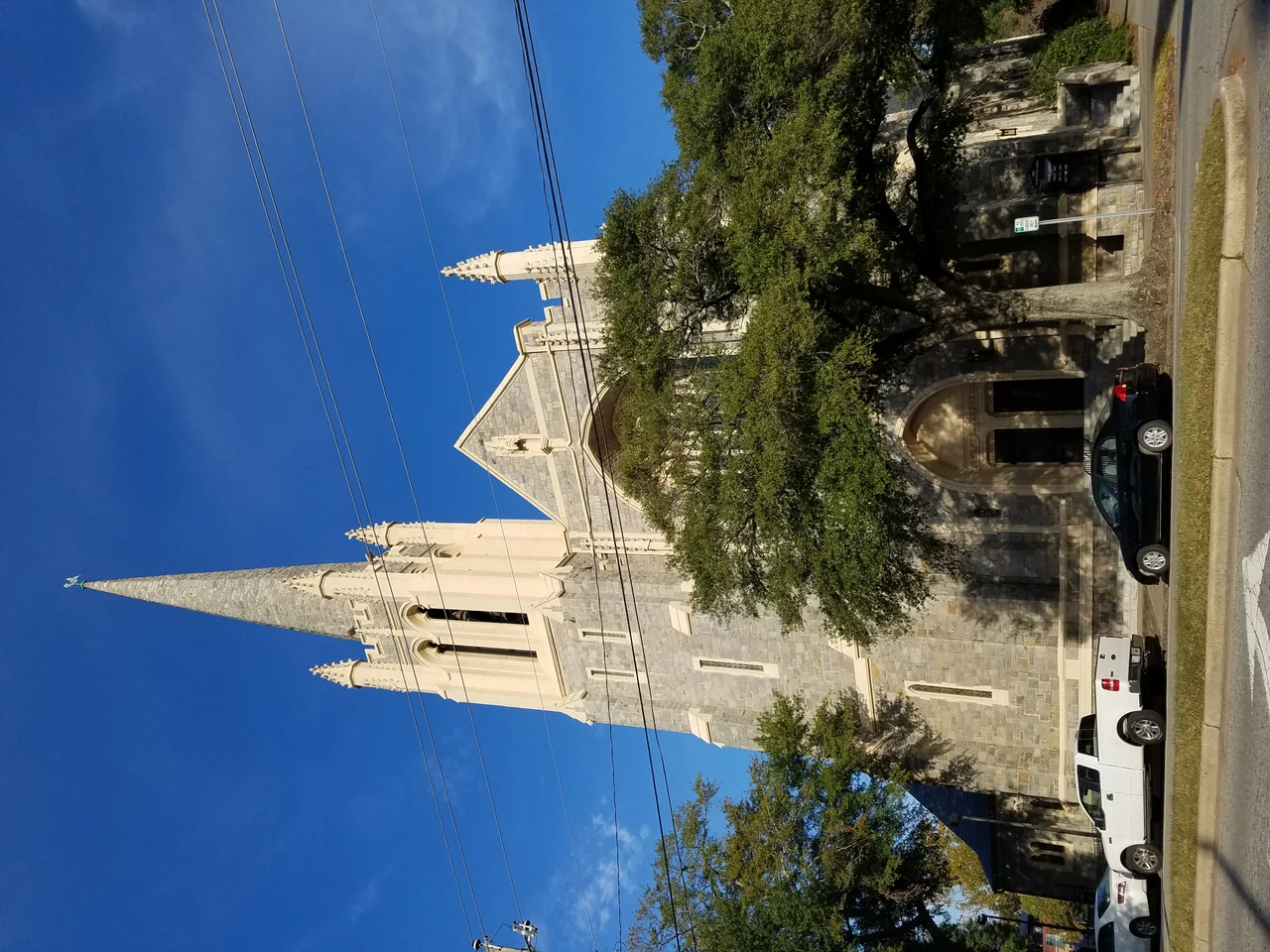

First Presbyterian Church
The Bible on the lectern survived because someone stole it. When Union forces occupied Wilmington in February 1865, a soldier walked off with the pulpit Bible from the 1861 church on this corner. Sixty years later, on New Year's Eve 1925, that 1861 church burned to the ground, like the two before it. Everything inside was lost. Everything except the Bible the Union officer had carried home as a souvenir, which his descendants returned to the congregation in 1928. The current church, designed by Hobart Upjohn and completed that same year, opened with that Bible on its lectern. It is still there.
Three Buildings, Three Fires
Presbyterians have been meeting in Wilmington since at least 1760, when the first resident minister arrived. In 1785 the legislature incorporated the Protestant Presbyterian Church of Wilmington. The congregation joined the Fayetteville Presbytery in 1817 and built its first church the following year, on Front Street between Dock and Orange. That building burned. They built a second in 1821 on the same site. That one burned too. The cornerstone of the 1821 building is still here, set at the foot of the stairs of the Kenan tower. The third building, on the present site at Third and Orange, was dedicated on April 28, 1861, just weeks after the Civil War began. It served the congregation through the war, through Reconstruction, through Jim Crow, through the Wilmington massacre of 1898, through the First World War, and then burned on New Year's Eve 1925. The current, fourth building rose by 1928.
The Wilson Family
Dr. Joseph R. Wilson served as the church's pastor from 1874 to 1885. His son Thomas Woodrow Wilson, who would become the 28th President of the United States, was a college student during those years. He spent one full year and most of his school vacations living with his parents in the manse on the corner of Fourth and Orange Streets. He attended this church. He sat in these pews, or rather in the pews of the church that stood here before the 1925 fire. A copy of a letter he wrote back to the congregation in 1886 is preserved in the southeast corner of the sanctuary. Wilson's presidency, which spanned 1913 to 1921, included the formal segregation of the federal civil service and is recognized today as a profoundly damaging chapter for Black federal employees and for civil rights. The church holds the connection without comment. History is more complicated than reverence usually admits.
Upjohn's Synthesis
The current building is the work of Hobart Upjohn, grandson of Richard Upjohn, who designed Trinity Church on Wall Street. Hobart inherited the family's Gothic Revival sensibility and pushed it into the 20th century. For First Presbyterian, he combined three medieval styles in three parts of the complex: Norman in the Kenan Memorial Chapel, English Decorated Gothic, with French influence, in the main sanctuary, and Elizabethan in the Church School Building. The clerestory windows, designed by Henry Lee Willet of Philadelphia, work through the I Am sayings of Christ from the Gospel of John, moving from Creation through the Nativity through the Ministry to Pentecost. The smaller lancet windows along the aisles carry the theme Christ, the Lord of Life. The Great West Window, given in 1986 in memory of Colonel Walker Taylor, places a descending dove above a triumphant Christ. The windows in the Kenan Chapel, made by Owen Bonawits of New York, depict the Twelve Apostles in antique stained glass.
The Skinner and the Noack
The sanctuary organ was built by Ernest M. Skinner, one of the most celebrated American organ builders of the early 20th century. Skinner tuned the instrument to the room. After a recent renovation, the organ is supposed to sound the way it did when Skinner finished it almost a century ago. The instrument is a memorial to James Sprunt, a ruling Elder in the church and the same Sprunt whose cotton exchange a few blocks away helped name the Cotton Exchange shopping complex. The smaller chapel organ was a 1993 gift from the Kenan family, built by the Noack Organ Company of Georgetown, Massachusetts: a two-manual, one-pedal instrument with nine stops, scaled to fit the Norman architecture of the chapel. A new office wing was added in 1995, sympathetic in Elizabethan style to the older school building. The kitchen got enlarged. The library and a small history room joined the complex. The church continues to support overseas mission work, including a medical mission in Haiti that periodically sends physicians from the congregation.
From the Air
First Presbyterian Church sits at 34.233 N, 77.945 W in downtown Wilmington, at the corner of South Third and Orange Streets. From 1,500-3,000 feet AGL the building reads as a substantial Gothic Revival pile with a square tower (the Kenan tower) rising above the surrounding rooftops. The Cape Fear River lies four blocks to the west. Wilmington International (KILM) lies about 5 miles north.
Nearby Stories
- Ocean Isle Beach house fire 4.7 km away
- Pender County, North Carolina 6.6 km away
- Bald Head Island 13 km away
- Marine Corps Base Camp Lejeune 16 km away
- Lake Waccamaw, North Carolina 17 km away
- The Robesonian Takeover 59 km away
- Swansboro 59 km away
- Mercury-Redstone 4 726 km away