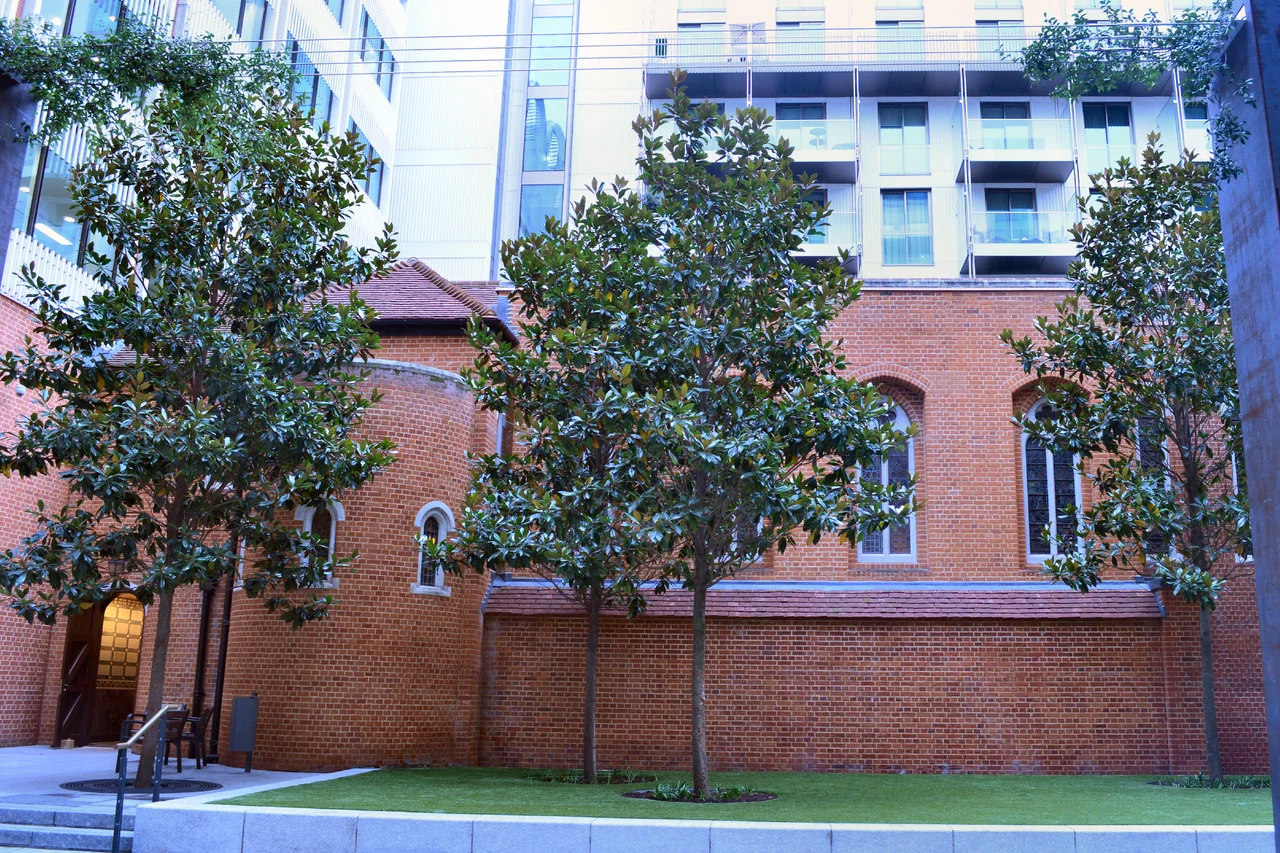

Fitzrovia Chapel
The Middlesex Hospital stood on this site for nearly two centuries. Its chapel was built in 1891 and 1892, designed by John Loughborough Pearson in the Italian Gothic style, with a rib-vaulted ceiling and surfaces decorated in polychrome marble and mosaic. When the hospital was rebuilt between 1929 and 1935, the work was done around the chapel rather than through it. When the hospital closed and was demolished between 2008 and 2015, the chapel was preserved again while everything else came down. It stood alone in the rubble for years, a Grade II* listed building surrounded by hoardings, until the residential development of Fitzroy Place was built around it. The chapel survived every institution that had contained it.
Pearson's Interior
John Loughborough Pearson was one of the great Victorian church architects, responsible for Truro Cathedral and Queensborough Terrace. The Middlesex Hospital Chapel, built in the last years of his life, shows his mastery in miniature: a rib-vaulted ceiling of unusual elegance, surfaces sheathed in polychrome marble and mosaics, the colour deep and jewel-like in a space that receives little natural light. Pearson died in 1897, before the interior was complete; the finishing work was overseen by his son Frank Loughborough Pearson, and the mosaics were completed in the 1930s by Maurice Richard Josey and his son John Leonard Josey. The interior was completed 32 years after Pearson's death, by craftsmen working from his original vision.
The First AIDS Ward
The Middlesex Hospital held a place in the history of the AIDS crisis. The Broderip Ward, opened in 1987, was the first dedicated AIDS ward in London. Diana, Princess of Wales, opened the ward, and photographer Gideon Mendel chronicled the lives of patients there in 1993. When the Friends of the Fitzrovia Chapel mounted their first exhibition in 2017, they chose The Ward as its subject — following the lives of four young men who had been treated in the Broderip and Charles Bell Wards. The photographs documented suffering and care and community at a time when the disease was terrifying and the stigma overwhelming. Showing this history in the chapel that had stood in the hospital's courtyard throughout those years connected the building to the institution it had served.
A Venue in Unlikely Surroundings
Since the hospital's closure, the Fitzrovia Chapel has functioned as an arts venue in a residential development in the heart of Fitzrovia. Grayson Perry's alter ego Claire has been photographed here. Katie Melua has recorded here. Lee Miller's wartime photographs of nurses across Europe have been exhibited within these walls. The chapel hosted an exhibition celebrating Leigh Bowery, the Australian performance artist whose extravagant costuming made him a figure of fascination and scandal in 1980s London. In 2024, King Charles III recorded his Christmas message at the chapel, in a break from the traditional locations used by the Royal Family. The building that was always an exception — too beautiful to demolish, too sacred to repurpose easily — has found a life as a place where art and memory and ceremony can still happen.
Gothic in the West End
The chapel's address — Pearson Square, in the centre of the Fitzroy Place development — gives it a strange contemporary context. The residential buildings that surround it are new; the streets beyond are Fitzrovia's usual mix of Georgian terraces, media offices, and restaurants. To walk into the chapel from that environment is to make an abrupt transition. The Italian Gothic interior, with its rich colour and vertical emphasis, belongs to a different tradition from the English Baroque of Hawksmoor or the Georgian restraint of the surrounding neighbourhood. Pearson designed it to feel sacred, to feel removed from the noise outside. The fact that the hospital came down while the chapel remained standing suggests that the building made that argument successfully.
From the Air
Located at 51.519°N, 0.138°W at Pearson Square in Fitzrovia, Westminster. The chapel is set within the Fitzroy Place development, bounded by Mortimer Street, Cleveland Street, Nassau Street, and Riding House Street. Oxford Circus tube station is approximately 500 metres south.
Nearby Stories
- Stevenage 5.7 km away
- Malling Abbey 5.7 km away
- 1952 Farnborough Airshow Crash 7.7 km away
- Ingatestone Hall 8.2 km away
- Hellfire Caves 9.1 km away
- The Carrington Event: The Solar Storm That Could Happen Again 9.8 km away
- Bletchley Park 16 km away
- Castle Hedingham 23 km away