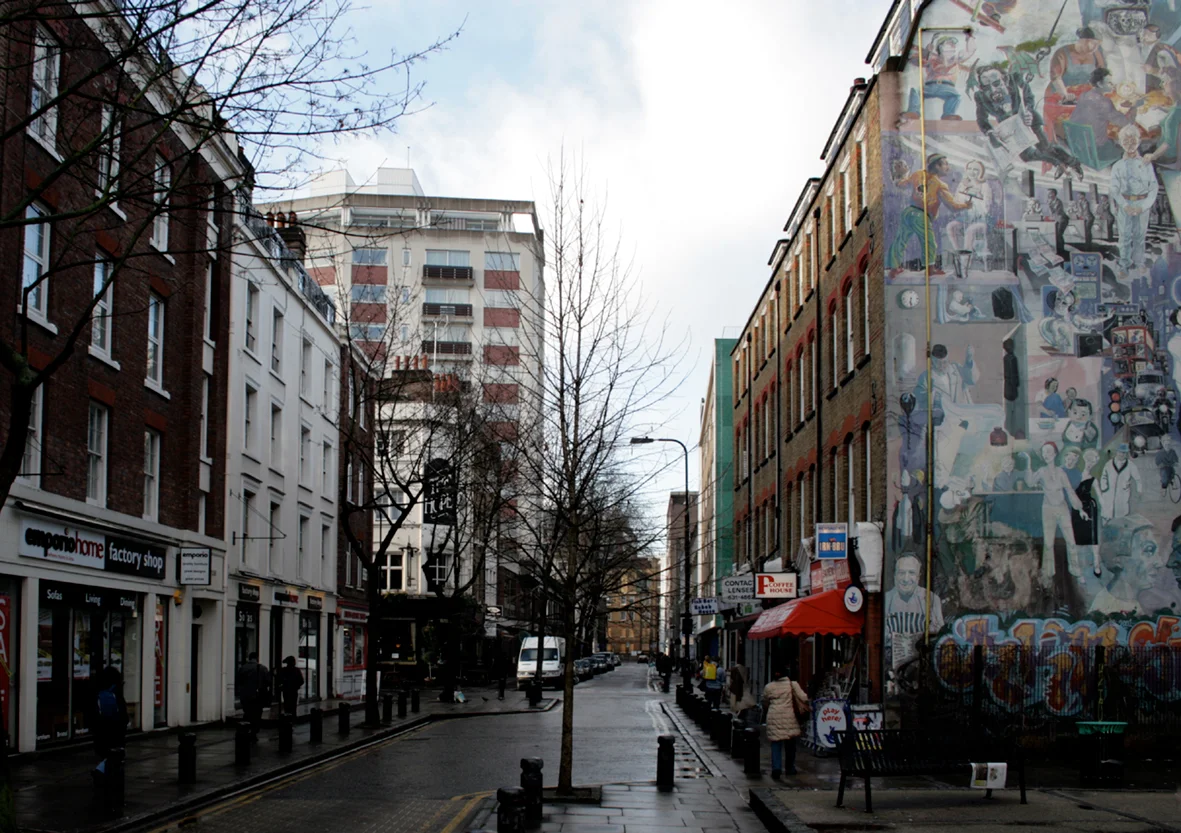

Fitzrovia
The name "Fitzrovia" was born on a pub crawl. Sometime in the early 1940s, a Sri Lankan poet named Meary James Thurairajah Tambimuttu — known simply as "Tambi" — was guiding the writer Julian MacLaren-Ross through a circuit of Charlotte Street taverns when he gestured at the surrounding streets and declared them "Fitzrovia." The name stuck, though the neighbourhood it described had no official boundaries, no administrative existence, and to this day appears on no government map. What it has, instead, is a century of extraordinary residents and a stubborn genius for reinvention.
Son of a King's Bastard
The streets of Fitzrovia carry the names of their aristocratic landowners like a genealogical puzzle. The FitzRoy family — whose surname is Norman-French for "son of the king" — derived from Henry FitzRoy, 1st Duke of Grafton, an illegitimate son of Charles II and Barbara Villiers. The Dukes of Grafton owned this land until the 19th century, which explains why Fitzroy Square, Fitzroy Street, Grafton Way, and Grafton Mews all cluster here. Add the Portlands, whose Margaret Harley lent her family's names to Portland Place, Great Portland Street, and Harley Street — itself named after her father, Edward Harley, 2nd Earl of Oxford — and you have a district where walking the streets means reading a compressed history of English aristocracy. The area's ancient roots go back to the manor of Tottenham Court, recorded in a charter from around AD 1000 and appearing in the Domesday Book of 1086 as "Totehele."
Where the Bohemians Drank
By the 1930s, Fitzrovia had developed a second identity as London's bohemian quarter, cheaper than Soho and less respectable than Bloomsbury. Virginia Woolf lived at 29 Fitzroy Square from 1907 to 1911, before her Bloomsbury years. Arthur Rimbaud and Paul Verlaine had lived on Howland Street decades earlier. By the wartime years, the Fitzroy Tavern and the Wheatsheaf on Rathbone Place drew a remarkable cross-section of writers, painters, and eccentrics: Dylan Thomas drinking himself toward legend, Augustus John with his wild beard, the occultist Aleister Crowley, the racing tipster Prince Monolulu in his feathered costume, and the artist Nina Hamnett. George Orwell frequented the Newman Arms on Rathbone Street so faithfully that he wrote it into both Keep the Aspidistra Flying and Nineteen Eighty-Four. French poet Donovan captured a later generation's Fitzrovia in his 1965 song "Sunny Goodge Street" — reportedly the first mention of hashish in pop music.
The Tower That Lost Its Top
Fitzrovia's most visible landmark today is the BT Tower on Cleveland Street, one of London's tallest structures. For a time it had a revolving restaurant at the top, open to the public — until a bomb exploded there in October 1971, claimed by the Angry Brigade, a far-left anarchist group. The IRA denied involvement. The restaurant closed and the tower became access-restricted, though it continued transmitting. The building's presence above the Georgian and Victorian rooflines defines Fitzrovia's skyline in the same way the bohemian myths define its character: a little unpredictable, slightly battered, still functional. More quietly, the area was also home to the Cleveland Street Workhouse, an 18th-century poorhouse for the parish of St Paul's, Covent Garden, whose proposed demolition in 2010 provoked substantial community opposition.
The People Live Here
Fitzrovia's identity nearly dissolved in the 1960s and 1970s as offices consumed its housing stock and the bohemian community dispersed. The recovery came from an unlikely source: a local festival. In 1973, organizers seeking to reclaim the district as a residential neighbourhood needed a name for their campaign. An elderly resident named Eric Singer remembered hearing "Fitzrovia" in the 1940s, and suggested it. The first Fitzrovia Festival carried the theme "The people live here!" — a declaration against gentrification before that word existed. The name, revived for civic protest, became the neighbourhood's permanent identity. Today over 128,000 people work within half a mile of Fitzrovia, according to the Fitzrovia Partnership's 2014 Economic Report, and despite The Sunday Times naming it the best place to live in London in 2016, parts of the district remain classified as above-averagely deprived.
Charlotte Street and Its Descendants
Charlotte Street became the spine of British advertising for much of the 20th century, home to agencies including Saatchi & Saatchi and TBWA, and it remains thick with restaurants. The fashion industry, once the dominant trade of the area's warehouses and workshops, gave way to media companies: MTV Networks Europe, CNN Europe, and Channel 4 all occupied Fitzrovia offices. What the neighbourhood has retained, amid all the reinvention, is a resistance to any single definition. It is not purely residential, not purely commercial, not purely creative. It is, as its Victorian planners noted of their grid of streets, a mixture — a quality it appears to treat as its founding principle.
From the Air
Fitzrovia sits at approximately 51.52°N, 0.14°W in central London, between Oxford Street to the south and Euston Road to the north. The BT Tower on Cleveland Street is a distinctive landmark visible from altitude. Nearest airports are London City (EGLC, approximately 10nm east) and Heathrow (EGLL, approximately 14nm west). Flying east from Heathrow at low altitude, the cluster of Georgian and Victorian rooflines with the BT Tower rising above them marks Fitzrovia's approximate boundaries.
Nearby Stories
- Stevenage 5.7 km away
- Malling Abbey 5.7 km away
- 1952 Farnborough Airshow Crash 7.7 km away
- Ingatestone Hall 8.2 km away
- Hellfire Caves 9.1 km away
- The Carrington Event: The Solar Storm That Could Happen Again 9.8 km away
- Bletchley Park 16 km away
- Castle Hedingham 23 km away