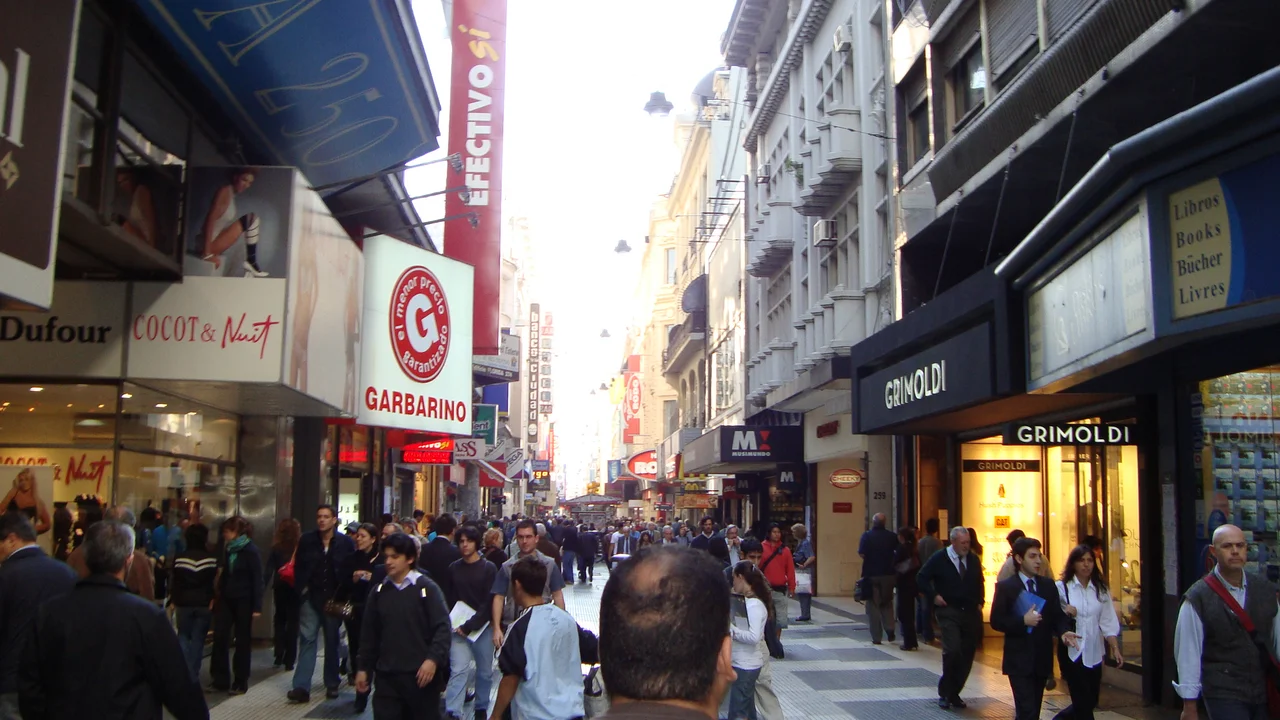

Florida Street
Stand at the corner of Florida and Lavalle on a weekday afternoon and the crowd never quite stops moving. Shoppers, office workers, vendors, and a knot of onlookers around a tango couple dancing on the paving stones all share a street with no cars, just a river of people flowing the kilometer from the Plaza de Mayo to the parkland of Plaza San Martin. Florida Street has been a pedestrian thoroughfare in name since 1971, with stretches closed to traffic as far back as 1913, but the truth is older than that. People have been walking this exact line since 1580, when the founders of Buenos Aires cut a primitive path up the slope from the banks of the Rio de la Plata. The street has changed its name and its fortunes many times since. It has never stopped being where the city walks.
A Street With Many Names
Florida has been called many things. Its first official name, fixed by Governor Miguel de Salcedo in 1734, was San Jose. Locals knew it as the Calle del Correo, Post Street, for the post office at its southern end, and later as the Empedrado, the Cobbled Street, after boulders shipped from Montevideo in 1789 made it the first paved road in the city. A surviving patch of that original cobblestone is displayed behind the entrance to Catedral subway station. After the British invasions of the Rio de la Plata it briefly honored a fallen officer, Baltasar Unquera. The name Florida arrived in 1821, commemorating a battle fought in 1814 in Upper Peru during the wars of independence. Governor Juan Manuel de Rosas changed it to Peru in 1837, but by 1857 Florida had returned for good. One small house on the street had already entered history: the Argentine National Anthem was first performed in 1813 in the home of Mariquita Sanchez de Thompson, one of the city's most prominent citizens.
The Age of the Grand Stores
The street became a shopping street in 1872, and in the decades that followed it dressed itself in the latest European fashion. Pharmacies, jewelers, and haberdashers gave way to something grander when the Parisian-inspired Bon Marche opened in 1889 as Florida's first large shopping arcade. In 1914 the Gath and Chaves department store opened the same year as Harrods Buenos Aires, the only branch the famous London store ever established outside Britain. Their 1922 merger produced two of the most ornate retail palaces in the Americas. Above it all rose the illuminated spire of Galeria Guemes, opened in 1914 and briefly one of the tallest buildings in the city. These were temples of commerce, and for a time Florida Street was their cathedral close, the address every great Argentine institution wanted, from the newspaper La Nacion to the country's first corporate headquarters.
Frescoes and Famous Tables
The street's masterpiece survives at its northern end. Galerias Pacifico fills nearly an entire block, a monumental building raised in 1888 to house the Au Bon Marche shops and modeled on Milan's Galleria Vittorio Emanuele II, with its cross-shaped passages and central glass dome. For a time it held the National Museum of Fine Arts, and later the offices of the Buenos Aires and Pacific Railway. Restored in 1991, its great central cupola, completed in 1945, blazes with murals by some of Argentina's finest painters, among them Antonio Berni and Juan Carlos Castagnino. Florida was a literary street too. Near its northern end lived Jorge Luis Borges, who liked to walk the half-empty pavement in the pre-dawn hours, and who gathered with other avant-garde writers at the Richmond Cafe. When the street was rebuilt in 1970, Borges, by then blind, was among its loudest critics: the new clutter of planters, trash cans, and magazine stands was, for a man who navigated by memory, a genuine hazard.
Decline, Crowds, and Survival
Florida has endured shocks that would have killed a lesser street. In 1953 a Peronist mob burned the aristocratic Jockey Club building that stood on the 500 block, which they saw as a fortress of anti-Peronism; the lot lay empty for more than two decades. The city's wealth drifted north to Recoleta and Palermo, the shopping malls of the 1990s drew the crowds away, and Harrods Buenos Aires finally closed in 1998 after a long decline. Yet the street refused to empty. It still commands some of the highest commercial rents in Buenos Aires, and its evenings still belong to street performers, tango singers, comics, and the living statues who hold their poses for the foreign tourists who arrive in growing numbers. The Jockey Club is gone, Harrods is shuttered, but the river of people on the paving stones flows on, exactly where it has flowed since 1580.
From the Air
Florida Street runs through the downtown core of Buenos Aires, a roughly one-kilometer line from near the Plaza de Mayo north to Plaza San Martin in the Retiro district, centered around 34.6077 degrees south, 58.3750 degrees west. The narrow pedestrian street cannot be seen from altitude, but it threads through one of the densest parts of the city, just inland from the Rio de la Plata waterfront and the port. Easy landmarks for orientation include the Plaza de Mayo with the pink Casa Rosada at the street's southern end, the wide Avenida 9 de Julio with its central Obelisk a few blocks west, and the green square and Kavanagh Building at Plaza San Martin to the north. The area lies about 4 km south of Aeroparque Jorge Newbery (ICAO SABE) on the river, with Ministro Pistarini (Ezeiza) International (ICAO SAEZ) some 30 km to the southwest. The city sits at sea level; clear, low conditions give the best read of the downtown grid.
Nearby Stories
- Ezeiza Massacre 1.9 km away
- Luján, Buenos Aires 5.1 km away
- Curutchet House 13 km away
- Colonia del Sacramento 17 km away
- Martín García Island 28 km away
- Atucha Nuclear Power Plant 37 km away
- Lobos 43 km away
- Cry of Asencio 87 km away