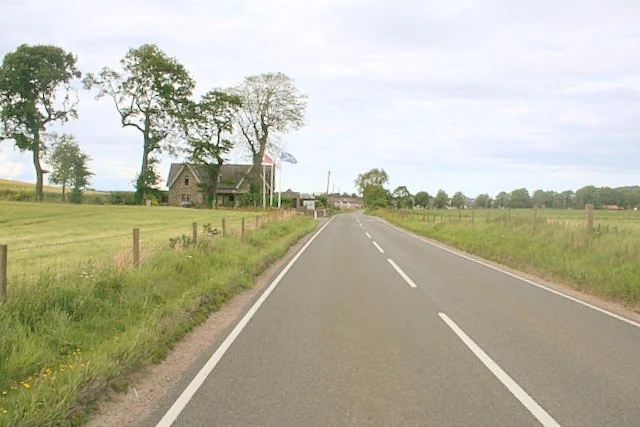

Forres
"How far is't called to Forres?" Banquo asks the witches in the third scene of Macbeth, after they have appeared on a heath outside the town - which gives Forres the distinction of being the only Scottish town namechecked by a man who is, in the play, about to be murdered by his best friend. Real Forres is more peaceful than its theatrical reputation suggests. Population 9,090 as of 2020. A small town on the Moray coast, twenty-five miles east of Inverness, sitting where the Findhorn estuary meets the firth. Claudius Ptolemy mapped it in the second century AD as Varar Estuary, which suggests it was already famous in the Roman world for reasons no one now remembers. Modern Forres trades in whisky distilleries, an elegant castle nearby, and the kind of well-preserved Victorian streetscape that becomes possible when a town gets a bypass.
Macbeth Was Real, the Witches Were Not
Duncan I, King of Scots from 1034, was not the saintly grey old man Shakespeare made him. He attacked Durham in 1039 and his army limped home shattered. The following year he marched north against Moray - a large semi-autonomous territory ruled by a warlord named Macbeth - and Macbeth killed him in battle near Elgin. By the laws of the Scottish succession of the time this was politics, not regicide, and Macbeth was duly crowned King of Scotland. He ruled for seventeen years. Shakespeare, writing 560 years later in an England where King James VI of Scotland had become King James I and where witch-hunts had become a national pastime, decided he could improve the story by adding three witches, a ghost, prophecies, and a murderous queen. The Three Witches met on the heath just outside Forres. Duncan's castle, in the play, was here, while Macbeth's was at Inverness. None of the supernatural details were true. The murder itself was a normal medieval battle. Macbeth's line eventually died out, which is why Shakespeare could safely depict him as a villain - no descendants remained to take offense.
Sueno's Stone and the Three Witches in the Glass
At the eastern edge of town stands Sueno's Stone, a 6.5-meter sandstone slab covered in Pictish carvings, probably from around the tenth century. Nobody knows who Sueno or Sven actually was, if he existed at all - the stone almost certainly commemorates a battle victory but the historical record is silent on which battle. The stone now stands inside a tall glass case that protects it from the weather and from graffiti. Local legend tells a more entertaining purpose for the case: it keeps the three witches of Macbeth from escaping. The Witches Stone on Victoria Road, just east of Grant Park, is a boulder said to mark where an 11th-century witch was elaborately put to death for cursing King Duncan. The story does not stand up - witch-hunts did not really get going in Scotland until centuries later, when James V more than made up for the previous five hundred years of relative restraint - but the boulder is still there, and visitors still photograph it.
Distilleries, Floral Sculptures, and Dava Way
Forres has whisky in its hinterland. Benromach Distillery sits just north of the bypass and runs an active visitor centre. Dallas Dhu, just south of town, is a perfectly preserved 1899 distillery operated as a museum since 1992 and slated to start production again under new ownership. Glenburgie Distillery, five miles east toward Burghead, makes 4.2 million litres of pure alcohol per year, almost all of it destined for blends. The town centre is mostly Victorian low-rise, considerably more peaceful since the bypass was built in the late 1980s. Forres has won the Scotland in Bloom award multiple times, and the floral sculptures along Grant Park draw visitors who would not otherwise stop here. The Dava Way - a 24-mile path along an old railway from Forres to Grantown-on-Spey - turns Forres into a useful base for hikers, with the Moray Coast Trail closing a 95-mile triangle to the east through Buckie.
The Findhorn Foundation Just Up the Road
Six miles north of town, on the edge of Findhorn Bay, sits one of the most influential New Age spiritual communities in the world. The Findhorn Foundation began in 1962 when Peter and Eileen Caddy parked a caravan near the village and started growing improbably large vegetables. By the 1970s it was a residential education centre attracting thousands of visitors a year. The Foundation closed its courses in September 2023, but the ecovillage continues under community ownership, and the village of Findhorn itself remains a destination - Moray Art Centre keeps weekend hours at Findhorn, and the Kimberley Inn and Crown & Anchor Inn anchor the village social life. Bus 31 runs hourly from Forres to Findhorn in about thirty minutes. Forres also serves as a transit point - trains from Inverness run every couple of hours, and Stagecoach Bus 10 runs every thirty minutes from Inverness via Nairn, taking just over an hour. The town has no bus station; the buses simply follow High Street, which is a fair description of how Forres handles most things.
From the Air
Forres lies at 57.61N, 3.62W in Moray on the A96 corridor, 25 miles east of Inverness and 12 miles west of Elgin. Identifiable from low altitude by its position between the wooded slopes of Cluny and Sanquhar Hills (south) and the floodplain of the River Findhorn (west), with Findhorn Bay 4 miles north. The A96 bypass marks the northern edge of town. Inverness Airport (EGPE) is 20 nm west. RAF Kinloss (now Kinloss Barracks) lies 3 miles north. Best viewing 2,000 to 3,500 feet AGL.
Nearby Stories
- Black Isle 2.8 km away
- Strathspey Railway (preserved) 5.7 km away
- Tarbat Ness Lighthouse 6.2 km away
- Gordon Castle 7.4 km away
- Bonar Bridge 9.7 km away
- Loch Ness Monster 14 km away
- Kildrummy Castle 17 km away
- Battle of Tannach 65 km away