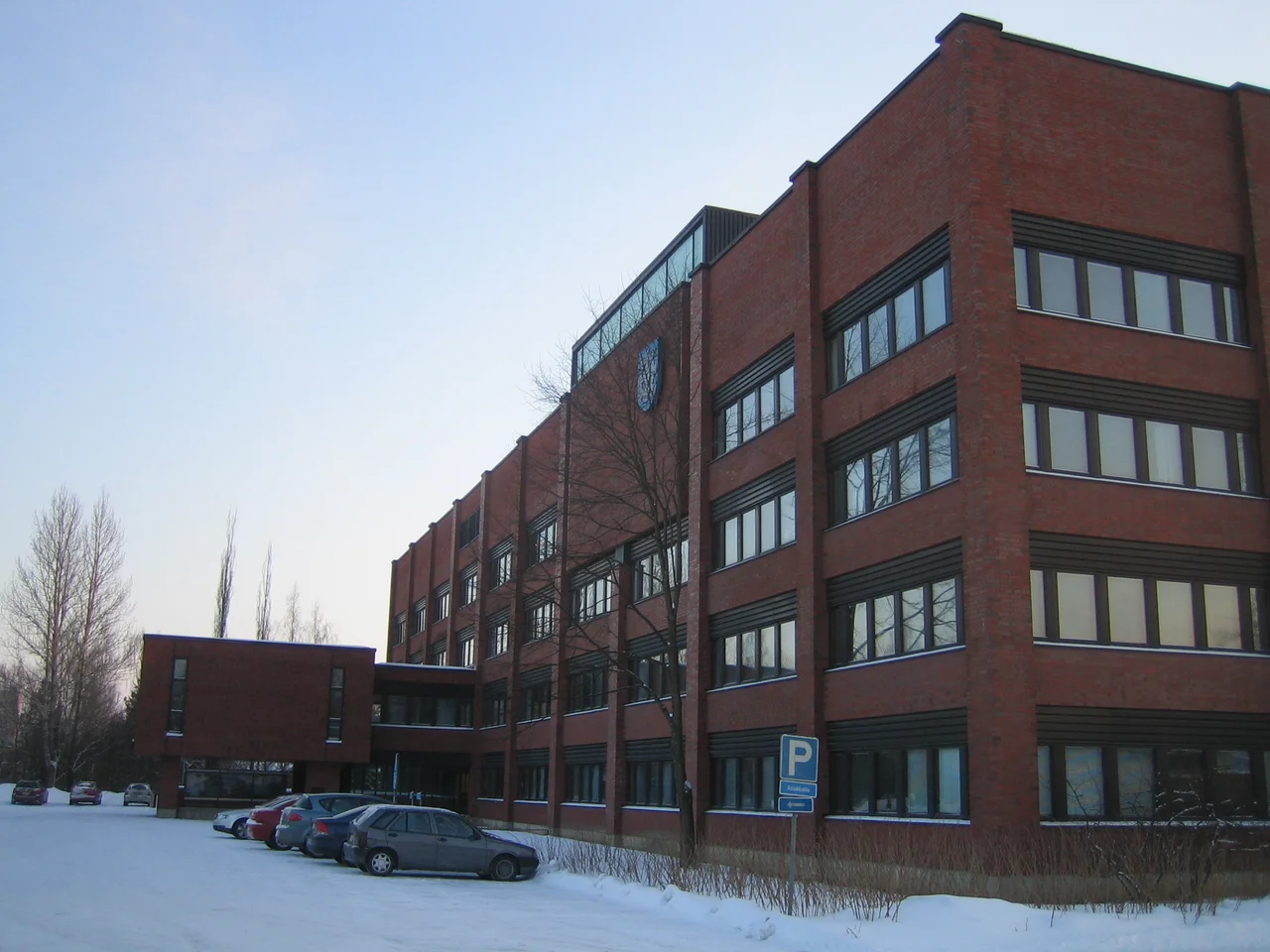

Forssa
The town speaks Finnish and only Finnish, and its name is Swedish. Fors means rapids. The rapids in question run through the middle of Forssa on the Loimijoki, and they are the reason there is a town here at all. In 1847 a Stockholm-born entrepreneur named Axel Wilhelm Wahren looked at that stretch of falling water and put a spinning mill beside it. Everything the place became afterwards - a company town, a red town, a town that learned what it feels like to shrink - unspooled from that one decision. The coat of arms adopted in 1962 shows a single silver waterwheel on a blue field, which is about as honest as municipal heraldry ever gets.
The Man Who Built a Town Around a Waterwheel
Wahren was born in Stockholm in 1814 and died in Forssa in 1885, and in between he assembled something Finland had not seen before: an industrial community in open countryside rather than at a port or a capital. The spinning mill came in 1847, a weaving mill in 1854. By the end of the 1850s more than three hundred people worked there, most of them women and girls drawn in from the surrounding parishes, and the company did not stop at wages. It ran the school, the library, the healthcare, a brewery, a hotel and the shops. Housing came with the job. This was paternalism in its purest nineteenth-century form - genuine welfare, delivered by the same hand that set the hours. Wahren was made a commercial counsellor in 1876, began generating hydroelectric power at the mill in 1877, and was ennobled in 1883.
What the Workers Wrote Down
In 1903 the delegates of the Finnish Workers' Party, founded four years earlier, gathered in this mill town for their second congress. They left it with a new name and a new platform. The name was the Social Democratic Party of Finland, adopted in defiance of a Russian governor-general who had forbidden the phrase 'social democratic' outright. The platform became known simply as the Forssa Programme, and its core demands - an eight-hour working day, a minimum wage, universal compulsory education, prohibition - were considered radical enough at the time to alarm respectable opinion. The programme stood as party policy until 1952. Three of those four demands are now unremarkable features of Finnish life. The town that hosted the meeting voted left for most of the century that followed, and the Social Democrats remain the largest bloc on a 43-seat council.
The Long Contraction
Forssa peaked at 20,074 residents at the end of 1985 and has been losing people, with brief interruptions, ever since. The Finnish depression of the early 1990s took roughly two thousand jobs by 1995 and pushed unemployment past a quarter of the workforce. The textiles went last and hardest: Finlayson-Forssa, the corporate descendant of Wahren's mill, went bankrupt in November 2008, and work on the factory floor stopped for good on 23 January 2009 - a hundred and sixty-two years after the first spindle turned. What is striking is what happened to the buildings rather than to the balance sheet. The old weaving halls now hold a university of applied sciences, a library, a civic college named for Wahren, a daycare and a supermarket. The population stood at 16,307 at the end of 2025. The mills outlasted the industry.
The Lake That Would Not Be Drained
Northern Forssa is farm country, thinly settled, absorbed from the former municipality of Koijärvi in 1969. It contains a shallow, reedy lake of about eighteen hectares that a drainage project in 1910 had left too shallow to be much use to anyone except birds, which arrived in extraordinary numbers. In the spring of 1979, with the legal question of the lake's future still unresolved, landowners began deepening the outlet ditches anyway. On 21 April a group of young conservationists dammed the outlet and chained themselves to the excavators. Police cut them loose; the activists came back and rebuilt. Prosecutors eventually charged 112 people, and 101 were convicted in December 1982 of obstructing officials, a verdict the Supreme Court upheld the following year on the grounds that calling an act civil disobedience does not unmake it a crime. Among those at Koijärvi were Ville Komsi, Osmo Soininvaara and Pekka Haavisto, who in 1995 became Europe's first Green government minister. Finland's Green League was registered in 1988. The lake was never drained; it is protected today under Natura 2000, with a bird tower looking out across the water.
The Middle of the Triangle
Draw a triangle between Helsinki, Turku and Tampere and Forssa sits close to the middle of it: 110 kilometres to the capital, 88 to Turku, 87 to Tampere. Highways 2 and 10 cross here, which is the town's whole logistical case for itself, and also its frustration - road 2 remains an ordinary two-lane trunk while the other radials out of Helsinki became motorways. The railway that once served the mill was pulled up in the 1970s and nothing has replaced it. What Forssa does have is green space: 110 parks covering 303 hectares, most of them left as woodland rather than groomed, and three areas granted national urban park status, including the old industrial quarter and the wooden-house districts of Kalliomäki, Kuhala and Rantalanmäki that grew up around Wahren's mill.
From the Air
Forssa lies at 60.814 N, 23.622 E in the Kanta-Häme region of southern Finland, roughly 100 km northwest of Helsinki. From altitude the town reads as a compact grey-and-red cluster on an otherwise agricultural plain, with the Loimijoki river curving through it and the X of national roads 2 and 10 crossing just outside the centre. The old red-brick mill complex on the riverbank is the most identifiable single landmark. Forssa Airfield sits in the Haudankorva district on the southwest side and handles light and recreational aviation only; a bypass lane built on road 2 at neighbouring Jokioinen doubles as a reserve landing strip for the Finnish Air Force. Nearest commercial airports are Helsinki-Vantaa (EFHK) to the east, Tampere-Pirkkala (EFTP) to the north and Turku (EFTU) to the west, each within about 90 km. Recommended viewing altitude 3,000-5,000 ft. Summer brings long light and frequent haze over the fields; winter visibility is often excellent but low sun angles wash out detail after early afternoon.
Nearby Stories
- Salo 10 km away
- The Artillery Museum of Finland 11 km away
- Nummi Church 12 km away
- Urjala 14 km away
- Sarka (museum) 16 km away
- Hakoinen Castle 24 km away
- Huittinen 34 km away
- National Museum of Finland 49 km away