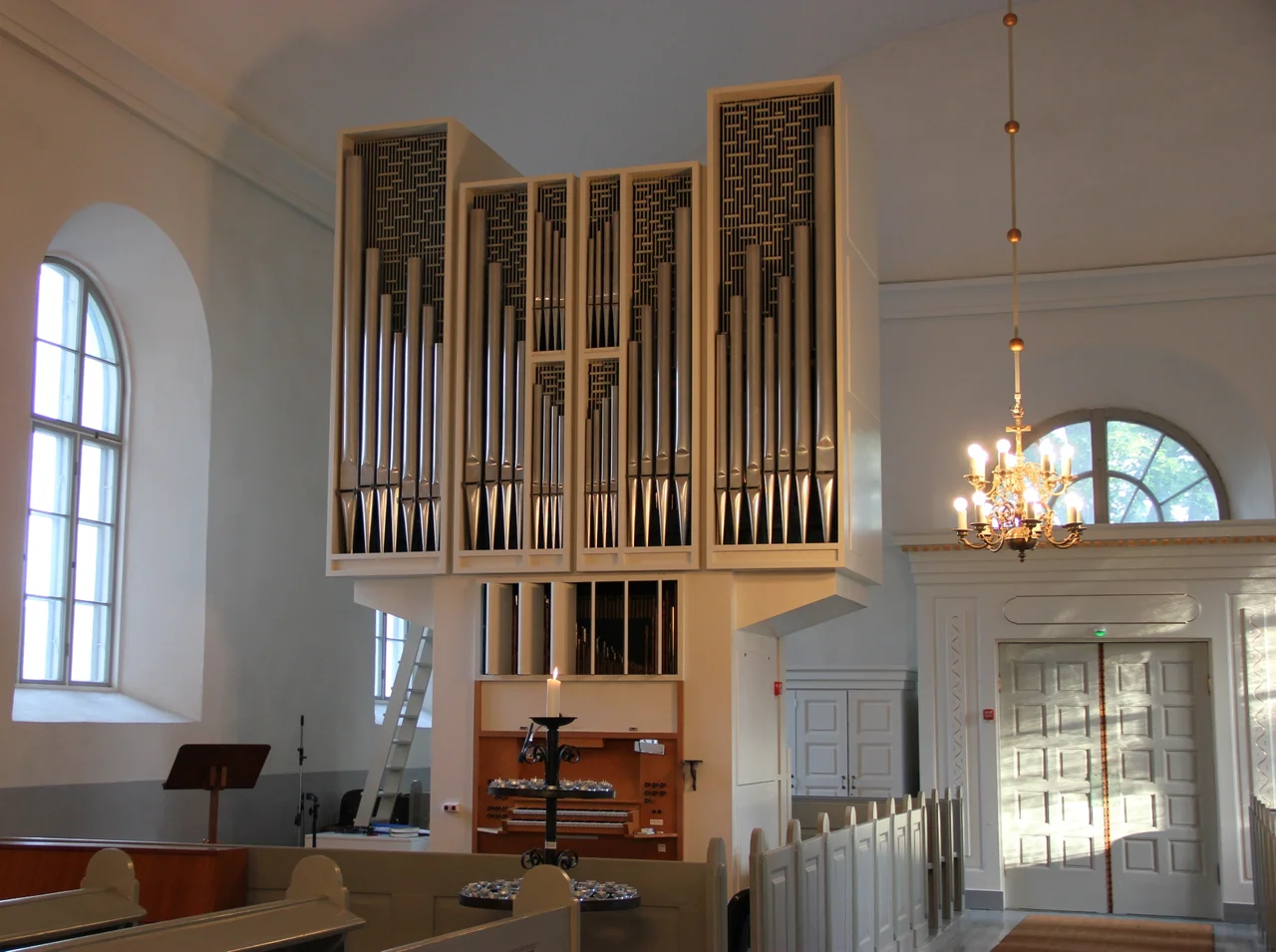

Nummi Church
In the summer of 2008 lightning found the bell tower of Nummi Church and set several small fires smouldering inside the woodwork. The grey stone underneath was a hundred and eighty-six years old and entirely unbothered; it was the tower's wooden cupola that suffered, and its outer shell had to be replaced. Stone has a way of outlasting whatever is fastened to it. This church has been outlasting things since 1822 — an earlier wooden building, one empire's rule and then another's, three separate cemeteries filled in succession — and the oldest object inside it was carved roughly four and a half centuries before the walls existed.
Designed Under One Empire, Finished Under Another
The drawings were made in Stockholm in 1807, at the Royal Intendent's Office, by Abraham Niclas Edelcrantz. Finland was Swedish territory when he drew them. By the time the grey stone church stood complete in 1822, Finland had spent thirteen years as a Grand Duchy of the Russian Empire under Alexander I, and the parish would soon be filing away the accession pledge of his successor, Nicholas I, which it still holds. Edelcrantz himself was born in Turku in 1754 under the name Clewberg and is better remembered for something entirely unrelated to architecture: he built Sweden's optical telegraph network, a system of shuttered iron signalling stations spaced about ten kilometres apart that ran nearly twice as fast as its French rival, and he published a treatise on telegraphy in 1796. He died in March 1821, a year short of seeing his church finished. Neoclassical, austere, seating eight hundred and fifty, it remains the largest church in the Lohja parish.
What Was Carried Over
Nummi already had a church — a wooden one from the seventeenth century, standing at what is now the old graveyard. Almost nothing of it survives; a sacristy of grey stone is the only piece left standing. But two things made the journey into the new building. The pulpit came from the wooden church raised in 1635 and was kept when that structure was dismantled, so preachers at Nummi still lean on woodwork that is nearly two centuries older than the room around it. Older still is a large crucifix made in the late 1300s, brought here from St Lawrence's Church in Lohja — a medieval parish church whose early sixteenth-century murals, painted to tell Bible stories to people who could not read them, make it one of the most valuable medieval buildings in Finland.
Paint, Pipes and Wool
The altarpiece was painted in Stockholm in 1825 by Axel Johan Jägerplan and comes in two panels: Jesus at the Last Supper in one, the Crucifixion in the other. The organ story is stranger. The facade built in 1864 by Gustaf Normann's organ factory in Tallinn still stands at the back of the church, handsome and completely mute — its pipes no longer work. The instrument that actually sounds was built by the Kangasala Organ Factory in 1973 and has twenty ranks of pipes. The textiles were woven by Impi Laaksonen in 1974, and in 1955 the Nummi branch of the Martha Association made the church its wedding ryijy, the knotted-pile Finnish textile traditionally laid down for a couple to kneel on and afterwards hung in their home. Outside, a weathervane of the sun and moon turns on the tower, and three crosses stand along the roof ridge.
Three Grounds for the Dead
Nummi buries in three places. The oldest cemetery dates from the 1600s and holds the footprint of the vanished wooden church. A second was laid out in the 1820s alongside the new building, and the newest was consecrated on 4 October 2009. Among the graves stands Emil Filén's memorial of 1951 to the parish's fallen soldiers, and it is worth looking at closely, because it does not do what war memorials usually do. There is no triumphant figure on a plinth. The sculpture shows a wounded man wading through snow — struggling, burdened, still moving. Finland lost an enormous number of men between 1939 and 1945, and a rural parish like this one lost sons it could name. Filén chose to commemorate them not at the moment of victory but in the middle of the worst of it.
Two Hundred Years In
The municipality of Nummi no longer exists as such; Nummi-Pusula was folded into the city of Lohja in 2013, and the church now belongs to the Lohja parish within the Diocese of Espoo. In August 2022 the parish marked the building's two hundredth anniversary with a festival mass. It is an unshowy survivor — grey stone in a landscape of forest and field, its tower repaired after a lightning strike, its pulpit inherited, its oldest crucifix borrowed from a bigger church down the road, its best organ silent and its second-best still playing.
From the Air
60.3953 N, 23.8794 E, in the former municipality of Nummi, now part of Lohja in Uusimaa, southern Finland. From 2,000-3,500 ft the church is easy to pick out: a pale grey stone block with a tower, standing clear of the surrounding forest amid open farmland, with the three cemeteries as distinct rectangles of cleared ground nearby. Nummela Airfield (EFNU) lies roughly 30 km southeast, Kiikala (EFIK) about 25 km west, Helsinki-Vantaa (EFHK) around 75 km east. This is lake-and-forest country north of Lohjanjärvi, prone to radiation fog on calm autumn mornings; the clearest air comes with the high sun of May and June.
Nearby Stories
- Salo 3.9 km away
- Liesjärvi National Park 8 km away
- Raseborg Castle 15 km away
- Sarka (museum) 24 km away
- Hakoinen Castle 32 km away
- Hanko Peninsula 32 km away
- National Museum of Finland 44 km away
- Peter the Great's Naval Fortress 74 km away